In summary:
- Toronto’s pilot program now allows alcohol in many designated parks, but rules on location, hours, and waste are strict.
- Success depends on logistical planning: choosing the right park, packing heat-resistant food, and knowing where facilities are.
- Navigating shared spaces with e-bikes and handling waste responsibly are key to a smooth, fine-free experience.
- During peak times like the High Park cherry blossom bloom, having a strategy for transit and park alternatives is essential.
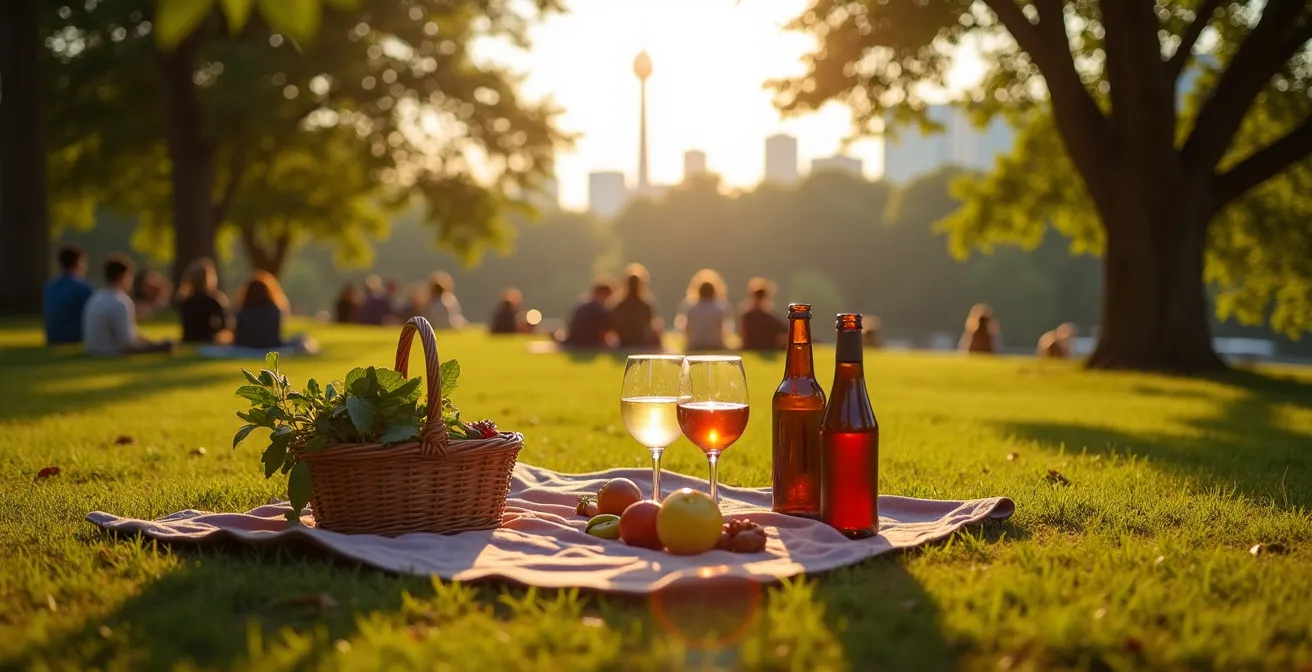
The hazy, golden hour of a Toronto summer evening seems practically designed for a checkered blanket, a curated charcuterie board, and a chilled drink. For years, however, that last element involved a degree of stealth and the risk of a hefty fine. Now, with the city’s alcohol in parks pilot program expanding, the dream of a legal, open-air happy hour is a reality. Yet, this newfound freedom has introduced a new layer of confusion. It’s no longer a simple question of “if,” but a complex puzzle of “where,” “when,” and “how.”
Simply knowing which parks are on the approved list isn’t enough. A successful and legal picnic in Toronto is a matter of picnic logistics. It requires a strategic approach that considers everything from city bylaws and public transit routes to food science and social etiquette. While many guides offer a basic list of dos and don’ts, they often overlook the practical challenges: overflowing bins, conflicts on multi-use trails, and the logistical nightmare of keeping your cheese from sweating before you’ve even found a spot. This guide moves beyond the headlines to provide a clear, actionable strategy for navigating the urban picnic ecosystem, ensuring your day in the park is memorable for the sunset, not for a bylaw infraction.
To navigate this new landscape effectively, it’s essential to understand the specific rules and master the practical skills for a seamless experience. This article breaks down the core components, from the legal framework to the on-the-ground logistics.
Summary: A Strategic Guide to Picnicking Legally in Toronto
- Why is Alcohol Allowed in Some Parks but Not Others?
- How to Pack a Charcuterie Board That Survives the Heat?
- Riverdale Park East vs. Christie Pits: Which Has the Best Sunset Vibe?
- The Picnic Mistake: Choosing a Spot Too Far from Public Washrooms
- How to Dispose of Your Waste When Park Bins are Overflowing?
- How to Route Your Shop to Keep Cheese and Fish Cold in Summer?
- Why are E-Bikes Causing Conflict on Multi-Use Trails?
- High Park Cherry Blossoms: How to Navigate the Parking Ban During Bloom Season?
Why is Alcohol Allowed in Some Parks but Not Others?
The decision to permit alcohol in certain Toronto parks is not arbitrary; it’s the result of a carefully managed pilot program based on specific criteria. Understanding this “bylaw navigation” is the first step to a compliant picnic. The program has been met with public approval, and as a result, the City has expanded it, with 55 parks now allowing alcohol consumption, a significant increase from the initial 27 in the 2023 pilot. This expansion reflects a data-driven approach, acknowledging the desire for more relaxed public spaces while managing potential risks.
However, not every green space is eligible. The City of Toronto, in consultation with local councillors, uses a strict set of criteria to determine a park’s suitability. These are not merely suggestions but firm requirements designed to ensure public safety and community comfort. The selection process considers factors like the park’s size, its proximity to schools, and, crucially, the availability of public washrooms. As Councillor Shelley Carroll, Chair of the Economic and Community Development Committee, noted, the goal is a “sensible pilot” that balances freedom with responsibility. Only parks where the local councillor has opted in are included, ensuring community representation in the decision.
This systematic selection process explains why you might be able to enjoy a beer in one park but not in the one a block away. It’s a logistical framework designed to maximize enjoyment while minimizing public nuisance. Before heading out, always verify that your chosen park is on the current year’s official list, as the roster can change.
The table below, based on information from the City’s program details, outlines the core requirements for a park to be included in the alcohol pilot.
| Selection Criteria | Requirement | Rationale |
|---|---|---|
| Washroom facilities | Must have accessible public washrooms | Essential for public health and safety |
| Distance from schools | Cannot be immediately adjacent to schools | Protecting youth from alcohol exposure |
| Park size | Minimum size requirements | Adequate space for responsible consumption |
| Councillor support | Local ward councillor must opt-in | Community representation |
How to Pack a Charcuterie Board That Survives the Heat?
A sophisticated charcuterie board is the centerpiece of a modern picnic, but it presents a significant logistical challenge in the summer heat. Soft cheeses melt, cured meats can become greasy, and delicate crackers lose their snap. The key is not just choosing the right ingredients, but selecting those specifically for their durability in an outdoor setting. This means prioritizing hard, aged cheeses, robust cured meats, and sturdy accompaniments that can withstand a few hours in a cooler without losing their integrity.
Think like a professional caterer: focus on items with lower moisture content and higher stability. Hard cheeses like aged cheddar or firm pecorino hold their texture far better than a soft brie or chèvre. For meats, look for dry-cured options like Genoa salami or prosciutto, which are less susceptible to heat than their cooked counterparts. Accompaniments should be equally robust; choose crunchy cornichons and firm olives over delicate fresh berries that can bruise and spoil easily. The goal is to curate a selection that tastes just as good at the park as it does when you first pack it.
Case Study: Trinity Market’s Heat-Resistant Picnic Strategy
Local businesses near popular parks have mastered this challenge. Trinity Market, located next to Trinity Bellwoods Park, has become a go-to for durable picnic provisions. They offer pre-assembled plates that showcase heat-resilient ingredients, such as a 10-year-aged cheddar from Cheese Boutique that maintains its firm texture. Their popular $13 charcuterie plate is a masterclass in outdoor dining, featuring house prosciutto and Genoa salami alongside robust Kozlik’s triple-crunch mustard and cornichons—all components specifically chosen for their ability to hold up without refrigeration for a short period.
This approach transforms your picnic from a race against time into a relaxed affair. By selecting ingredients with high heat tolerance, you can focus on enjoying the company and the scenery, rather than worrying about a melted, unappetizing spread.
Riverdale Park East vs. Christie Pits: Which Has the Best Sunset Vibe?
Choosing a park is about more than just its legal status for alcohol consumption; it’s about curating an experience. The “sunset vibe” of a park can make or break an evening, and two of Toronto’s most popular choices, Riverdale Park East and Christie Pits, offer distinctly different atmospheres. Your decision should be guided by the kind of evening you’re looking for: a serene, cinematic view or a lively, communal gathering. Each park caters to a different social energy, and matching the park to your mood is a key piece of picnic logistics.
Riverdale Park East is synonymous with one of the city’s most iconic views. The steep hill on the park’s west side acts as a natural amphitheater facing the downtown skyline. The vibe here is often more contemplative and relaxed. It attracts couples and small groups who come to watch the sky change colours behind the CN Tower. The experience is cinematic and often quiet, with people spread out on blankets, soaking in the panoramic vista. It’s the ideal choice for a romantic date or a peaceful end to a long week, where the city itself is the main event.
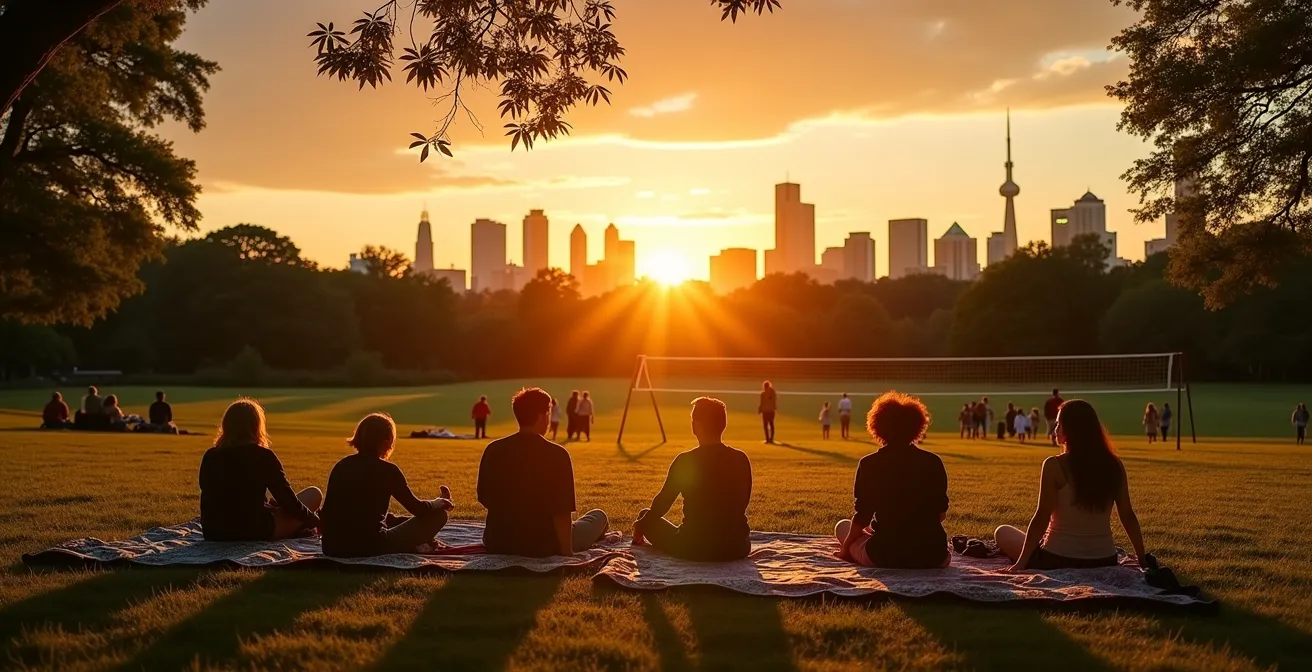
In contrast, Christie Pits Park offers a more dynamic and social atmosphere. Situated in a large, bowl-like depression, the park feels more contained and communal. Sunsets here are less about the skyline and more about the people. The open fields are often filled with larger groups, the sounds of conversation, and the thwack of a volleyball or frisbee. It’s a hub of activity, with a palpable, energetic buzz. If your ideal picnic involves socialising, people-watching, and being part of a lively neighbourhood scene, Christie Pits is the superior choice. The focus is inward, on the community within the park, rather than the city beyond it.
The Picnic Mistake: Choosing a Spot Too Far from Public Washrooms
Among the many logistical details of planning a park picnic, one is consistently underestimated: proximity to a public washroom. It seems like a minor point until it becomes an urgent one. The addition of alcohol, a diuretic, to the equation elevates this from a convenience to a critical planning factor. Choosing a picnic spot that is a 10-minute walk from the nearest facility is a rookie mistake that can quickly derail an otherwise perfect evening. A core principle of successful picnic logistics is to position your group within a 2-to-3-minute walk of the designated washroom building.
This requires pre-planning. Before you even lay down your blanket, consult a park map or use an app to identify the washroom locations. In large parks like Trinity Bellwoods, facilities can be surprisingly far apart. The washrooms near the community centre, for example, often have shorter lines than those in more central, high-traffic areas. At Christie Pits, the most reliable facilities are located near the pool building. It’s also crucial to check the hours of operation; while the program permits drinking from 5:30 a.m. to midnight, many park washrooms close earlier, typically between 9 p.m. and 11 p.m. Having a backup plan, like knowing the location of a nearby 24-hour coffee shop, is a savvy move.
Failing to plan for this basic need is one of the most common friction points of urban picnicking. A well-chosen spot offers a balance of scenic views, comfortable seating, and strategic access to essential amenities. Don’t let a long trek to a distant washroom interrupt your enjoyment.
Your Pre-Picnic Logistics Checklist: Ensuring a Smooth Outing
- Points of Contact: List all required stops in order of your route, such as the LCBO, deli, bakery, and the specific park entrance you will use.
- Inventory Check: Before leaving, review your existing supplies. Do you have a functional cooler, sufficient ice packs, a bottle opener, and designated waste bags?
- Coherence & Compliance: Cross-reference your chosen park with the city’s official list of designated alcohol zones. Check the park’s specific public washroom hours online.
- Emotional Resonance: Assess the park’s typical vibe. Is a quiet, scenic spot like Riverdale Park East or a social hub like Christie Pits better suited for your occasion?
- Integration Plan: Finalize your shopping and travel route, establish a timeline, and assign roles to your group (e.g., who brings the cooler, who is in charge of waste).
How to Dispose of Your Waste When Park Bins are Overflowing?
The success of Toronto’s alcohol in parks program, which enjoys an 87% overall satisfaction rate according to a City report, hinges on responsible public behaviour. The most visible aspect of this is waste management. On a warm summer evening, park bins in popular spots like Trinity Bellwoods can overflow quickly, creating a significant friction point for park-goers and maintenance staff alike. Simply leaving your trash beside a full bin is not a solution and can result in fines. The golden rule is: if you pack it in, you must be prepared to pack it out.
A strategic approach to waste is a non-negotiable part of modern picnic logistics. This begins with minimizing the waste you bring in the first place—remove excess packaging at home and use reusable containers. The next step is to bring your own designated bags for sorting. Toronto’s waste system is specific, and park bins align with it. Your waste should be sorted as follows:
- Green Bin: All food scraps (including meat and bones), soiled napkins, and wooden or compostable utensils. Packing a separate, sealable “wet bag” for these items is a pro move.
- Blue Bin: Empty wine bottles, beer cans, and rinsed plastic cups. Remember that pizza boxes are only recyclable if they are clean and free of grease; the greasy bottom part goes in the garbage.
- Garbage: The most common picnic offenders fall into this category: chip bags, plastic wrap, greasy pizza box liners, and disposable plates or cutlery that are not certified compostable.
By pre-sorting your waste into your own heavy-duty bags, you are prepared for the likely scenario of finding a full public bin. Taking your neatly sorted bags home for disposal in your own bins is the hallmark of a responsible urban picnicker and ensures the continued success and expansion of these valued programs.
How to Route Your Shop to Keep Cheese and Fish Cold in Summer?
Maintaining the “cold chain”—the unbroken refrigerated journey from store to stomach—is the most critical logistical task for any picnic involving perishable items like cheese, cured fish, or deli meats. The challenge is magnified in a Toronto summer, where a short walk from the store to the park can expose your food to damaging heat. The solution lies in strategic route planning. Your shopping trip should be organized in reverse order of perishability: non-refrigerated items first, and the most sensitive cold items last.
Your final stop before heading to the park should always be where you purchase your coldest items. This minimizes their time out of refrigeration. For example, you should pick up your bread, crackers, and drinks first. Your second-to-last stop could be the deli for cured meats and cheeses. Your absolute final stop should be the LCBO or beer store for chilled wine, beer, or ciders, which can act as additional cooling agents inside your cooler bag.

This principle is well-demonstrated by seasoned picnickers heading to popular spots. For a Trinity Bellwoods outing, an optimal shopping route is a masterclass in efficiency and food safety.
Case Study: The Optimal Cold-Chain Route for Trinity Bellwoods
As detailed in guides like TasteToronto’s deli recommendations, a smart route for a Trinity Bellwoods picnic involves a multi-stop strategy. One could start further away at a specialty shop like Scheffler’s Delicatessen in St. Lawrence Market for high-end cheeses, packing them immediately into an insulated bag with an ice pack. The route would then proceed closer to the park, with a final, last-minute stop at a place like Lambo’s Deli on Bellwoods Ave, just steps from the park, for a fresh Italian sandwich that requires minimal time in the heat. This “just-in-time” approach to purchasing ensures everything is as fresh and cool as possible when you finally lay out your spread.
Why are E-Bikes Causing Conflict on Multi-Use Trails?
E-bikes have become a popular and efficient way to transport picnic supplies to Toronto’s parks, but their integration into the park ecosystem has not been without friction. The primary source of conflict on multi-use trails, such as the Martin Goodman Trail along the waterfront, stems from the significant speed differential between fast-moving e-bikes and pedestrians, traditional cyclists, or families with small children. A cargo e-bike loaded with a cooler and picnic basket can be heavy and difficult to stop quickly, creating potentially hazardous situations in crowded areas.
The issue is compounded by varying user expectations. Pedestrians expect a leisurely and safe environment, while some e-bike riders may be focused on reaching their destination quickly. This mismatch can lead to near-misses and general tension. Furthermore, the quiet nature of electric motors means pedestrians may not hear an e-bike approaching from behind until it is very close. Toronto bylaws mandate speeds be kept under 20 km/h on these trails, but enforcement can be challenging, and awareness is often low. This creates a clear need for a shared code of conduct to ensure the trails remain safe and enjoyable for everyone.
Responsible e-bike use is therefore a crucial part of modern picnic etiquette. It’s not about avoiding e-bikes, but about using them with heightened awareness and consideration for other park users. Following a clear set of guidelines can help mitigate these friction points and promote a more harmonious park experience.
- Keep your e-bike speed well below the 20 km/h limit on all park trails, adjusting for pedestrian density.
- Use your bell well in advance when preparing to pass pedestrians, giving them ample time to react.
- Be prepared to dismount and walk your loaded cargo e-bike through particularly crowded areas, such as near park entrances or concession stands.
- Use designated bike parking areas near alcohol-permitted zones and always lock your e-bike to a rack, never to a tree or park bench.
- Choose less-crowded park entrances that are accessible by e-bike to make unloading your supplies easier and less disruptive to others.
Key Takeaways
- Legality is Logistical: Compliance with Toronto’s program requires more than knowing the park list; it demands planning for hours, washrooms, and waste.
- Pack for the Heat: The success of your picnic spread depends on choosing heat-stable foods like hard cheeses and planning a “cold chain” shopping route.
- Etiquette is Essential: Sharing parks means being a good neighbour, whether it’s managing your waste properly or riding your e-bike considerately on shared trails.
High Park Cherry Blossoms: How to Navigate the Parking Ban During Bloom Season?
The annual cherry blossom bloom transforms High Park into one of Toronto’s most magical—and congested—destinations. To manage the massive crowds, the City of Toronto implements a complete vehicle and parking ban within the park during the peak bloom period. This presents a major logistical challenge for anyone planning a picnic, especially since the alcohol pilot program remains active in High Park’s designated zones. Navigating this period successfully requires abandoning the idea of driving and embracing a transit-first strategy.
The most effective approach is to use the TTC. The best route involves taking the subway to High Park Station on Line 2. From the station, it’s a pleasant, albeit potentially crowded, 10-to-15-minute walk south through the park to reach the main blossom areas and the designated alcohol consumption zones. Given the crowds, packing light is essential. A backpack cooler is far more practical than a rolling one. The key is to treat the journey through the park as part of the experience itself.
However, the most strategic move of all may be to avoid High Park entirely during peak bloom. The congestion can be overwhelming and detract from a relaxing picnic experience. Fortunately, the pilot program includes many other excellent parks that offer beautiful spring scenery without the crowds. This is a perfect opportunity to explore another part of the city. Earlscourt Park, for example, was one of the original launch sites for the pilot and offers wide-open spaces and easy transit access. This is where a prepared picnicker has an advantage: having a list of appealing, transit-accessible alternatives.
The following table provides a few excellent, alcohol-permitted park alternatives to consider during the High Park bloom, helping you enjoy a peaceful spring picnic away from the main crowds.
| Park Alternative | Spring Features | TTC Access | Alcohol Permitted |
|---|---|---|---|
| Cedarvale Park | Ravine setting, spring flowers | Eglinton West Station | Yes |
| Earlscourt Park | Open fields, less crowded | Dufferin bus from station | Yes |
| Monarch Park | Large green space | Streetcar accessible | Yes |
By adopting a strategic mindset—treating your outing not as a spontaneous event but as a planned operation—you can fully embrace the new freedoms of Toronto’s parks. This logistical approach transforms potential frustrations into a smooth, enjoyable, and perfectly legal picnic experience.