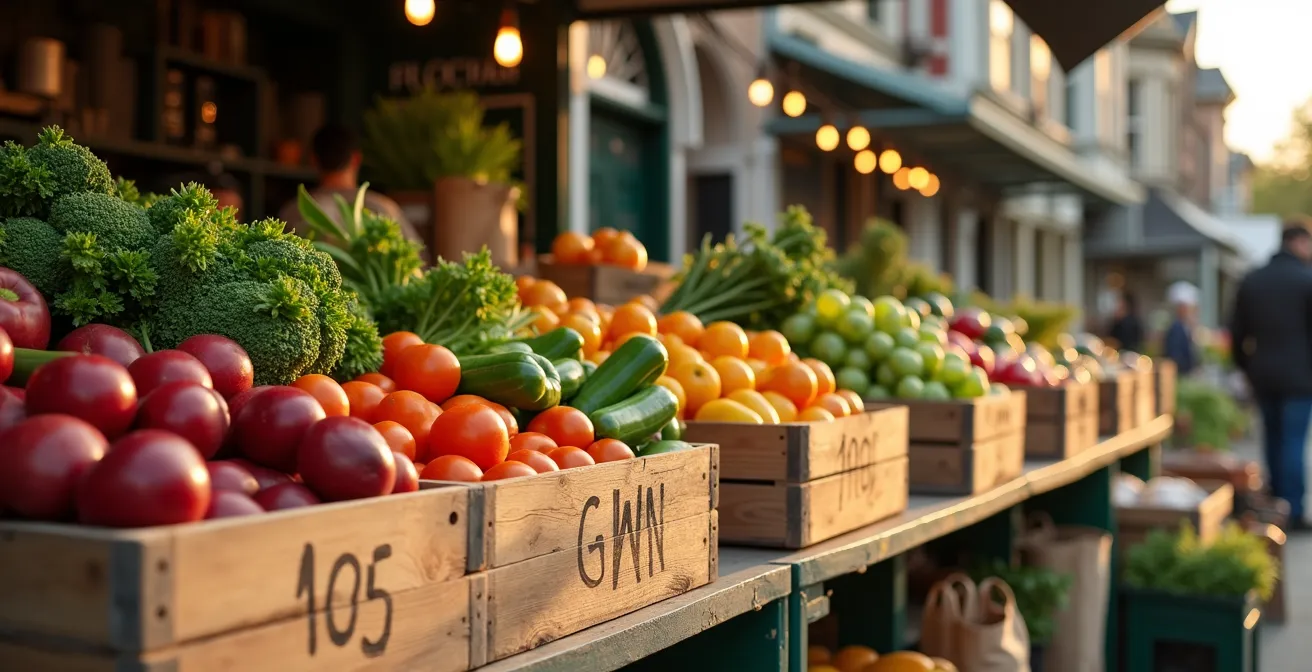
The key to affordable organic groceries in Toronto isn’t just knowing where to shop, but *how* to shop within Kensington Market’s unique economic ecosystem.
- Kensington’s independent vendors operate outside the big-chain model, offering significant savings on produce, bulk goods, and specialty items.
- A strategic shopping route is essential for efficiency and food safety, especially for perishable items like cheese and fish during summer.
Recommendation: Plan your trip by mapping vendors for dry goods first and refrigerated items last, and always bring cash as a backup to unlock potential discounts.
For any health-conscious Torontonian on a budget, the feeling is all too familiar: you walk into a major grocery chain for a few organic items and walk out with a receipt that feels more like a car payment. The desire to eat well often clashes with the reality of high food prices, a situation made more acute when you realize that 80% of the grocery market is controlled by 5 companies, limiting true price competition. This leaves many feeling stuck between expensive health food stores and conventional, less-than-ideal options.
The common advice for budget shopping often includes vague tips like “buy in season” or “look for sales.” While helpful, these platitudes don’t address the core issue of systemic food costs. This is where Kensington Market enters the picture, not just as a tourist destination, but as a practical solution. However, simply showing up isn’t a strategy. The market’s chaotic charm can be overwhelming, and a casual wander often leads to missed opportunities and impulse buys.
What if the secret to unlocking Kensington’s value wasn’t just about finding the cheapest stall, but about understanding its internal logic? The real strategy lies in seeing the market as a unique ecosystem with its own rules of pricing, logistics, and vendor specialization. It’s about shifting from a passive shopper to a strategic navigator who knows why things are cheaper, when to go, how to pay, and the optimal path to take.
This guide will deconstruct that ecosystem. We will explore the economic reasons for the market’s affordability, provide tactical advice for navigating its busiest days, and map out a logistical plan for a successful grocery haul. By the end, you’ll have a complete blueprint for filling your basket with healthy, organic food for under $60, transforming a trip to the market into a systematic and rewarding experience.
To help you master this unique Toronto neighbourhood, this article breaks down the essential strategies for shopping smart. The following sections provide a clear roadmap, from understanding pricing to planning your route for maximum efficiency and savings.
Summary: Eating Organic in Kensington Market: How to Fill Your Basket for Under $60?
- Why is Kensington Produce Often Cheaper Than Metro?
- How to Shop on Pedestrian Sundays Without Getting Stuck in Crowds?
- House of Spice vs. Carlos’ House of Spice: Which Has Better Variety?
- The ATM Mistake That Costs You Fees in Kensington Market
- How to Route Your Shop to Keep Cheese and Fish Cold in Summer?
- Why is Carousel Bakery’s Peameal Sandwich World-Famous?
- Markham vs. Spadina: Where is the Better Asian Grocery Experience?
- Hosting a Dinner Party: How to Build a Charcuterie Board Using Only St. Lawrence Market Finds?
Why is Kensington Produce Often Cheaper Than Metro?
The price difference between Kensington Market and a chain like Metro isn’t magic; it’s a direct result of two different economic models. Major grocery chains have immense overhead: massive real estate costs, complex supply chains, corporate administration, and marketing budgets. These costs are inevitably passed on to you, the consumer. Kensington Market, on the other hand, operates as a collection of independent micro-businesses. Most vendors own or rent small-footprint stalls, buy produce more directly, and have minimal corporate overhead. This lean structure is the primary reason for the lower prices.
Furthermore, the market thrives on a principle major chains abhor: imperfection. A slightly misshapen (but perfectly edible) bell pepper or a cosmetically bruised apple that would be rejected by a large grocer’s strict cosmetic standards is sold without issue at a Kensington stall. This significantly reduces food waste and allows vendors to offer produce at a lower cost. This creates a powerful opportunity for value arbitrage, where you can access high-quality food that is simply filtered out of the mainstream commercial system.
The proof is in the pricing. A walk through the market reveals tangible savings that add up quickly. For instance, a specialty shop like Essence of Life Organics often features deals like cases of coconut water or multi-buys on almond milk that are significantly cheaper than their big-box counterparts. When you multiply these savings across produce, bulk goods, and pantry staples, a $60 budget suddenly goes much further than you might expect.
How to Shop on Pedestrian Sundays Without Getting Stuck in Crowds?
Pedestrian Sundays are a beloved Toronto institution, transforming Kensington Market into a vibrant street festival. However, for a focused grocery run, the swelling crowds can turn a simple task into a frustrating ordeal. The key to successfully navigating these days is a simple timing strategy: think of your trip in two phases—the “shop” and the “stroll.” The crucial piece of information is that, according to the Hilton Travel Guide, streets are closed to cars from 1 p.m. onward during the summer.
This gives you a clear window of opportunity. The optimal strategy is to arrive between 11 a.m. and 12 p.m. During this pre-closure window, the market is fully operational, but the festival-level crowds have not yet peaked. You can move freely between produce stands, butchers, and bakeries, completing the bulk of your grocery shopping with relative ease. You get the benefit of the weekend’s full selection without the logistical nightmare of navigating a shoulder-to-shoulder crowd with heavy bags.
Once your shopping is done, you can either head home or transition into the “stroll” phase. After 1 p.m., the atmosphere shifts. With your groceries safely stored or ready to be taken home, you are free to enjoy the live music, street performers, and community vibe without the stress of a mission-critical shop. This approach allows you to enjoy the best of both worlds: an efficient, productive grocery haul followed by a leisurely experience of one of Toronto’s best summer events.

As seen from above, the flow of people post-1 p.m. fills the streets, making a targeted shopping trip challenging. By finishing your purchasing beforehand, you can join the celebration without the burden of a shopping list.
House of Spice vs. Carlos’ House of Spice: Which Has Better Variety?
For a newcomer, the existence of two “House of Spice” shops on the same street can be confusing. The question isn’t which one is better, but which one is right for your specific culinary needs. These two family-run institutions represent the principle of vendor specialization that makes Kensington so unique. They are not direct competitors so much as complementary resources. One focuses on South Asian and Caribbean flavours, while the other is a haven for Latin American ingredients.
A detailed comparison, as outlined in a Hilton Travel Guide to the market, clarifies their distinct offerings. Your choice depends entirely on the recipe you have in mind.
| Aspect | House of Spice | Carlos’ House of Spice |
|---|---|---|
| Specialty | South Asian & Caribbean bulk spices | Mexican dried chilies & Latin American herbs |
| Unique Items | Black Persian lime powder, Bengali spices, Israeli couscous | Ancho, Guajillo, Pasilla chilies, Goya products |
| Organic Options | Wide selection of organic bulk items | Focus on traditional non-organic Latin products |
| Secondary Offerings | Specialty flours, teas, salted lemon pistachios | Hot sauces, Latin American pantry staples |
| Price Range | Competitive bulk pricing | Slightly higher for specialty imports |
As culinary expert Jim Byers notes for Hilton’s guide, the original House of Spice is a treasure trove of global ingredients: “The family-owned store is crammed with everything from black Persian lime powder to salted lemon pistachios, pineapple habanero hot sauce, Bengali spices and Israeli couscous.” Meanwhile, Carlos’ is your go-to for building the foundation of a perfect mole or salsa verde. Understanding this distinction saves you time and ensures you find exactly what you’re looking for without guesswork.
The ATM Mistake That Costs You Fees in Kensington Market
In a city where food costs are a significant concern, every dollar counts. With food prices rising, a report from Statistics Canada notes that 25.5% of Canadians in the provinces faced food insecurity in 2023, making savvy financial habits more important than ever. One of the easiest ways to lose money in Kensington Market is by falling into the convenience trap of private-label ATMs. While many vendors now accept cards via systems like Square, the “cash is king” ethos still lingers, and some smaller stalls may offer a slight discount for cash payments. This can tempt shoppers to use the nearest ATM.
However, the independent, no-name ATMs located inside the market’s small shops and corners often charge transaction fees ranging from $3 to $5. Using one is like paying a voluntary tax on your own money. This is an easily avoidable mistake with a little bit of planning. The solution is to treat your cash withdrawal as the first step of your shopping trip, before you even enter the market’s core.
The periphery of the market is well-served by major Canadian banks. There are TD, RBC, and CIBC branches and ATMs located along the main arteries of Spadina Avenue, Dundas Street, and College Street. By using your own bank’s ATM or one within its network, you can withdraw the cash you need without incurring any extra fees. Planning to withdraw a bit more than you think you’ll need is also a wise move, giving you the flexibility to take advantage of any cash-only deals you might find without having to make a second costly withdrawal.
How to Route Your Shop to Keep Cheese and Fish Cold in Summer?
Shopping in Kensington Market during a hot Toronto summer requires more than a shopping list; it requires a logistical plan. The biggest challenge is preserving the quality and safety of perishable items like artisanal cheese from Global Cheese or fresh cuts from Sanagan’s Meat Locker. The key is a strategic shopping route—a concept of logistical flow that prioritizes temperature-sensitive items last. A haphazard route where you buy cheese first and then spend another hour browsing in the sun is a recipe for spoiled food and wasted money.
Your route should be a deliberate path from non-perishable to highly perishable. The “Beyond Kensington Market Toronto Food Tour” offers a great model for this: start with dry goods and end with refrigerated items. Begin your journey at a place like Essence of Life Organics for bulk bins, spices, and pantry staples. Next, move on to the open-air fruit and vegetable stands along Augusta Avenue and Baldwin Street. With all your shelf-stable items collected, you are now ready for the final, temperature-sensitive leg of your trip.

Make your last stops at the specialty shops like Global Cheese, Sanagan’s Meat Locker, or one of the fishmongers. Once these items are in your bag—ideally an insulated one—your shopping is complete. It’s time to head directly home. This systematic approach ensures everything from your leafy greens to your delicate brie arrives in your kitchen in perfect condition.
Your Summer Shopping Route Checklist
- Start at Essence of Life Organics for all dry bulk goods, canned items, and pantry staples.
- Proceed to the fruit and vegetable stands along Baldwin Street and Augusta Avenue for your produce.
- Consider a mid-shop break at a cafe like Moonbean Coffee *before* purchasing any perishables.
- Make your final stops at Global Cheese, Sanagan’s Meat Locker, or fish markets for all refrigerated items.
- Once perishables are purchased, head directly home or ensure they are in well-insulated bags.
Why is Carousel Bakery’s Peameal Sandwich World-Famous?
While Carousel Bakery’s peameal bacon sandwich is undeniably a world-famous Toronto icon, a seasoned local knows a crucial fact: it’s located in St. Lawrence Market, not Kensington. Asking for it in Kensington is a classic tourist tell. However, this doesn’t mean the neighbourhood lacks its own legendary handheld meals. In fact, Kensington Market offers a pantheon of iconic sandwiches and tacos that truly represent its diverse, multicultural spirit.
Instead of peameal bacon, Kensington’s signature flavour is global. You can find incredible Mexican tortas, hefty sandwiches piled high with fillings like carnitas or milanesa, served on crusty bread from various Latin American grocers and eateries. These offer a completely different but equally satisfying experience. This is where Kensington’s strength lies—not in replicating other markets, but in celebrating its own unique culinary landscape.
Perhaps the most quintessential Kensington “sandwich” experience can be found at PowWow Cafe, which specializes in Indigenous fusion cuisine. As noted by the There She Goes Again travel blog, chef Shawn Adler of the Ojibway tribe has made the cafe famous for its “Indian tacos.” These are built on a base of traditional, house-made Ojibwa-style fry bread—fluffy, slightly chewy, and utterly delicious. Piled with toppings like jerk chicken, beef chili, or vegan options, they are a handheld meal that tells a story of heritage and modern creativity, embodying the true soul of the market.
Markham vs. Spadina: Where is the Better Asian Grocery Experience?
The debate over the best Asian grocery experience in the GTA often centres on the suburban plazas of Markham versus the bustling density of Toronto’s downtown Chinatown on Spadina. However, framing it as an “either/or” choice misses a crucial third player in a savvy shopper’s strategy: Kensington Market. Located just west of Spadina, Kensington doesn’t seek to replace the comprehensive experience of a massive Asian supermarket but instead offers a complementary one focused on freshness, specialty items, and organic options.
Spadina is unparalleled for bulk staples. If you need a 50lb bag of rice or a specific brand of soy sauce, it’s the place to go. But for fresh Asian produce like gai lan, bok choy, or fresh herbs, Kensington’s open-air stalls often provide better quality at more competitive prices. The market’s compact nature means you can find a surprising variety of pan-Asian ingredients within a two-minute walk, from Filipino condiments to Vietnamese herbs and Japanese produce. This convenience is a significant advantage over driving to a suburban superstore.
Kensington Market shows Toronto’s true multicultural spirit better than any other place in the city. It’s gritty and polished, old and new, global and local all at once.
– Adventure Explore Discover, Kensington Market Toronto: Complete Neighbourhood Guide
Furthermore, Kensington allows you to seamlessly blend your Asian grocery shopping with a hunt for organic products, a market segment that continues to grow. Data from the Canadian Organic Trade Association shows the organic food and beverage market in Canada reached $8.4 billion in 2022. You can buy specialty sauces on Baldwin Street and then walk 30 seconds to Essence of Life for organic tofu and kale. The best strategy, therefore, isn’t Markham vs. Spadina, but Spadina and Kensington, using each for its unique strengths.
Key takeaways
- Understand that Kensington’s lower prices stem from its ecosystem of independent vendors with low overhead, not random chance.
- Strategize your visit by time (shop before 1 p.m. on Pedestrian Sundays) and by route (dry goods first, cold items last).
- Embrace vendor specialization; know which shop to visit for specific needs, from South Asian spices to Mexican chilies.
Hosting a Dinner Party: How to Build a Charcuterie Board Using Only St. Lawrence Market Finds?
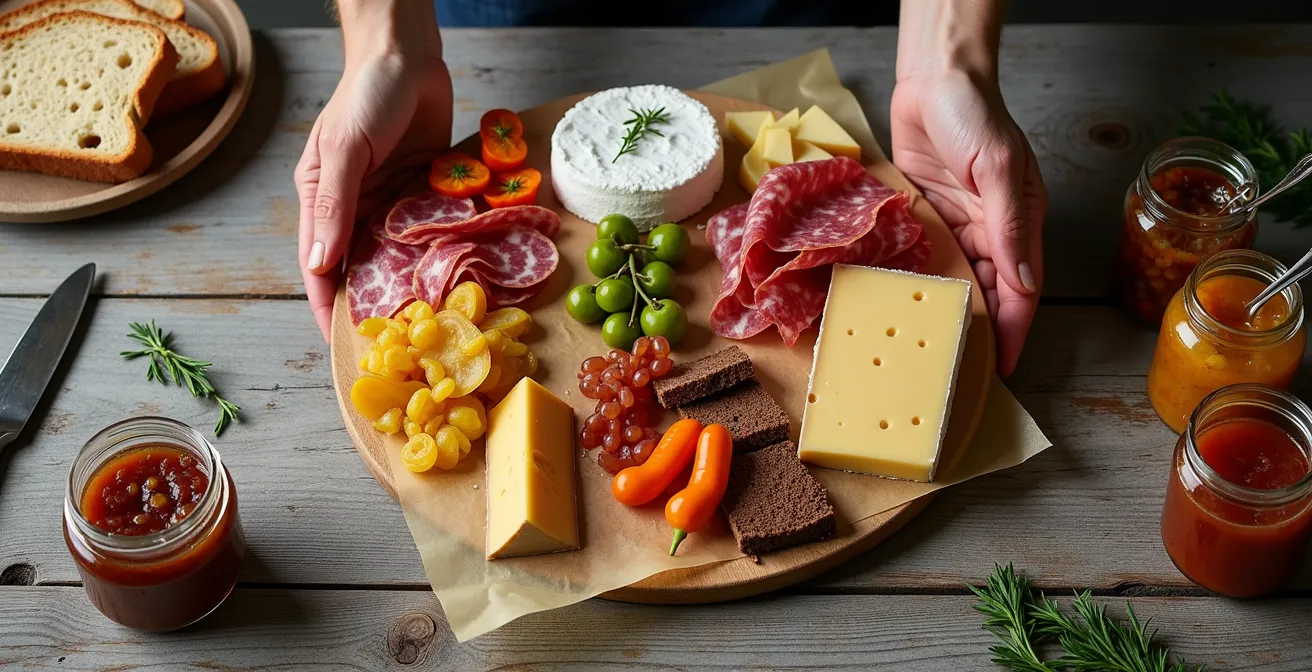
While the prompt suggests a trip to St. Lawrence Market, a true Kensington connoisseur knows that an exceptional—and arguably more affordable—charcuterie board can be assembled without ever leaving the neighbourhood. Building a board using only Kensington finds is not only possible but is a perfect way to celebrate local artisans and vendors. The goal is a board that is impressive, delicious, and stays within our $60 budget, a welcome challenge when the average family of four is expected to spend $16,297.20 on food in 2024.
A successful board is a study in balance: salty, sweet, tangy, and savoury. Here’s a shopping list that hits all those notes, sourced entirely from Kensington’s specialty shops:
- Ontario Cheeses from Global Cheese ($20): Ask for a variety, such as a firm, aged cheddar (like Applewood smoked), a creamy goat cheese, and perhaps a mild blue cheese.
- Cured Meats from Sanagan’s Meat Locker ($15): Select a few locally made options like prosciutto-style ham, spicy salami, or a rich pâté.
- Olives and Pickled Vegetables from Essence of Life ($8): The bulk bar is your best friend here. Get a mix of olives, gherkins, and tangy pickled peppers.
- Fresh Baguette from Blackbird Baking Co. or other local bakeries ($5): A crusty baguette is non-negotiable. Many of the smaller bakeries in the market offer fantastic, fresh options.
- Local Preserves or Jelly from a specialty grocer ($10-12): A sweet fruit preserve or a spicy pepper jelly provides the perfect counterpoint to the rich meats and cheeses.
This shopping list brings your total to approximately $58-$60 and results in a generous, diverse board that tells a story of its local origins. It’s a testament to the market’s ability to provide everything you need for an elegant gathering, all within a few vibrant, walkable blocks.
Now that you’re armed with these strategies, the next step is to put them into practice. Your next trip to Kensington Market can be more than just a shopping run; it can be a deliberate, enjoyable, and highly effective way to nourish yourself and your family with high-quality, affordable food. Start by planning your next visit with these principles in mind.