
In summary:
- Treat your shopping trip as a tactical mission, not a casual outing.
- Utilize underground PATH connections and alternative parking (Green P) to bypass surface-level congestion.
- Divide the mall into operational zones (North vs. South) to execute targeted purchases efficiently.
- Maintain situational awareness in high-density areas like food courts to prevent theft.
- Plan your exfiltration routes using secondary exits and store shortcuts to avoid the main Yonge Street crowds.
The annual holiday rush transforms the CF Toronto Eaton Centre from a shopping destination into a high-stress combat zone. The sheer volume of foot traffic, which can feel overwhelming, is part of a massive ecosystem; according to Destination Toronto, the Eaton Centre welcomes 48 million visitors annually, with numbers surging during the festive season. Conventional advice—”make a list,” “go on a weekday”—is insufficient for navigating this level of human density. These are platitudes for amateurs, not strategies for operatives.
Success requires a paradigm shift. You are not merely a shopper; you are an operative on a time-sensitive mission. Your objective is to acquire specific assets (gifts) and exfiltrate with minimal friction and zero stress. This approach demands intelligence, reconnaissance, and a precise operational plan that leverages the mall’s architecture and the city’s infrastructure to your advantage. Forget wandering aimlessly. It’s time to think like a strategist.
This briefing will provide the tactical intelligence necessary to conquer the Eaton Centre. We will cover infiltration points, operational zones, threat assessment in high-density areas, and multiple exfiltration strategies. By understanding the terrain and crowd dynamics, you can turn a chaotic experience into a flawlessly executed mission.
Summary: Your Eaton Centre Tactical Briefing
- Why is the “Urban Eatery” Located at the Bottom Level?
- How to Park at the Eaton Centre Without Paying Premium Rates?
- Queen Street vs. Dundas Street Side: Which End Has Better High-End Brands?
- The Distraction Mistake That Leads to Pickpocketing in Food Courts
- How to Exit the Mall onto Yonge Street Without Getting Stuck in a Crowd?
- Where to Host a Power Breakfast at 7 AM in the Financial Core?
- The Behavior That Gets You Kicked Out of Office Lobbies Instantly
- Shopping on the Mink Mile: How to Get VIP Service Without Spending Millions?
Why is the “Urban Eatery” Located at the Bottom Level?
The placement of the main food court, the Urban Eatery, on the concourse level is a deliberate act of architectural crowd control. By positioning this high-traffic magnet at the lowest public level, the design encourages a vertical distribution of visitors. This pulls a significant portion of the crowd downwards, alleviating pressure on the primary retail floors (Levels 1 and 2). For the strategic shopper, this is critical intelligence: the main food court is a designated congestion zone, especially between 12:00 PM and 1:00 PM. Engaging with it during peak hours is a tactical error.
A superior strategy involves utilizing alternative sustenance points. Your primary alternative is the Queen’s Cross Food Hall on Level 1, near the Queen Street entrance. This smaller, more curated space by Oliver & Bonacini offers unique options with typically shorter lines. For a rapid resupply, the Shoppers Drug Mart on Level 1 provides grab-and-go options via its own dedicated entrance. For operatives needing to remain mobile, the best tactic is to use the PATH system to access the food courts in adjacent complexes like First Canadian Place, which are geared towards a corporate lunch rush that may not align with retail peak times. The mission imperative is to refuel efficiently without getting bogged down in the primary feeding zone.
Ultimately, avoiding the Urban Eatery during the holiday blitz is not about finding better food; it’s about preserving time and energy for the primary objective.
How to Park at the Eaton Centre Without Paying Premium Rates?
Your mission’s success begins with a strategic infiltration, and that means securing a cost-effective and efficient parking position. The on-site Eaton Centre parkade is a tactical trap: it is expensive, heavily congested, and funnels you directly into the densest part of the crowd. A professional operative avoids this obvious chokepoint. The superior alternative is to leverage the city’s infrastructure by using off-site Toronto Parking Authority (TPA) lots, known as Green P. The financial advantage is significant; on-street Green P rates range from $1.50 to $6.75 per hour, often substantially less than private commercial lots.
Your primary tool for this operation is the official Green P mobile app. This provides real-time intelligence on parking availability and allows for remote payment and session extension. Key strategic parking locations include the massive Nathan Phillips Square Garage (110 Queen St W) and the lot at 25 Dundas St E. These positions offer a short, open-air approach to the mall, allowing you to choose your entry point rather than being forced into one.

Using the app, you can pre-plan your parking, pay without fumbling for cash or cards at a machine, and receive expiry notifications directly on your device. This eliminates a common point of stress and vulnerability. By choosing an off-site Green P lot, you maintain control over your approach and departure, saving both money and critical time. This is the difference between an amateur’s frantic search and a professional’s planned insertion.
Consider your parking choice the first strategic decision of your mission. A well-chosen spot sets the tone for a successful operation.
Queen Street vs. Dundas Street Side: Which End Has Better High-End Brands?
The Eaton Centre is not a monolith; it is a territory with two distinct operational zones, divided by the iconic glass bridge over Queen Street. Understanding this North-South divide is critical for mission efficiency. Your target assets determine your zone of operation. The southern flank (Queen Street side) is the designated luxury sector. This end is anchored by Saks Fifth Avenue and Hudson’s Bay, providing direct, weather-proof access from Queen subway station. This is your primary theater if your objectives include high-end fashion, cosmetics, and premium brands.
Conversely, the northern flank (Dundas Street side) is the hub for technology and fast fashion. Anchored by major retailers like the Apple Store, Best Buy, and Uniqlo, this zone caters to a younger demographic and is directly accessible from Dundas station. Attempting to shop for luxury goods by entering from Dundas is a tactical blunder that will force you to navigate the entire length of the mall’s most crowded spine. The key is to choose your infiltration point based on your shopping list, minimizing movement through non-essential territory.
The following table provides a clear strategic overview of the two primary entrances.
| Entrance | Anchor Stores | Shopping Focus | Direct Transit Access |
|---|---|---|---|
| Queen Street Side | Saks Fifth Avenue, Hudson’s Bay | Luxury & High-End Fashion | Queen Station (weather-proof connection) |
| Dundas Street Side | Apple Store, Best Buy, Uniqlo | Tech & Fast Fashion | Dundas Station (direct underground access) |
For operatives seeking to avoid the main Yonge Street thoroughfare entirely, the less-frequented entrances on the west side, such as James Street and Trinity Square, offer direct mid-mall access. This allows for surgical strikes on specific stores while bypassing the heaviest foot traffic.
Define your objectives, select your zone, and execute with precision. Do not wander; navigate with purpose.
The Distraction Mistake That Leads to Pickpocketing in Food Courts
High-density areas like food courts are prime hunting grounds for opportunistic thieves. Their primary weapon is distraction, and the number one mistake shoppers make is creating vulnerabilities through carelessness. Toronto Police consistently warn that the most common error is leaving bags or jackets on a chair to “save” a table while ordering food. This act separates you from your valuables, creating an easy target for a swift snatch-and-grab. In the chaos of the holiday rush, a thief can disappear into the crowd in seconds. This is a rookie mistake that a trained operative must never make.
Maintaining situational awareness is non-negotiable. The “payment point panic”—fumbling for a wallet or phone at the cashier—is another moment of high vulnerability. Prepare your payment method well before you reach the front of the line. For parents, strollers can be targets; secure bags to the frame with carabiner clips and keep all essential valuables in a front-facing pouch or interior pocket. A highly effective tactic is the “buddy system,” where one person guards the table and belongings while the other orders. This simple protocol eliminates the single greatest security risk. Finally, avoid using public Wi-Fi for any sensitive activity; your cellular data is a more secure channel for transactions. As a report in Toronto Today highlights, the sheer volume of people necessitates heightened personal security protocols.
Your focus on the mission objective must not lead to a lapse in personal security. Stay alert, stay secure.
How to Exit the Mall onto Yonge Street Without Getting Stuck in a Crowd?
Exfiltration is the final and most critical phase of your mission. A successful acquisition phase can be ruined by a poorly planned exit that traps you in the Yonge Street pedestrian gridlock. The main Dundas and Queen exits are human funnels and must be avoided. A strategic operative uses alternative exfiltration points (XPs) that bypass the primary chokepoints. One of the most effective tactics is the Store Shortcut Method. The Shoppers Drug Mart on Level 1 has its own separate Yonge Street exit, which is often overlooked and significantly less congested.
Another key strategy is the Level Up/Down approach. Instead of exiting on the crowded ground floor, ascend to Level 2 or 3 and use the smaller, less-frequented doors. These often lead to quieter side streets. The most secure and weather-proof exfiltration route, however, is the underground PATH system. As detailed by Metrolinx guides on PATH navigation, you can proceed south towards the Richmond-Adelaide Centre or north towards College Park, emerging far from the Eaton Centre’s immediate chaos. This is the preferred route in adverse weather conditions.
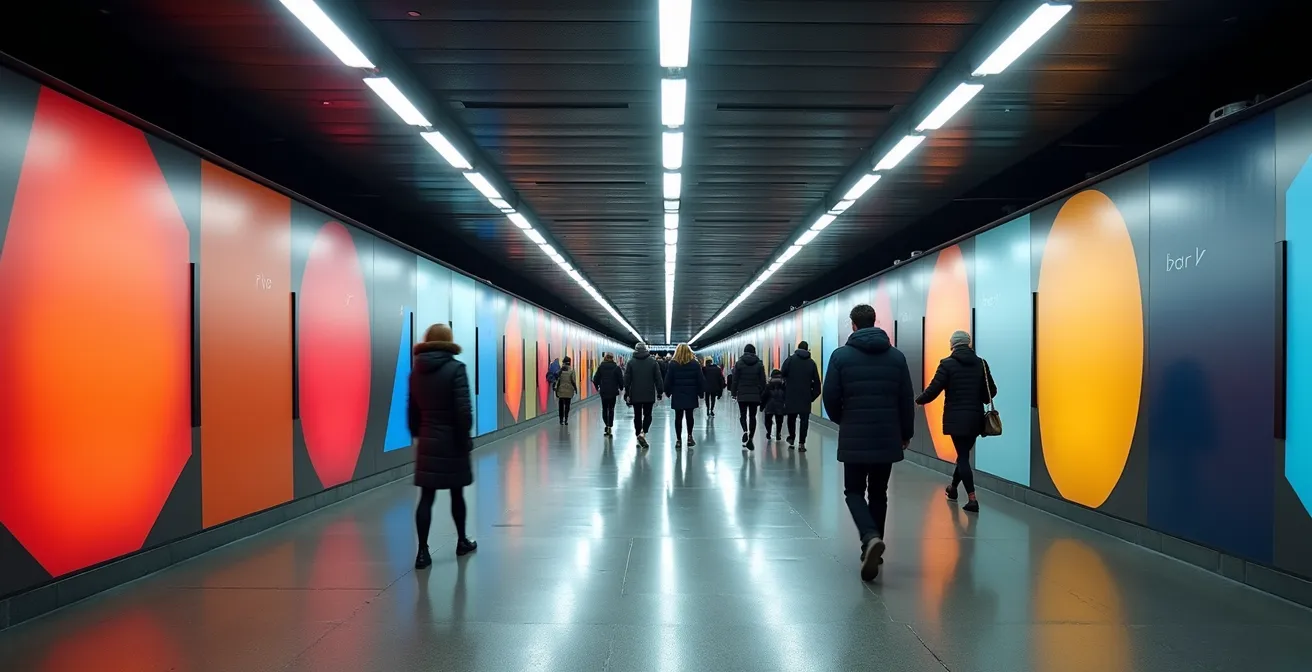
If using a ride-share service, setting your pickup location on the main thoroughfares of Yonge, Queen, or Dundas is a tactical failure. Instead, designate your pickup on the quieter parallel streets like Richmond Street (near Hudson’s Bay) or James Street on the mall’s west side. This allows for a clean getaway without getting stuck in traffic. An additional option is to exit through the connected Hudson’s Bay store, which provides multiple escape routes onto Queen Street, away from the epicentre of the crowds.
Your mission is not complete until you are clear of the operational area. Plan your exit as carefully as you plan your entry.
Where to Host a Power Breakfast at 7 AM in the Financial Core?
For the executive operative, the shopping mission may be an extension of the business day. The CF Toronto Eaton Centre’s direct connection to the Financial District via the PATH allows for a seamless transition from corporate to retail environments. A power breakfast is a strategic precursor to an efficient shopping strike. The key is selecting a venue that opens early and provides direct, unimpeded access to the underground network. Your primary targets for a 7:00 AM start are concentrated around the major office towers.
Prime venues include Dineen Coffee Co. on Temperance Street, known for its high-quality coffee and proximity to the PATH entrance at the Bay Adelaide Centre. For a more formal setting, the PATH-connected restaurants within the Sheraton Centre are accustomed to hosting Bay Street’s early risers. For maximum speed, the food courts at First Canadian Place and the Richmond-Adelaide Centre open early, offering multiple quick-service options. While more upscale options like Leña at Saks Fifth Avenue open slightly later (8:00 AM), they offer a strategic starting point for a luxury-focused shopping mission. As the official mall information confirms, these integrated venues are designed for this exact purpose.
The true strategic advantage is the subsequent journey. From a breakfast at First Canadian Place, an operative can navigate the entire 15-minute walk to the Eaton Centre’s Hudson’s Bay entrance without ever stepping outside. This subterranean route transforms the mission, moving from the quiet, corporate ambiance of the bank towers to the vibrant energy of the retail centre. It’s a temperature-controlled, crowd-managed corridor that delivers you directly to your southern operational zone, ready to execute.
This integrated approach allows an operative to conclude a morning meeting and be on the retail floor in minutes, maximizing time and efficiency.
The Behavior That Gets You Kicked Out of Office Lobbies Instantly
The Eaton Centre complex is a hybrid environment, seamlessly blending public retail space with private corporate towers like the Cadillac Fairview Tower at 20 Queen St W and 250 Yonge Street. Mistaking one for the other is a critical error that can compromise your mission. The transition is often subtle, but the consequences of crossing the line are immediate. The single behavior that will get you escorted out by security is loitering or attempting to bypass access control in a private corporate lobby. These areas are not public thoroughfares; they are secured zones for tenants.
An operative must be trained to recognize the environmental cues that signal this transition. These are your reconnaissance indicators. If you find yourself in a private lobby by mistake, the correct protocol is to immediately approach the security desk, state your error, and ask for directions back to the public PATH or retail area. Any hesitation, wandering, or attempt to appear like you belong will be interpreted as a potential security threat. Security personnel in these AAA office towers are trained to identify and challenge non-tenants swiftly.
Your Audit Checklist: Identifying Public vs. Private Space
- Flooring Changes: Note the shift from public terrazzo/tile to private polished marble or granite. This is your first warning line.
- Security Desk Presence: The appearance of a formal security desk is a definitive sign you have entered a restricted zone.
- Turnstile Barriers: Physical turnstiles are an unambiguous indicator of private, pass-required access. Do not approach them.
- Directory Changes: Observe if the signage switches from retail store listings to corporate tenant directories.
- Lighting Shifts: A change from bright, energetic retail lighting to a more subdued, formal ambiance often marks the corporate boundary.
Respecting these boundaries is not just about politeness; it is about maintaining a low profile and ensuring your mission is not interrupted by an unnecessary and embarrassing encounter with building security.
Your ability to read the environment is a core skill. Know your territory and stay within the designated public zones of operation.
Key takeaways
- Mission Success is defined by preparation, not improvisation. A pre-planned strategy is your greatest asset.
- Leverage the city’s infrastructure (PATH, Green P) to gain a tactical advantage over the average shopper.
- Treat the mall as a territory to be navigated, not a space to be wandered. Know your zones, entry points, and exit strategies.
Shopping on the Mink Mile: How to Get VIP Service Without Spending Millions?
For certain high-value acquisitions, the mission may extend beyond the Eaton Centre to Toronto’s luxury corridor: the Mink Mile on Bloor Street. Securing VIP service in these elite retail environments is not about the size of your bank account; it’s about demonstrating strategic intent. The amateur wanders in and hopes for attention; the professional commands it through preparation. The most critical element is strategic timing. Visit on a Tuesday or Wednesday afternoon between 2:00 PM and 4:00 PM. This is the quietest period, ensuring you receive the full attention of senior sales associates, not just weekend staff.
Next, deploy the Educated Enthusiast Approach. Before you enter the store, conduct online reconnaissance and identify one specific item. Approaching an associate with a targeted request (“I’m interested in seeing the new calfskin tote in slate grey”) immediately signals you as a serious buyer, not a tourist. This is far more effective than a vague “I’m just looking.” For the highest level of service, book a complimentary personal shopping appointment. Both Holt Renfrew and Nordstrom offer this service, providing you with a dedicated expert who will have items pre-selected based on your needs, completely bypassing the need to browse the floor.
A smart operational flow is to combine locations. Begin your mission at the “accessible luxury” anchors in the Eaton Centre (Saks, the former Nordstrom space), then take the Line 1 subway two stops north from Queen to Bloor-Yonge station. This efficient transit leg delivers you to the heart of the Mink Mile. Finally, leverage special events. Attending trunk shows or new collection launches, often advertised to mailing list subscribers, grants you access to a higher level of service and a more exclusive atmosphere. It’s about being in the right place, at the right time, with the right intelligence.
With the right strategy, you can achieve a VIP experience based on your intelligence and preparation, proving that in luxury retail, knowledge is power.