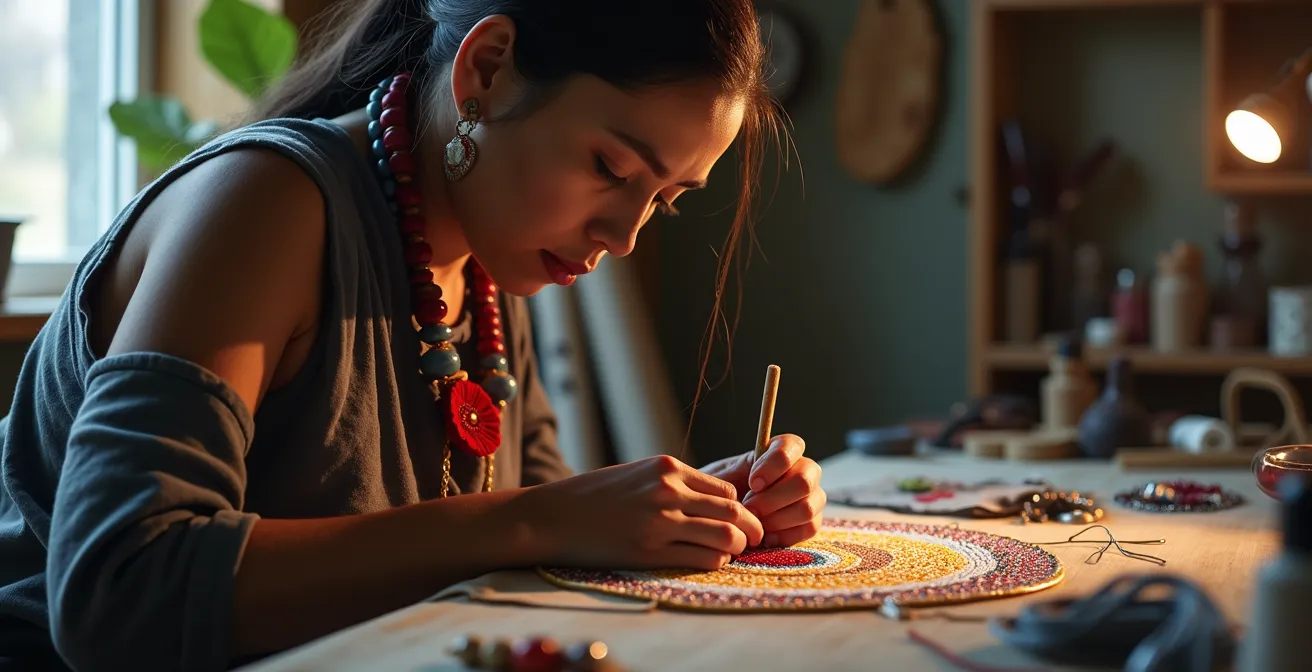
To truly support Indigenous creators in Toronto, your engagement must be based on informed participation, not just a simple purchase.
- Authentic art has distinct markers that separate it from mass-produced fakes, and buying it is an act of economic reconciliation.
- Indigenous heritage is not just in museums; it’s a living history embedded in the city’s food, land, and language.
Recommendation: Start by visiting one verified Indigenous-owned gallery or restaurant to ensure your money directly supports the artists and their communities.
You see a beautiful piece of beadwork in a Toronto market or a striking piece of art in a gallery window. You want to buy it, to take home a meaningful souvenir that connects you to this place. But a wave of uncertainty stops you. Is it authentic? Is it disrespectful for me to own this? Am I supporting a real artist or a factory? This hesitation is common for many tourists and locals who wish to engage with Indigenous culture but are afraid of making a mistake, contributing to cultural appropriation, or being duped by fakes.
The typical advice to “buy local” or “visit a cultural centre” is a good start, but it barely scratches the surface. It doesn’t equip you with the knowledge to navigate the nuances of a culture that is both ancient and vibrantly modern. True support for Toronto’s Indigenous creators goes beyond a simple transaction. It’s an act of informed participation that requires a genuine desire to understand the context behind the creation. It means learning to see the city through a different lens, recognizing its deep history, and appreciating the stories woven into every piece of art and every shared meal.
But what if the key wasn’t just knowing *what* to buy, but *how* and *why* to engage respectfully? This guide is designed to move you from a hesitant observer to a confident supporter. We will explore the meaning behind Toronto’s land acknowledgements, teach you how to distinguish authentic craftsmanship, compare culinary experiences, clarify respectful terminology, and show you how to recognize Indigenous heritage not in buildings, but on the very land you walk upon. This is your path to becoming an ethical and appreciative ally to the First Nations, Métis, and Inuit communities of Tkaronto.
For those who prefer a visual summary, the following video provides a great overview of the key points for respectfully engaging with Indigenous cultures in Canada, complementing the specific Toronto-focused advice in this guide.
To help you navigate this journey of informed participation, we have structured this article to answer your most pressing questions. From understanding foundational concepts to practical tips on buying art, each section is a step towards a more meaningful connection with Indigenous Toronto.
Summary: Your Guide to Ethically Supporting Indigenous Toronto
- Why Do Toronto Events Start with a Land Acknowledgment?
- How to Distinguish Authentic Indigenous Beadwork from Mass-Produced Fakes?
- Pow Wow Cafe vs. Tea N Bannock: Which Culinary Experience Suits Your Palate?
- The Language Mistake Visitors Make When Referring to Indigenous Peoples
- How to Find Indigenous-Led Walking Tours in Downtown Toronto?
- Why Does University IP Policy Complicate Your Spin-Off Company?
- Why Does a “Part IV” Designation Restrict Your Exterior Paint Choices?
- Buying Local Art in Toronto: How to Start a Collection on a $500 Budget?
Why Do Toronto Events Start with a Land Acknowledgment?
Hearing a land acknowledgment at the start of a conference, hockey game, or concert in Toronto may seem like a formal or political gesture. However, it is the fundamental first step in informed participation. It is a public recognition that the city, which many know as Toronto, has a much deeper history under its original name, Tkaronto. This acknowledgment serves as a constant reminder that we are all on Indigenous land and that its original stewards have a relationship with this territory that predates colonial settlement by millennia.
This practice is especially significant in a city where Toronto has the biggest Indigenous population in Ontario and the fourth largest in Canada. It’s an act of respect towards the diverse First Nations, Inuit, and Métis peoples who live here today. The acknowledgment specifically names the traditional territories of the Anishinaabe (most recently the Mississaugas of the Credit First Nation), the Haudenosaunee Confederacy, and the Wendat. It is a verbal commitment to counter the historical erasure of Indigenous peoples from their own lands.
Understanding the specific history is crucial. As Sara Roque and Selena Mills explain for the United Way Greater Toronto, this recognition is tied to formal agreements. They note that “The treaty that was signed for this particular land is collectively referred to as the Toronto Purchase and applies to land from Brown’s Line in the west to Woodbine Avenue in the east, and from the shore of Lake Ontario north toward Newmarket.” Far from being a hollow phrase, a land acknowledgment is a call to action: it invites every listener to learn more about the treaties governing the land they stand on and to recognize the enduring presence of Indigenous communities.
How to Distinguish Authentic Indigenous Beadwork from Mass-Produced Fakes?
When you purchase authentic Indigenous art, you are doing more than acquiring a beautiful object; you are participating in economic reconciliation. You are directly supporting an artist, their family, and the continuation of a cultural tradition. This is why learning to distinguish genuine, handcrafted work from mass-produced imitations is one of the most important skills an ethical consumer can develop. Fakes not only divert income from Indigenous creators but also misrepresent and devalue their cultural expressions.
The market for authentic Indigenous goods is significant. In 2021, there were over 18,605 Indigenous-owned businesses in Canada, many of them artisans and craftspeople whose livelihoods depend on buyers like you. Mass-produced fakes often use plastic beads, synthetic materials, and are sold at suspiciously low prices. They lack the spirit and story embedded in a piece that an artist may have spent days or weeks creating. Authentic beadwork, by contrast, is a testament to skill, patience, and cultural knowledge.
The intricate detail of genuine craftsmanship is often visible upon close inspection, showcasing the artist’s personal touch and the quality of the materials used.
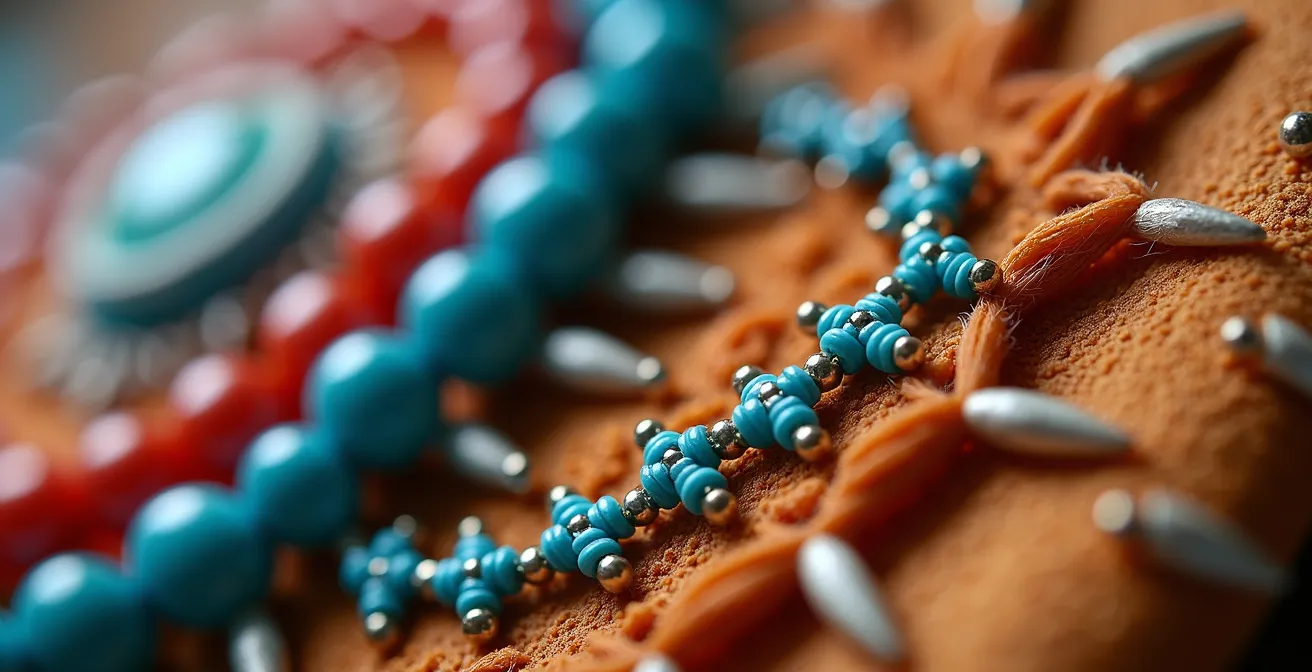
As you can see, hand-stitched work reveals slight variations and a tactile quality that machines cannot replicate. To avoid costly and unethical mistakes, you need a clear set of criteria. The following checklist will help you assess the authenticity of a piece before you buy.
Your Checklist for Identifying Authentic Indigenous Beadwork
- Material Check: Look for natural materials like smoked hide backing (often with a distinct scent and texture), real leather, and glass or stone beads, not plastic.
- Artist Connection: Ask if the piece comes with an artist’s card or biography. Authentic sellers are proud to tell you about the creator and their Nation.
- Price Justification: Is the price reflective of hours of skilled labor? A handcrafted medallion priced at $20 is a major red flag; authentic work is an investment in an artist’s time and expertise.
- Hand-Crafted Details: Examine the stitching and pattern. Look for slight, beautiful imperfections and variations that are the signature of handmade art, unlike the perfect uniformity of machine work.
- Purchase Point: Buy directly from the artist at a pow wow, from a trusted Indigenous-owned shop like the Cedar Basket Gift Shop at the Native Canadian Centre of Toronto, or a reputable gallery.
Pow Wow Cafe vs. Tea N Bannock: Which Culinary Experience Suits Your Palate?
Engaging with Indigenous culture is also a sensory experience, and there’s no better way to connect than through food. In Toronto, two standout restaurants offer delicious but distinct gateways into Indigenous cuisine: Pow Wow Cafe in Kensington Market and Tea N Bannock in Gerrard East. Choosing between them depends entirely on the experience you’re seeking. One offers a modern, quick-paced fusion, while the other provides a cozy, traditional comfort-food setting.
Bannock, a type of fried or baked bread that is a staple in many Indigenous communities, is the star at both, but it’s used in very different ways. At Pow Wow Cafe, Chef Shawn Adler uses it as a base for his famous Indigenous tacos, piling it high with creative toppings like jerk chicken or pulled pork. It’s a vibrant, fast-casual spot perfect for a flavour-packed lunch while exploring the eclectic market. Tea N Bannock, on the other hand, serves bannock in a more traditional style, alongside hearty, home-style dishes. Since its opening in 2012, it has become a vital cultural hub, offering a space to experience true Indigenous flavours like pickerel, bison, and elk stew in a leisurely, sit-down atmosphere.
To help you decide, this table breaks down the key differences between the two establishments, as highlighted by Destination Toronto’s guide.
| Aspect | Pow Wow Cafe | Tea N Bannock |
|---|---|---|
| Location | Kensington Market | Gerrard East |
| Atmosphere | Vibrant, modern, fast-casual | Cozy, sit-down, home-style |
| Specialty | Indigenous fusion cuisine | Traditional comfort food |
| Best For | Quick flavourful lunch | Leisurely dining experience |
| Must-Try | Modern interpretations like bannock tacos | Bison burgers, elk stew, wild rice salad |
Whether you choose the innovative fusion of Pow Wow Cafe or the comforting traditions of Tea N Bannock, you are supporting Indigenous-owned businesses that serve as vital spaces for cultural expression and community gathering.
The Language Mistake Visitors Make When Referring to Indigenous Peoples
Respectful engagement begins with respectful language. One of the most common and revealing mistakes visitors make is using incorrect, outdated, or overly generalized terms when referring to Indigenous Peoples. Using broad or inaccurate labels can unintentionally perpetuate stereotypes and disrespect the distinct identities of hundreds of unique Nations. The key is to be as specific and accurate as possible.
The umbrella term “Indigenous” is widely accepted in Canada to collectively refer to First Nations, Métis, and Inuit peoples. It is useful when you don’t know a person’s specific Nation. However, it’s an adjective, not a noun (e.g., “Indigenous people,” not “Indigenous”). Whenever possible, it is always better to refer to someone by their specific Nation. For Toronto, this means recognizing the territories of the Anishinaabe (specifically the Mississaugas of the Credit), the Haudenosaunee Confederacy, and the Huron-Wendat. Using these names shows you’ve done your homework and respect the local context.
Similarly, avoid outdated and offensive terms. The term “Indian” is generally considered archaic and is only used in specific legal or historical contexts in Canada (e.g., The Indian Act). Learning a few words in the local Indigenous language is another powerful act of respect. In the language of the Mississaugas, Anishinaabemowin, “Aanii” means hello and “Miigwetch” means thank you. Using these simple greetings demonstrates a willingness to engage with the culture on its own terms.
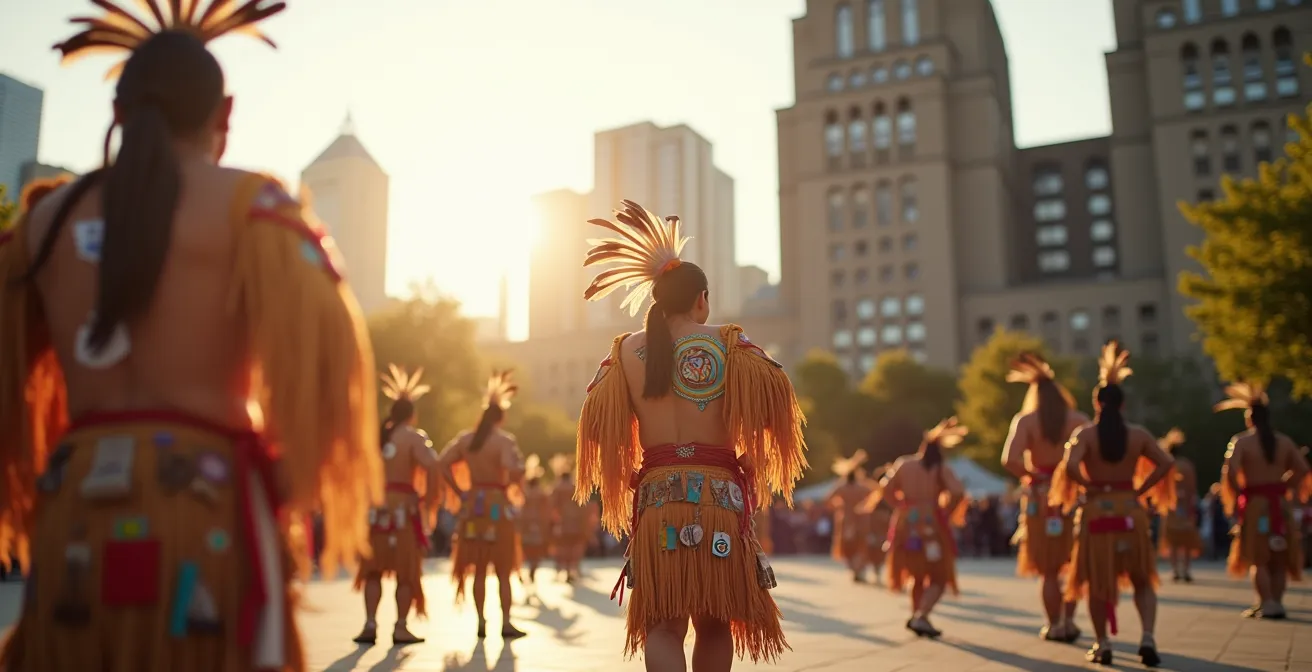
Cultural celebrations in the heart of the city, like those at Nathan Phillips Square, are a vibrant reminder of the living, breathing presence of diverse Indigenous cultures in Toronto. By using respectful and specific language, you honour the people behind these traditions.
How to Find Indigenous-Led Walking Tours in Downtown Toronto?
To truly understand Toronto’s Indigenous roots, you must look beyond the concrete and skyscrapers to see the living history embedded in the land itself. An Indigenous-led walking tour is one of the most powerful ways to do this. These tours reframe the city’s landscape, revealing ancient trails hidden beneath modern roads, sacred sites in public parks, and the stories that settler history has often overlooked. They transform a simple walk into an act of discovery and recognition.
While formal, guide-led tours are sometimes available through organizations like the Native Canadian Centre of Toronto, you can also embark on a self-guided journey using resources developed by Indigenous community members. Heritage Toronto, with support from Indigenous coordinators, has created an exceptional digital tour that allows you to explore these historical layers at your own pace. This approach encourages a deeper, more personal connection to the stories of the land.
As highlighted by Heritage Toronto, their Indigenous Roots tour was thoughtfully developed by “Heritage Toronto’s Indigenous Content Coordinator, Mnawaate Gordon-Corbiere, with the support of Miziwe Biik Aboriginal Employment and Training,” ensuring its authenticity and respectful perspective. To begin your own exploration, you can follow this itinerary:
- Start at the Humber River Mouth, a traditional gathering and trading place for thousands of years.
- Visit the ‘First Teacher’ sculpture at Toronto Metropolitan University to learn about Indigenous educational traditions.
- Walk along Davenport Road, which follows the path of an ancient Indigenous trail that ran along the former shoreline of Lake Iroquois.
- Explore High Park’s sacred burial mounds, remembering to do so with the quiet respect appropriate for such sites.
- Download the First Story Toronto App, which provides self-guided tours with audio clips, historical maps, and personal stories from community members.
Why Does a University IP Policy Complicate Your Spin-Off Company?
In a university setting, intellectual property (IP) rules are relatively straightforward: they define who owns an invention or creation—the researcher, the university, or a spin-off company. This model is built on Western concepts of individual ownership and commercial rights. However, this framework completely fails when applied to Indigenous art and design, and trying to use it is a critical mistake. Understanding this difference is essential for any ethical buyer.
For Indigenous artists, a design, story, or pattern is often not an individual “property” to be bought or sold. Instead, it is part of Indigenous Cultural and Intellectual Property (ICIP) or Traditional Knowledge (TK). This knowledge is frequently held collectively by a family, clan, or entire Nation, passed down through generations. It represents a sacred inheritance, not a commercial asset. Replicating a clan symbol or a sacred design without permission isn’t just copyright infringement; it can be a profound violation of cultural and spiritual protocols.
Case Study: The Woodland School Art Forgery Crisis
The prolific fakes of the Woodland School of Art, popularized by Anishinaabe artist Norval Morrisseau, represent a devastating example of the impact of ignoring ICIP. These forgeries not only undermined the economic value of authentic works but also violated the collective, ancestral knowledge that these distinct designs represent. Unlike standard IP, these Indigenous designs and stories are not individual property but Traditional Knowledge (TK) that cannot be bought, sold, or replicated without proper protocols and permissions from the community.
As a buyer, you become part of this ecosystem. By purchasing directly from an Indigenous artist or a verified Indigenous-owned gallery, you are ensuring the artist has the authority to share that specific design. You are respecting the protocols—seen and unseen—that govern the use of that knowledge. You are not buying “IP”; you are being granted permission to appreciate a story, respectfully and ethically.
Why Does a “Part IV” Designation Restrict Your Exterior Paint Choices?
In Toronto, a “Part IV” designation under the Ontario Heritage Act is used to protect the architectural heritage of a specific building, often restricting exterior changes like paint colours. This approach reveals a distinctly Western or settler concept of heritage: something that is architectural, documented, and fixed to a structure. This view, however, is radically different from many Indigenous concepts of heritage, which are often tied not to buildings, but to the land itself.
For Indigenous Peoples, heritage is a living history embedded in waterways, sacred sites, ancient trails, and ecosystems. It is a relationship with the land, viewed as a shared responsibility rather than a property to be owned. A perfect Toronto example is High Park. While non-Indigenous visitors might see a beautiful urban green space, the park contains sacred burial mounds and evidence of Indigenous presence dating back thousands of years. These are heritage sites of immense significance, yet they are largely unmarked, protected by respect rather than by plaques or legal designations on a building.
Recognizing this land-based heritage is a crucial part of ethical engagement. The city is slowly beginning to acknowledge this through initiatives that formally honour the Indigenous heritage embedded in the landscape. As the University of Toronto Library notes, “The City of Toronto’s project to give Indigenous names to public spaces (e.g., ‘Ishpadinaa’ for Spadina) is a modern way of formally recognizing and honouring the Indigenous heritage embedded in the city’s landscape.” When you learn that a modern road follows an ancient trail or a park contains a sacred site, your understanding of the city deepens, moving beyond the architectural to the ancestral.
Key Takeaways
- Ethical support for Indigenous creators is about informed participation and relationship-building, not just a simple financial transaction.
- Authentic, handcrafted art has clear markers of quality—natural materials, justified pricing, and a direct connection to the artist—that distinguish it from mass-produced fakes.
- Indigenous heritage in Toronto is a living history embedded in the land, its original place names, and sacred sites, a concept fundamentally different from settler ideas of architectural preservation.
Buying Local Art in Toronto: How to Start a Collection on a $500 Budget?
Starting an art collection can feel intimidating, but supporting Indigenous artists and building a meaningful collection is accessible even on a modest budget. The key is to shift your mindset from seeking a single, large “masterpiece” to acquiring several smaller, authentic pieces that tell a story. With a budget of $500, you can begin a beautiful and ethical collection that has a direct, positive impact on Indigenous artists and their communities.
The most important principle is to buy directly and ethically. This ensures the maximum amount of your money goes to the creator. Rather than buying from a generic souvenir shop, seek out Indigenous-owned galleries, attend community markets, or purchase items at cultural centres. This practice of relational purchasing—building a connection with the source of the art—is far more rewarding than an anonymous transaction. Your $500 can go a long way if you know where to look.
Here are some practical ways to start building your authentic Indigenous art collection in Toronto for under $500:
- Start with high-quality, limited-edition prints from established Indigenous artists. They offer the visual impact of a large painting at a fraction of the cost.
- Look for intricate beadwork pieces like earrings, medallions, or keychains at the Cedar Basket Gift Shop inside the Native Canadian Centre of Toronto.
- Attend the annual Indigenous Arts Festival at Fort York Historic Site to buy directly from dozens of artists in one place.
- Consider smaller, exquisite items like small carvings, quillwork boxes, or artist-designed textiles and scarves.
- Buy directly from Indigenous-owned galleries like the Bay of Spirits Gallery, where the staff can share the story behind each piece and artist.
Your journey of informed participation can start today. Choose one gallery to visit, one restaurant to try, or one self-guided tour to walk. By taking this first step, you move beyond being a passive tourist and become an active and respectful participant in Toronto’s vibrant, living Indigenous culture.
Frequently Asked Questions About Engaging with Indigenous Culture in Toronto
What are the specific Nations whose traditional territory Toronto is on?
Toronto is on the traditional territory of the Anishinaabe (specifically the Mississaugas of the Credit), the Haudenosaunee Confederacy, and the Huron-Wendat. Acknowledging these specific Nations is an important act of respect.
What basic greeting words can visitors learn in Anishinaabemowin?
‘Aanii’ means hello and ‘Miigwetch’ means thank you in Anishinaabemowin, the language of the Mississaugas. Using these words is a simple but meaningful way to show respect.
Why is ‘Indigenous’ a useful umbrella term in Toronto?
While Toronto is on specific traditional territories, it is now home to a diverse urban population of First Nations, Inuit, and Métis people from across Turtle Island (North America). The term ‘Indigenous’ is useful when a person’s specific Nation is not known.
What makes Indigenous IP different from standard copyright?
For many Indigenous artists, designs and stories are not individual ‘property’ but collective, ancestral knowledge belonging to their Nation or community. This is known as Indigenous Cultural and Intellectual Property (ICIP) or Traditional Knowledge (TK), and it cannot be treated like a standard commercial asset.
What respectful questions can buyers ask artists?
Instead of asking about price first, try building a relationship. A great question is: “Is there a story behind this piece that you are able to share?” This shows respect for the art as more than just a product for sale.
Why is Traditional Knowledge (TK) protected differently?
Traditional Knowledge represents generations of cultural heritage, spirituality, and survival. It cannot be bought, sold, or replicated like standard intellectual property because it is not owned by an individual but stewarded by a community. Its use is governed by specific cultural protocols, not just commercial law.