
Building a memorable St. Lawrence Market charcuterie board is not just about buying food; it’s about curating a narrative of Toronto on a platter.
- Master the market’s ecosystem by learning vendor secrets and optimal shopping times to source the best local ingredients.
- Focus on the “cost-per-use” of bulk items and unique finds over pre-packaged supermarket goods to achieve superior quality and value.
Recommendation: Approach your board as a storytelling project, where each cheese, cured meat, and accompaniment has a distinct Ontario provenance, turning your dinner party into a truly local gourmet experience.
There’s a certain magic to hosting a dinner party in Toronto. In a city of vertical living, creating a warm, impressive experience for guests is a rewarding challenge. Often, the go-to solution is a charcuterie board. It’s elegant, social, and requires no cooking. But a truly exceptional board—one that people talk about long after the night is over—is more than a simple collection of meats and cheeses from a big-box store. It’s a curated experience, a story told through flavour and texture.
Many guides will give you the generic formula: a hard cheese, a soft cheese, a blue cheese. They’ll tell you to add crackers and grapes. While that’s not wrong, it misses the soul of the craft. It overlooks the opportunity to tap into the vibrant heart of Toronto’s food scene: the St. Lawrence Market. The real secret to an unforgettable board isn’t just what you buy, but how and where you buy it. It’s about understanding the market as a living ecosystem of artisans, farmers, and history.
What if the key to an impressive charcuterie board wasn’t a formula, but a strategy? A strategy built on insider knowledge of the market’s rhythms, its iconic vendors, and its hidden economic advantages. This isn’t about just assembling food; it’s about building a narrative on a platter, where every element, from the world-famous peameal bacon to the specific Ontario cheddar, has a story to tell. It’s about creating a board that is unapologetically, deliciously Torontonian.
This guide will walk you through that very strategy. We’ll explore how to navigate the market like a seasoned chef, from selecting a perfect trio of local cheeses to understanding the subtle logistics that make for a seamless shopping trip. You’ll learn how to transform your finds into a stunning centerpiece, perfectly suited for entertaining, even in a 500-square-foot condo.
Summary: Your Guide to Crafting a Local Charcuterie Experience
- Why Is Carousel Bakery’s Peameal Sandwich World-Famous?
- How to Select 3 Cheeses That Complement Each Other Perfectly?
- Saturday Market vs. Weekday Shop: When Is the Produce Freshest?
- The Payment Mistake That Slows You Down at Busy Stalls
- How to Find Vintage Serving Platters at the Sunday Antique Market?
- Why Is Kensington Produce Often Cheaper Than Metro?
- How to Host a Dinner Party in a 500 Sq Ft Condo Comfortably?
- Eating Organic in Kensington Market: How to Fill Your Basket for Under $60?
Why Is Carousel Bakery’s Peameal Sandwich World-Famous?
To build a board that tells a Toronto story, you must start with its most iconic ingredient. Before you even think about cheese, you need to understand the significance of peameal bacon. And for that, you must go to Carousel Bakery. This isn’t just a food stall; it’s a living piece of Toronto history, a landmark at St. Lawrence Market for over half a century. Its fame isn’t just built on a good recipe, but on its deep connection to the city’s identity.
The peameal bacon sandwich from Carousel is a rite of passage for tourists and a comforting staple for locals. But for your charcuterie board, you’re not buying the sandwich; you’re sourcing the star ingredient from its most authentic home. The key is to buy the peameal bacon sliced, ready to be pan-seared lightly at home and served warm on your board. This single element immediately grounds your creation in local heritage. Its distinctive, non-smoked, lean flavour provides a savoury, slightly sweet counterpoint to salty cured meats and rich cheeses.
The historical significance cannot be overstated. As Mayor Olivia Chow highlighted, this ingredient is a Toronto invention that has gained global recognition. She notes:
Peameal bacon was invented at St. Lawrence Market – and is now known as Canadian bacon all around the world
– Mayor Olivia Chow, NOW Toronto – Key to the City Award Ceremony
By including slices of this iconic meat, you’re not just adding a protein; you’re serving a piece of the market’s legacy. It’s a conversation starter and an immediate signal to your guests that this board is thoughtfully sourced and deeply connected to its place of origin.
How to Select 3 Cheeses That Complement Each Other Perfectly?
The heart of any charcuterie board is the cheese, and in Ontario, we are spoiled for choice. With a national production that reached 528,207 metric tonnes in 2024, the variety of high-quality, artisanal Canadian cheese is staggering. The common advice is to pick a hard, a soft, and a blue cheese. This is a good starting point for texture, but to create a truly great board, you need to think about a narrative trio. Your goal is to select three cheeses that tell a story about Ontario’s terroir and cheesemaking artistry.
The key is not to wander aimlessly but to engage the experts: the cheesemongers at stalls like Alex Farm or Scheffler’s. Instead of asking “What’s good?”, ask targeted questions that lead to a curated selection. This transforms a simple transaction into a collaborative, creative process. You’re not just a customer; you’re a curator seeking expert advice. This is how you uncover the hidden gems and create a combination that is both delicious and meaningful.
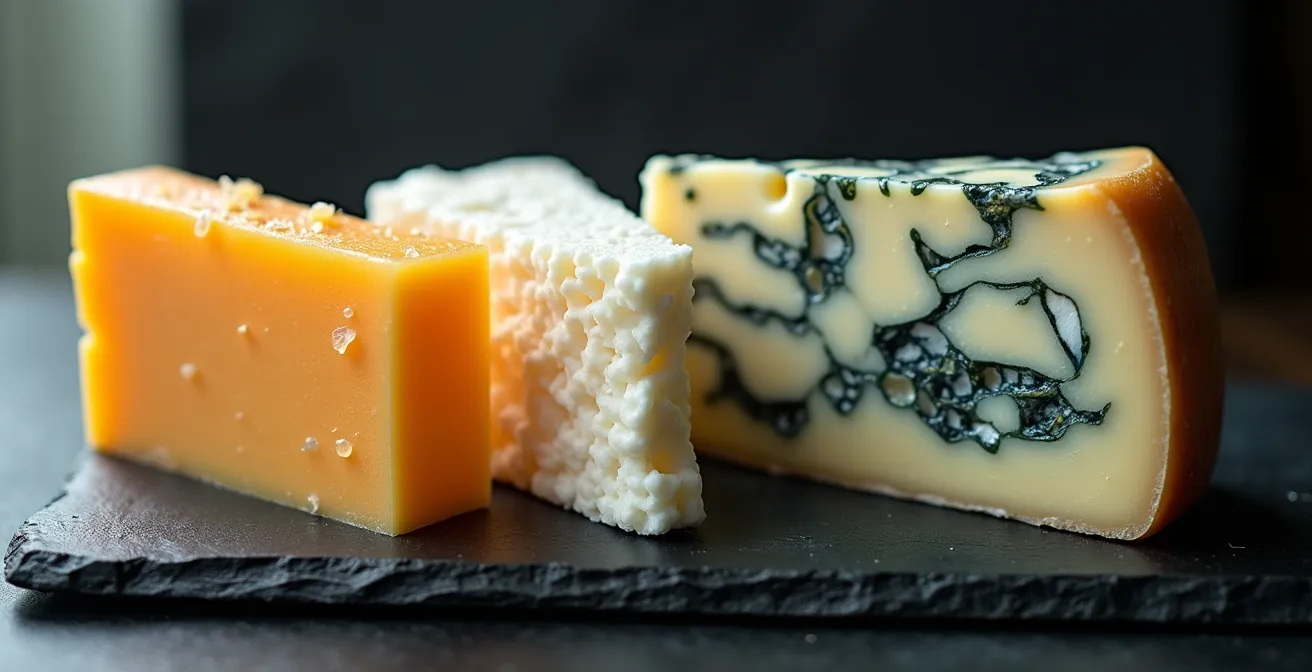
As you can see from the distinct textures, each cheese brings a unique character to the board. To find your perfect trio, try asking a cheesemonger one of these powerful questions:
- “I’m building a board with only Ontario products. Can you give me a hard, a soft, and a blue that tell a story about the province?” This question signals your intent and invites the cheesemonger to share their knowledge.
- “I’m serving a Niagara VQA Riesling, what three local cheeses would you pair with it and why?” This connects the cheese to another local product, creating a sophisticated pairing.
- “Can you suggest a traditional aged cheddar, an experimental cheese, and one made in European style?” This framework ensures a dynamic range of flavours, from the familiar to the unexpected.
By approaching cheese selection this way, you move beyond the generic and create a thoughtful, cohesive collection that truly represents the best of the region.
Saturday Market vs. Weekday Shop: When Is the Produce Freshest?
Mastering the market ecosystem means understanding its rhythm. The question of when to shop isn’t just about freshness; it’s about the kind of experience you want. Your strategy for timing will dictate everything from product availability to your own stress levels. The market operates with two distinct personalities: the bustling, inspirational Saturday and the calm, transactional weekday.
Saturday is the market at its most vibrant. It opens early, and this is when you’ll find the absolute peak freshness for weekend stock, especially delicate breads, pastries, and fruits. However, this is also when the market is most crowded with tourists and locals alike. For an optimal Saturday, the strategy is to arrive between 8 AM and 9 AM. You’ll get the best selection while beating the intense 11 AM rush. This is the time for an “inspirational” shop, where you can browse, enjoy live music, and take advantage of the many samples offered by vendors.
Weekday shopping, from Tuesday to Friday, offers a completely different atmosphere. It’s quieter, more local-focused, and highly efficient. This is your “transactional” shop. If you have your list and know exactly what you need, a weekday visit allows you to get in and out quickly, with more opportunities for one-on-one conversations with vendors. While most vendors are present, some smaller operators may only be there on weekends, and sample availability is limited. The following table breaks down the key differences to help you plan your visit, based on insights from market regulars who understand that timing is everything.
| Aspect | Saturday | Weekday (Tue-Fri) |
|---|---|---|
| Opening Time | 7:00 AM | 9:00 AM |
| Atmosphere | Energetic, tourist-heavy | Calm, local-focused |
| Best Time to Arrive | 8-9 AM (before crowds) | Any time |
| Product Freshness | Peak freshness for weekend stock | Mid-week restocking |
| Vendor Availability | All vendors present | Most vendors present |
| Sample Availability | Many samples offered | Limited samples |
Ultimately, the “best” time depends on your goal. For the highest energy and widest selection of special weekend items, a strategic early Saturday is unbeatable. For a calm, focused, and efficient trip, weekdays are your best bet. A true market pro knows how to leverage both.
The Payment Mistake That Slows You Down at Busy Stalls
Navigating St. Lawrence Market on a busy Saturday is a dance. To do it gracefully, you need to master market etiquette, and the single biggest misstep that slows everyone down is being unprepared at the point of payment. In an era of tap-and-go, it’s easy to assume every vendor is equipped with the latest technology. This is a crucial mistake. Many of the market’s most iconic and beloved stalls, especially those run by families for generations, are cash-only or have a minimum for card purchases.
Fumbling for a card at a cash-only counter, or trying to make a small purchase on a debit card, creates a bottleneck that frustrates you, the vendor, and the long line of people behind you. The professional approach is to always carry a mix of cash (especially smaller bills and coins) for quick purchases like a loaf of bread or a small piece of cheese. A TripAdvisor reviewer’s experience at the legendary Carousel Bakery perfectly illustrates this point:
The peameal bacon sandwich lives up to the hype. Be advised, it is cash only – not a big deal especially compared to the quality of the sandwich.
– TripAdvisor reviewer, Carousel Bakery
This highlights that relying solely on plastic can mean missing out on some of the market’s best offerings. Efficient payment is part of a broader set of practices that separate the novice shopper from the market regular. It’s about respecting the flow and the time of both vendors and fellow shoppers.
Your Action Plan: Efficient Toronto Market Etiquette
- Know Your Order: Decide what you want while you’re in line, not when you get to the front. This is the single most important step to keep the line moving.
- Have Bags Ready: Have your reusable bags open and ready. A two-bag system works best: one insulated bag for cheese and meats, and a canvas tote for bread and dry goods.
- The “Step Aside” Maneuver: As soon as you’ve placed your order and paid, step to the side while the vendor wraps your items. This allows the next person to order immediately.
- Carry Cash: Always have at least $40-50 in cash for smaller vendors and purchases under $10. Never assume a stall takes cards.
- Consolidate Your Visit: Plan your route through the market. Start with dry goods and produce, and finish with refrigerated items like cheese and meat to minimize their time out of the cold.
By adopting these simple habits, you’ll not only have a more pleasant and efficient shopping experience, but you’ll also earn the silent approval of the market’s vendors and seasoned regulars.
How to Find Vintage Serving Platters at the Sunday Antique Market?
A stunning charcuterie board is as much about presentation as it is about the food. While a simple wooden board works well, sourcing your serving platters from the St. Lawrence Sunday Antique Market adds another layer of storytelling and local character. Instead of a mass-produced platter, you can find a piece with history, patina, and a distinctly Canadian identity. This is the final touch that elevates your board from “nice” to “unforgettable.”
The hunt for the perfect piece is part of the experience. The Sunday market is a treasure trove of items that can be repurposed for a beautiful food display. You’re not just looking for a “platter”; you’re looking for objects with texture and soul. Think beyond the obvious and keep an eye out for items that can be given a new life as part of your entertaining toolkit. An old wooden breadboard, a set of silver-plated cheese knives, or colourful Depression-era glass bowls can all become functional, beautiful parts of your charcuterie presentation.

To guide your search, go in with a vintage hunter’s checklist. Knowing what to look for helps you focus your energy and spot potential gems among the vast array of items. Here are a few things to keep on your radar:
- Ontario-Made Wooden Breadboards: Look for pieces from historic Ontario furniture makers like ‘Krug’ or ‘Vilna’. Their patina tells a story.
- Canadian Silver-Plated Cheese Knives: Search for unique utensils with Canadian hallmarks (often a beaver or maple leaf).
- Depression-Era Glass Bowls: These come in beautiful shades of amber, green, and pink, and are perfect for holding olives, nuts, or jams.
- Vintage Linen Napkins: A stack of old linen napkins with traditional patterns adds a touch of classic elegance.
- Early 20th Century Toronto Postcards: Find a few to use as creative, thematic labels for your cheeses.
When you find something you love, don’t be afraid to bundle items and politely ask the vendor, “Is there any flexibility on the price?” It’s an expected part of the market culture and can often lead to a better deal.
Why Is Kensington Produce Often Cheaper Than Metro?
This is a fantastic question that gets to the heart of food economics in Toronto. While this guide focuses on St. Lawrence Market, the principle behind Kensington’s affordability is a universal market lesson that you can apply to make your charcuterie board more economical without sacrificing quality. The short answer is that independent market vendors have a different business model than large supermarket chains like Metro. They have lower overhead, more direct supply chains, and the flexibility to price based on daily stock levels.
However, the most powerful economic advantage for a charcuterie board builder isn’t at the produce stall—it’s in the bulk bins. This is where St. Lawrence Market truly outshines a conventional grocery store. While the sticker price of artisanal cheese has been rising, with the Consumer Price Index showing that cheese prices have risen by almost 18% between 2020 and 2024, you can control the cost of your accompaniments by embracing the principle of “cost-per-use.”
In the lower level of St. Lawrence Market, vendors like Lively Life Fine Foods offer a vast selection of olives, nuts, dried fruits, and other specialty items in bulk bins. At a supermarket, you’re forced to buy a pre-packaged container of Kalamata olives or Marcona almonds, of which you might only use half for your board. The rest sits in your fridge, often forgotten. At the market, you can buy the exact quantity you need—say, 150g of a specific olive mix or just a handful of walnuts. While the per-kilo price might be comparable, your total outlay is significantly less because you’re buying only what you will use. This simple shift in purchasing strategy allows you to save money on the supporting cast of your board, freeing up more of your budget to invest in the stars: high-quality, artisanal Ontario cheeses and cured meats from the main floor.
How to Host a Dinner Party in a 500 Sq Ft Condo Comfortably?
The Toronto dream often comes with a spatial reality: the 500-square-foot condo. Hosting a dinner party in a small space can feel daunting, but a charcuterie board is the perfect solution. It eliminates the need for a formal dining table and complex, multi-pot cooking. The key to comfortable condo entertaining is to position the charcuterie board as the main event, a beautiful, grazing-style meal that encourages mingling rather than a cramped, sit-down affair.
The strategy is all about workflow and designated zones. Your kitchen island becomes the “cool zone”—a clean, dedicated space for assembling the board. This is where you do all your prep before anyone arrives. Once guests are present, there is no cooking, no stress, and no running back and forth to a hot stove. You can be present and enjoy your own party. One of the best ways to manage a small space is to create a separate beverage station. A simple bar cart set up in a corner frees up valuable counter space and prevents traffic jams around the food.
Once assembled, move the finished board from the kitchen island to the coffee table in your living area. This simple move transforms the dynamic of the party, drawing guests into the more comfortable seating area and encouraging a relaxed, social atmosphere. As one participant from a Toronto charcuterie workshop shared, this format is perfectly suited to the city’s social life:
The charcuterie lesson beforehand is a nice compliment so you can leave confident the next time you want to entertain. I went solo which was great as you get to meet great people but I can totally see this as a thing for couples or small groups.
– A Toronto workshop participant
To maximize your limited surface area, think vertically. Use tiered serving stands to create different levels on your board. This not only adds visual interest but also allows you to fit more on a smaller footprint. With the “no-cook” charcuterie strategy, your small condo becomes the perfect venue for an intimate and impressive gathering.
Key Takeaways
- A great Toronto charcuterie board tells a story using ingredients with local provenance, starting with iconic vendors at St. Lawrence Market.
- Mastering the market involves more than buying; it requires strategic timing, smart vendor questions, and logistical savvy like carrying cash.
- The most economical approach is focusing on “cost-per-use” by buying accompaniments from bulk bins, allowing a bigger budget for high-quality local cheeses and meats.
Eating Organic in Kensington Market: How to Fill Your Basket for Under $60?
While Kensington Market is an undeniable hub for organic and budget-friendly shopping in Toronto, you can absolutely apply the same principles to curate a beautiful, predominantly organic charcuterie board at St. Lawrence Market. The perception is that St. Lawrence is purely a high-end destination, but with a smart plan, you can assemble a fantastic board featuring organic and sustainably-produced items for around $75, a very reasonable investment for a gourmet dinner party centerpiece.
The strategy is about being intentional and communicative. While not every vendor at St. Lawrence has the official “certified organic” label, many practice sustainable and ethical farming. The key is to ask the right questions. Don’t just look for a logo; engage with the producers. Ask them directly: “Do you use pesticides?” or “How are your animals raised?” You’ll often find that their standards are exceptionally high, even without the formal certification. Canada’s dairy sector is seeing strong growth in specialty products, indicating a rising consumer demand for quality and transparency that market vendors are keen to meet.
To create a board that is both high-quality and budget-conscious, you need a shopping list that allocates your funds strategically. Here is a sample plan for an all-organic (or sustainably-sourced) St. Lawrence Market board:
- $25 at Scheffler’s: Ask for two standout organic Ontario cheeses. They have a fantastic, well-curated selection.
- $15 at a Certified Butcher: Choose one high-quality organic salami or other cured meat. Quality over quantity is key here.
- $10 at Domino Foods (Lower Level): Fill up on organic nuts and dried fruit from their extensive bulk bins. This is where the ‘cost-per-use’ principle saves you money.
- $8 for Organic Crackers: Explore the lower level stalls for a variety of specialty and organic cracker options.
- $10 for Local Honey and Preserves: Visit one of the farmers’ stalls for a jar of local, unpasteurized honey or artisanal jam.
- $7 for Fresh Organic Produce: Pick up a few organic grapes, figs, or apple slices for garnish from a produce vendor.
This targeted approach proves that you don’t need to choose between the historic atmosphere of St. Lawrence and your desire for organic, mindfully-sourced ingredients. You can have both.
Now that you are equipped with the insider knowledge to navigate St. Lawrence Market like a professional, the next step is to put it all into practice. Start planning your shopping list, and transform your next dinner party from a simple meal into a memorable Toronto story.