In summary:
- Operating any motorized boat, including a Sea-Doo, in Toronto requires a Pleasure Craft Operator Card (PCOC) by law.
- Specific high-risk zones, like the area around Billy Bishop Airport, are strictly off-limits with severe penalties for violations.
- Beyond boat traffic, environmental hazards like E. coli after rainfall pose a significant, often overlooked, health risk.
- Understanding the unique mix of commercial and recreational traffic is critical for safely navigating the inner harbour, especially for paddlers.
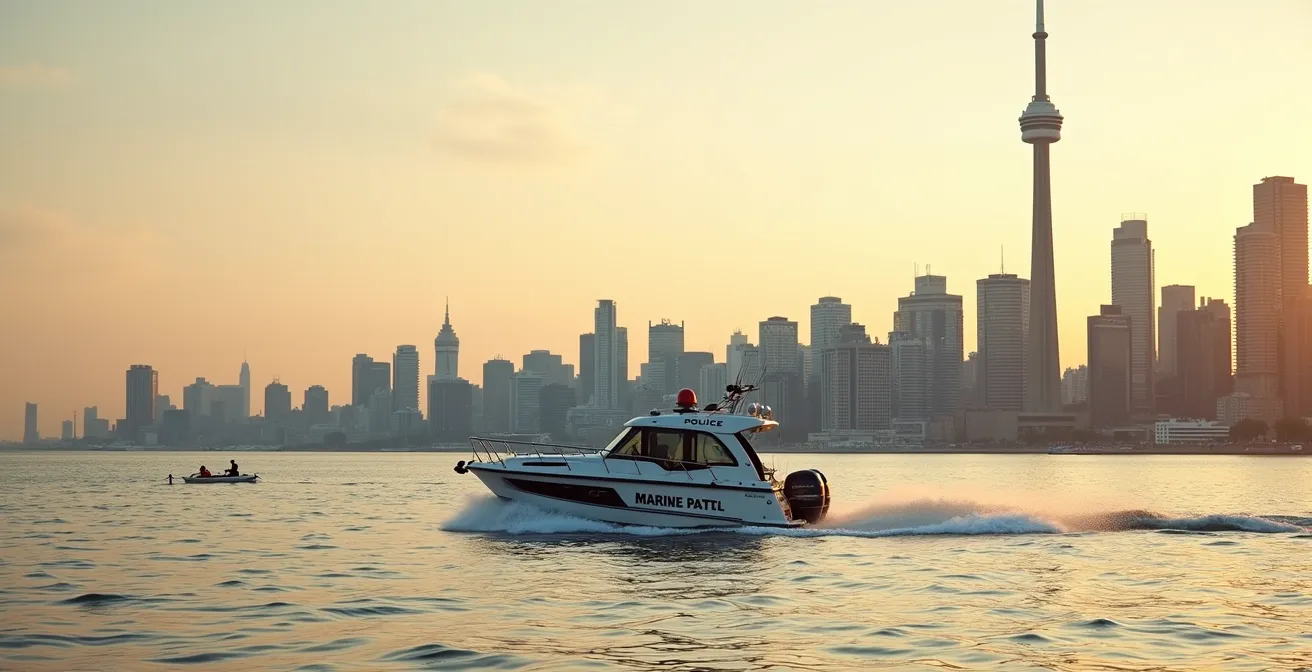
Toronto’s waterfront offers a stunning escape, a skyline vista from the unique perspective of Lake Ontario. For many, renting a Sea-Doo or a pontoon for the day seems like the perfect summer activity. However, this bustling urban waterway is far from a simple recreational lake. It’s a complex, heavily regulated environment where a moment of ignorance can lead to hefty fines, dangerous accidents, or severe health risks. Many new boaters assume basic caution is enough, but they quickly learn that the Toronto Police Marine Unit and other authorities enforce a specific set of rules designed for this unique, high-traffic harbour.
Most guides will give you the generic advice: wear a life jacket, don’t drink and boat. While crucial, this barely scratches the surface of what’s required for safe operation in Toronto. The real key to a safe and enjoyable day on the water isn’t just knowing the rules, but understanding the *why* behind them—the specific local hazards they are designed to mitigate. This guide moves beyond the obvious to provide operational knowledge. We’ll explore the rationale behind licensing, decode the invisible boundaries that protect critical infrastructure, and highlight the hidden environmental dangers that can turn a perfect day into a disaster.
This is not a list of regulations to memorize; it’s an operational briefing. By understanding the context of each rule, from navigating around seaplanes to knowing when the water itself is a hazard, you can develop the situational awareness of a seasoned captain. This knowledge is your best defence against fines and, more importantly, your best tool for ensuring the safety of yourself and everyone around you.
This article provides a comprehensive briefing on the essential regulations and safety considerations for enjoying Toronto’s waterways. We will cover everything from mandatory certifications to navigating specific local hazards, ensuring you are fully prepared.
Table of Contents: Harbourfront Water Sports and Regulations
- Why Do You Need a Pleasure Craft Operator Card Even for a Seadoo?
- How to Navigate the “Keep Out” Buoys Near the Island Airport?
- Boat Club Membership vs. Ownership: Which is More Cost-Effective in Toronto?
- The E. Coli Mistake: Swimming in the Harbour After a Heavy Rainfall
- How to Rent a Private Pontoon for Sunset Without a Captain?
- Why Do Maintenance Fees Spike for Buildings Directly on Lake Ontario?
- How to Fly a Drone in Toronto Without Violating Transport Canada Rules?
- Urban Kayaking: How to Navigate the Inner Harbour Traffic Safely?
Why Do You Need a Pleasure Craft Operator Card Even for a Seadoo?
The single most important piece of documentation for anyone operating a motorized vessel in Toronto is the Pleasure Craft Operator Card (PCOC). Many renters or casual users mistakenly believe it’s only for large boats, but the law applies to *any* craft with a motor, including personal watercraft like Sea-Doos and Jet Skis. This isn’t bureaucratic red tape; it’s a fundamental safety measure. The PCOC course ensures every operator understands the basics of navigation, right-of-way rules, and emergency procedures. In a crowded harbour with ferries, water taxis, and sailboats, this baseline knowledge is critical to prevent collisions.
When stopped by the Toronto Police Marine Unit, you will be required to present your PCOC, your vessel’s license (for motors over 10hp), and personal photo ID. Failure to produce a PCOC results in an immediate fine, no exceptions. This emphasis on certification is a direct response to accident statistics. In Ontario, the vast majority of boating incidents involve operators who lack formal training. In fact, provincial police data shows that small vessels are disproportionately involved in accidents; having a certified operator is seen as the first line of defence against tragedy.
Think of the PCOC as your driver’s license for the water. It proves you have learned the rules of the “road” and are competent to handle a machine that can cause serious harm if operated improperly. Given that more than 85% of marine fatalities since 2015 involved small vessels, the authorities’ strict enforcement of the PCOC requirement is a critical component of their strategy to keep the harbour safe for everyone.
How to Navigate the “Keep Out” Buoys Near the Island Airport?
One of the most unique—and dangerous—features of Toronto’s Inner Harbour is its proximity to Billy Bishop Toronto City Airport (YTZ). The airport operates seaplanes that use the Western Gap as a runway for takeoffs and landings. To protect this airspace and prevent catastrophic collisions between boats and aircraft, a strictly enforced exclusion zone is marked by large, white “Keep Out” buoys. Navigating this area requires absolute adherence to these markers. Crossing into this zone is not a minor infraction; it is a serious federal offense.

These buoys create an invisible wall that all boaters must respect. The area is under constant surveillance by both the Toronto Police Marine Unit and airport authorities. The rationale is simple: an aircraft moving at high speed during takeoff or landing has no ability to manoeuvre around an unexpected boat. The risk of a fatal accident is exceptionally high. As a result, the penalties for entering the zone are severe, intended as a powerful deterrent. Violators can face not only immediate intervention from police but also significant legal consequences.
The cost of non-compliance is steep. Ignoring these warnings is considered reckless endangerment, and the justice system treats it as such. According to reports on harbour regulations, breaking this rule can carry a fine of upwards of $10,000. This isn’t a simple ticket; it’s a penalty reflecting the potentially disastrous outcome of such a transgression. For any boater, understanding and respecting the airport exclusion zone is non-negotiable operational knowledge for being on Toronto’s water.
Boat Club Membership vs. Ownership: Which is More Cost-Effective in Toronto?
For many Toronto residents, especially those in condos, the dream of boating is often met with the harsh reality of urban logistics. The question of access often comes down to two models: joining a boat club or purchasing your own vessel. While ownership offers freedom, a cost-benefit analysis in a dense city like Toronto heavily favours club membership for most people. The “walk on/walk off” convenience of a club eliminates the three biggest headaches of city boat ownership: marina fees, winter storage, and maintenance.
A detailed comparison of costs reveals the stark difference. Owning even a modest 30-foot boat in Toronto involves a cascade of expensive, recurring fees that are often overlooked by first-time buyers. These costs are completely absorbed by the club’s membership fee, providing predictable expenses and zero logistical hassle. An analysis from Harbourfront Centre Marine shows condo residents overwhelmingly prefer this model precisely because it sidesteps the challenges of storage and upkeep in a city with limited space.
The following table, based on data from local marine operators, breaks down the typical annual expenses:
| Cost Factor | Boat Club Membership | Boat Ownership (30ft) |
|---|---|---|
| Annual Marina Fees | Included | $4,000-$7,000 |
| Winter Storage | Included | $2,500-$3,500 |
| Insurance | Included | $1,200-$2,000 |
| Maintenance | Included | $3,000-$5,000 |
| Fuel | Pay per use | $2,000-$3,500 |
| Time Commitment | Walk on/Walk off | 20+ hours monthly |
Beyond the direct financial costs, the time commitment for owners is substantial. Maintenance, cleaning, and preparation can consume dozens of hours per month, whereas a club member simply arrives, uses the boat, and leaves. For the urban professional or family, this time saving is often as valuable as the financial savings, making club membership the most pragmatic and cost-effective solution for enjoying the Toronto waterfront.
The E. Coli Mistake: Swimming in the Harbour After a Heavy Rainfall
While navigational hazards are top of mind for most boaters, one of the most significant dangers in Toronto’s Harbour is invisible: water quality. A common and dangerous mistake is assuming the water is safe for swimming at all times. After a heavy rainfall, the risk of exposure to E. coli and other bacteria increases dramatically. This is a direct result of Toronto’s aging sewer system, which can get overwhelmed and discharge a mix of stormwater and raw sewage into the lake—an event known as a Combined Sewer Overflow (CSO).
This environmental hazard is most acute in the Inner Harbour and near the mouth of the Don River. Engaging in any activity with water contact, including swimming, falling off a paddleboard, or even getting heavily splashed, can lead to gastrointestinal illness and infections. For this reason, authorities strongly advise against any water contact for 24 to 48 hours following significant precipitation. This is not a suggestion; it’s a critical public health warning based on scientific water quality monitoring.
The city provides resources like the SwimSafe water quality monitoring program, which gives real-time readings for designated beaches. However, these readings are less representative of the Inner Harbour, which is more susceptible to runoff. The safest approach is to assume the water is contaminated after a storm. This advice is as important as wearing a life jacket, a piece of equipment that is tragically underutilized. In 2022, a shocking 90% of Canadians who drowned while boating were found not wearing a life jacket or PFD. Just as a life jacket protects against the visible danger of drowning, avoiding post-rain water contact protects against an invisible but equally serious threat.
How to Rent a Private Pontoon for Sunset Without a Captain?
Renting a pontoon boat for a sunset cruise is a popular Toronto experience, but many assume it requires hiring a captain if they don’t have a PCOC. However, a specific provision in Canadian regulations allows rental companies to issue a temporary boating license valid only for the duration of the rental. This creates a legal pathway for beginners to operate a boat themselves, provided they meet certain criteria. Companies like Rent Our Ski leverage this by requiring operators to be at least 20 years old and hold a valid Ontario G2 or G driver’s license.
Before handing over the keys, the rental company is legally obligated to walk you through a comprehensive rental boat safety checklist. This briefing covers the vessel’s specific operation, safety equipment locations, and the key rules of the harbour. This process serves as a condensed, on-the-spot training session, but it is not a substitute for the comprehensive knowledge gained from a full PCOC course. While this loophole provides access, it places a significant responsibility on the temporary operator to be diligent and cautious.
Operating under this temporary license means you are still subject to all harbour rules, including speed limits and lighting requirements. According to regulations enforced by the Toronto Police Marine Unit, speed is limited to 5 knots (10 km/h) within 150 metres of any shoreline and 10 knots (19 km/h) elsewhere, with fines of around $400 for violations. Furthermore, operating without proper navigation lights after sunset is illegal and dangerous. Since many rental personal watercraft are not equipped with these lights, you are typically required to return to the dock just after sunset. Ignoring these rules not only risks fines but also jeopardizes the safety of everyone on the water as visibility drops.
Why Do Maintenance Fees Spike for Buildings Directly on Lake Ontario?
While seemingly unrelated to boating, the challenges faced by waterfront condominium buildings offer a powerful lesson on the harsh reality of the Lake Ontario environment. Residents of buildings along Queens Quay often see higher-than-average maintenance fees, and the reason is the relentless impact of the lake itself. Constant moisture, winter freeze-thaw cycles, and wind-driven spray accelerate the degradation of building materials like concrete, window seals, and metal railings. This isn’t just a cleaning issue; it’s a battle against accelerated structural aging.

This same environmental assault affects every boat docked in the harbour. The same forces that require a condo to have a larger reserve fund for facade repairs also cause corrosion on a boat’s metal fittings, degrade its fiberglass hull, and wear out its canvas covers. Harbourfront Centre’s analysis of marina-adjacent properties, such as those at Marina Quay West, confirms that these locations face unique upkeep challenges, including the maintenance of shoreline retaining walls and flood prevention systems. A boat owner must budget for this accelerated wear-and-tear in their own maintenance schedule.
Understanding this “environmental tax” is crucial for anyone considering a long-term commitment to the waterfront, whether through property or boat ownership. The beauty of the location comes with a hidden cost of continuous maintenance. For boaters, this translates into more frequent cleaning, replacing sacrificial anodes to fight corrosion, and investing in high-quality protective covers. Ignoring these environmental factors leads to rapid depreciation and potential safety failures, reinforcing the need for a proactive and well-funded maintenance strategy.
How to Fly a Drone in Toronto Without Violating Transport Canada Rules?
The allure of capturing stunning aerial shots of the Toronto skyline and harbour is strong, but the airspace is as regulated as the water. Flying a drone in downtown Toronto is extremely restricted and falls under the strict jurisdiction of Transport Canada, with enforcement assistance from local police. The entire downtown core, including the Harbourfront and Toronto Islands, is classified as controlled airspace due to proximity to Billy Bishop Airport, heliports, and the general density of the urban environment. Flying a drone here without proper certification and authorization is illegal.
For recreational pilots with basic certification, flying in these no-fly zones is strictly prohibited. To operate legally, you must travel to designated areas outside the core. The NAV CANADA drone site selection tool is the official resource for identifying these zones. Popular legal alternatives for capturing waterfront scenery include designated areas at Scarborough Bluffs Park or along the Leslie Street Spit (Tommy Thompson Park). These locations offer fantastic views while keeping you outside the restricted downtown airspace.
Attempting to fly a drone on the Harbourfront not only risks significant fines from Transport Canada but also puts you in the purview of the Toronto Police Marine Unit, whose command extends to ensuring safety in the air near the water. For any commercial work or flight in a restricted area, a pilot must hold an Advanced Pilot Certificate and receive specific, written authorization from NAV CANADA, which is rarely granted for recreational purposes. The key takeaway is to always assume you cannot fly downtown and to consult the official NAV CANADA map before every flight.
Key Takeaways
- A Pleasure Craft Operator Card (PCOC) is a non-negotiable legal requirement for operating any motorized craft, big or small.
- The Toronto Harbour contains invisible but strictly enforced boundaries, such as the airport exclusion zone and post-rainfall contamination areas, that carry severe penalties or health risks.
- Situational awareness is paramount; boaters must be constantly vigilant of the diverse traffic mix, from large ferries to small kayaks, and yield accordingly.
Urban Kayaking: How to Navigate the Inner Harbour Traffic Safely?
Kayaks, canoes, and paddleboards offer an intimate way to experience the harbour, but their low profile makes them incredibly vulnerable in a port filled with large, fast-moving vessels. For paddlers, safety is not just about personal skill; it’s about defensive paddling and maximizing visibility. Toronto’s Inner Harbour is a working port with commercial ferries, water taxis, and countless recreational powerboats. From the bridge of a larger vessel, a kayak can easily disappear behind a wave or in the sun’s glare, as highlighted by incidents where paddlers have been struck by commercial boats.
The primary rule for paddlers is to assume you are invisible and take proactive steps to be seen. This includes wearing high-visibility clothing, using a brightly colored kayak, and attaching a tall safety flag. It is also your responsibility to stay out of the main traffic channels. The Eastern and Western Gaps are high-traffic arteries for ferries and should be avoided, especially during peak hours. The protected lagoons and channels within the Toronto Islands offer a much safer environment for leisurely paddling, away from the harbour’s busiest routes.
As the most vulnerable users on the water, paddlers must yield to all motorized traffic. This isn’t a suggestion; it’s a fundamental principle of the harbour’s navigational hierarchy. Carrying a waterproof VHF radio to monitor marine channels and communicate in an emergency can be a lifesaver. By adopting a defensive mindset and adhering to a strict safety protocol, you can mitigate the inherent risks of paddling in a busy urban waterway.
Your Defensive Paddling Safety Checklist
- Wear high-visibility clothing (e.g., neon yellow, orange) and choose a brightly colored kayak to stand out against the water.
- Attach a tall, bright safety flag to your vessel to increase your vertical visibility to larger boats.
- Carry a waterproof VHF radio for emergency communication and always have your sound-signalling device (whistle) accessible.
- Stay within 150 meters of the shoreline to avoid the main traffic channels used by ferries and powerboats.
- Plan your route through the protected channels of the Toronto Islands instead of the open, exposed Inner Harbour.
Frequently Asked Questions About Toronto Harbour Rules
What are the speed limits in Toronto Harbour at sunset?
The speed limit is 5 knots (10 km/hr) within 150 metres of any shoreline or breakwater, and 10 knots (19 km/hr) in the open areas of the Inner and Outer Harbours. The Toronto Police Marine Unit actively enforces these limits, especially during evening hours, with fines starting around $400.
Can passengers drink alcohol on a rented pontoon boat?
No. Under Canadian law, alcohol consumption is only permitted on a boat that is equipped with permanent sleeping quarters, cooking facilities, and a toilet, and only when that boat is docked or anchored. Open alcohol on a typical rental pontoon is illegal and passengers may face charges for public intoxication.
What happens if we return after sunset without proper navigation lights?
Operating any vessel without proper, functioning navigation lights between sunset and sunrise is illegal and extremely dangerous. Toronto Police Marine Unit patrols increase during these hours, targeting impaired boating and safety violations. You can expect to be stopped and receive a significant fine.
Ultimately, navigating the Toronto Harbour safely is about more than just avoiding fines; it’s about respecting a dynamic and demanding environment. By understanding the specific reasons behind the rules—from aircraft safety to public health—you shift from a passive rule-follower to a proactive, responsible operator. Your PCOC, your knowledge of restricted zones, and your awareness of both environmental and traffic hazards are the tools that ensure a day of fun doesn’t end in disaster. Begin every trip with a review of these principles to ensure your waterfront experience is both memorable and safe.