In summary:
- Vehicle access to High Park is completely restricted during peak bloom; do not attempt to drive into the park.
- The only exception is for TTC Wheel-Trans vehicles, which must be booked in advance for accessible access.
- Your best strategy is a multi-modal plan: drive to a less-crowded TTC station like Keele or an alternative location with parking.
- For a stress-free experience, consider visiting one of Toronto’s other cherry blossom spots like Centennial Park, which offers ample parking.
- Respect the trees by not touching, climbing, or shaking branches; this preserves them for everyone.
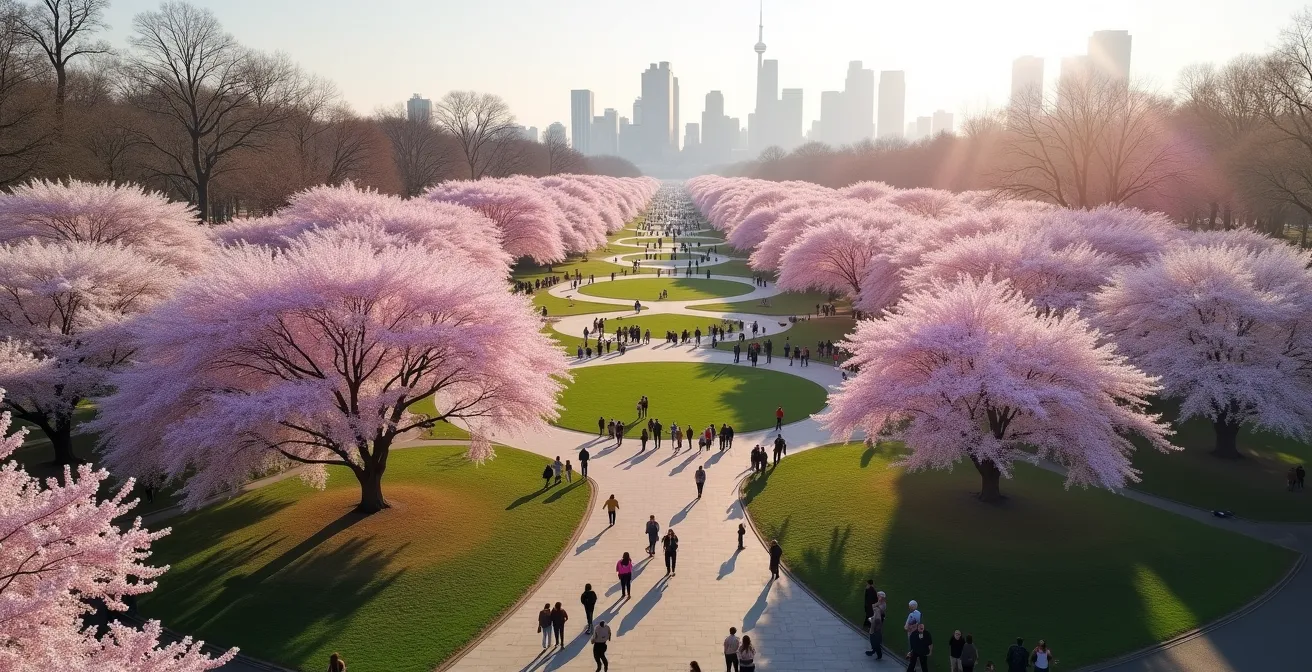
Every spring, a wave of frustration washes over Toronto drivers and families. The goal is simple: witness the breathtaking beauty of the High Park cherry blossoms. The reality, however, is a logistical nightmare of road closures, vehicle bans, and the recurring, unhelpful advice to “just take the TTC.” For those who rely on a vehicle, this period feels less like a celebration of nature and more like an annual exercise in traffic-induced anxiety. You plan your day, load up the car, and are met with barricades and a sense of exclusion.
The standard solutions feel inadequate. You know you should go early, and you know not to touch the trees. But what about the fundamental problem? How do you bridge the gap between your car and the park’s entrance when they are separated by an impenetrable wall of regulations? This isn’t just about avoiding crowds; it’s about navigating a hard operational constraint. But what if the vehicle ban isn’t an obstacle to be defeated, but a parameter to be integrated into a smarter plan?
This guide abandons the usual platitudes. It is an operational plan for drivers, reframing your vehicle as the first leg of a strategic, multi-modal journey, not the final destination. We will dissect the logistical reality of the bloom season, providing actionable intelligence on access, timing, and alternatives. By treating this not as a casual visit but as a planned operation, you can bypass the frustration and successfully complete your mission: enjoying the sakura.
This article provides a complete operational briefing for your visit. The following sections break down every critical aspect, from understanding the bloom’s fleeting nature to mastering the logistics of access and exploring strategic alternatives.
Summary: A Driver’s Operational Plan for the High Park Bloom
- Why Does the “Peak Bloom” Only Last 4 to 10 Days?
- How to Access High Park with a Wheelchair During Vehicle Bans?
- Subway to High Park Station vs. Streetcar to Parkside: Which is Less Crowded?
- The Branch-Shaking Mistake That Angers Locals and Damages Trees
- Where to Find Cherry Blossoms in Toronto That Aren’t High Park?
- Summer Garden vs. Winter Conservatory: Which Wedding Date Offers Better Value?
- Polson Pier vs. Riverdale Park: Which Offers the Superior Skyline Shot?
- Riverdale Park Winter: How to Toboggan Safely on Toronto’s Steepest Hill?
Why Does the “Peak Bloom” Only Last 4 to 10 Days?
The first operational parameter to understand is the extremely limited time window. The “peak bloom,” when over 70% of blossoms are open, is a fleeting event lasting merely 4 to 10 days. This is not an arbitrary timeline; it’s dictated by a precise and fragile biological process heavily influenced by Toronto’s specific weather conditions. The trees must accumulate a certain number of “warm-weather” hours to trigger the bloom, but a sudden cold snap can halt progress, while an unexpected heatwave can accelerate and shorten the entire display. This volatility makes long-range planning difficult.
The park’s unique geography adds another layer of complexity. Local expert “Sakura Steve” noted in an analysis for BlogTO that Toronto’s microclimates play a significant role. In one recent season, for instance, trees near Grenadier Pond bloomed 1-2 days later than those on the warmer, more protected hillsides due to Lake Ontario’s cooling effect. Furthermore, the delicate blossoms are highly vulnerable to weather. A single windy day or a spring thunderstorm can strip the branches bare overnight, prematurely ending the peak bloom and turning a 10-day window into a 4-day sprint. Understanding this fragility is key to managing expectations and planning a successful visit.
To navigate this, you must monitor the bloom’s progression through its stages:
- Day 1-3 (Stage 6 Begins): Only 10-15% of blossoms are open. This is the best time for photographers and those seeking peace, as crowds are minimal.
- Day 4-7 (Peak Bloom): 70-100% of blossoms are open. This is the classic, postcard-perfect view but coincides with massive crowds, especially on weekends.
- Day 8-10 (Petal Fall): Known as ‘sakura fubuki’ (cherry blossom blizzard), this phase offers a magical experience as petals carpet the ground.
How to Access High Park with a Wheelchair During Vehicle Bans?
The logistical reality of the peak bloom is stark: there is a 100% vehicle restriction within High Park. This is not a suggestion; it is a strict, enforced rule. No public vehicles are permitted to enter or park inside. However, there is one, and only one, critical exception to this ban: the TTC’s Wheel-Trans service. This is the only authorized method for bringing a vehicle into the park, making it the sole access plan for visitors with mobility devices.
This illustration showcases the paved, accessible pathways available within High Park, allowing visitors using wheelchairs to navigate the groves and enjoy the sakura display in a safe and welcoming environment.
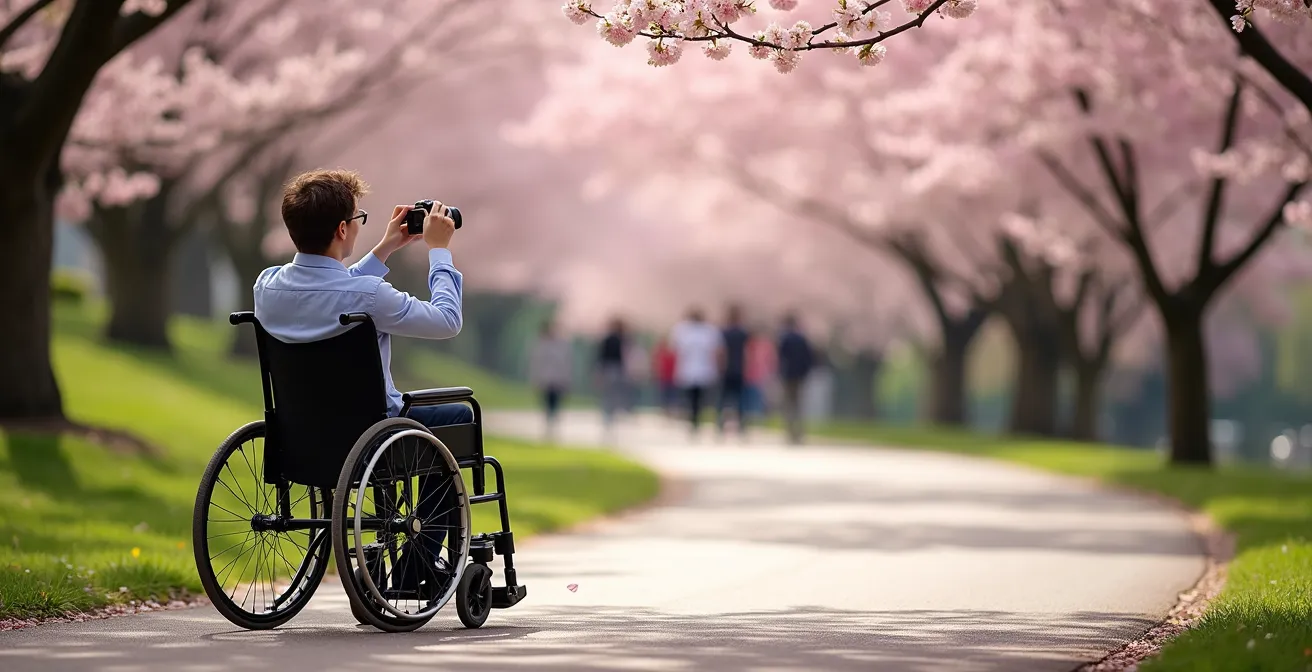
As confirmed in the TTC’s official guidelines for the cherry blossom season, Wheel-Trans vehicles are granted special permission to pass the barricades and drop off registered users at designated accessible viewing areas within the park. This service must be planned in advance and is not an on-demand taxi. It is an essential piece of infrastructure for ensuring equitable access to this public event. TTC staff are also present on-site to assist with directions and ensure a smooth experience for all visitors.
To utilize this service, a clear, step-by-step procedure must be followed:
- Step 1: Registration. If you are not already a user, you must register for Wheel-Trans service through the TTC’s online Self-Registration Portal.
- Step 2: Booking. Book your trip to High Park using the Wheel-Trans self-booking website or its dedicated mobile application. This should be done in advance.
- Step 3: Specify Destination. Clearly designate High Park as your destination. The system and drivers are aware of the special access protocols during this time.
- Step 4: On-Site Assistance. Upon arrival, do not hesitate to ask any TTC staff for assistance. They can direct you to the best and most accessible viewing spots and facilities.
Subway to High Park Station vs. Streetcar to Parkside: Which is Less Crowded?
For the majority of visitors, a multi-modal journey is not a choice but a necessity. The critical decision is selecting the most efficient “access node”—the TTC point where you transition from your car (parked elsewhere) or another transit line to the final approach on foot. The two primary nodes, High Park Station and the streetcar stops along Parkside Drive, present a classic logistical trade-off: proximity versus crowd density. High Park Station is the closest subway stop, but this convenience makes it the epicentre of crowd congestion.
A strategic choice requires analyzing the crowd dynamics and walking distances associated with each option. The following data provides a clear operational comparison to inform your plan.
This comparative analysis breaks down the pros and cons of the main transit access points for High Park during the high-traffic cherry blossom season.
| Transit Option | Walking Distance | Crowd Level | Best Time |
|---|---|---|---|
| High Park Station (Line 2) | 5 min walk | Very High | Weekdays before 10am |
| Keele Station (Line 2) | 10 min walk | Moderate | Any time |
| 506 Carlton Streetcar | Direct to park loop | Moderate | Midday weekdays |
| 508 Lakeshore Streetcar | 8 min from Parkside | Low-Moderate | Afternoons |
From a traffic coordination perspective, the data is clear. High Park Station should be avoided during peak hours (weekends and weekday afternoons) unless you are prepared for significant queuing and congestion. The superior strategic choice for most is Keele Station. The slightly longer 10-minute walk acts as a natural crowd filter, resulting in a significantly more manageable and less stressful approach to the park. Similarly, the streetcar options, particularly the 508 Lakeshore, offer a lower-density experience, though they may require a transfer depending on your starting point.
The Branch-Shaking Mistake That Angers Locals and Damages Trees
Once you have successfully navigated the logistical maze to arrive at the park, a code of conduct becomes the primary operational directive. The most severe infraction, and the one that causes the most damage and public anger, is physical contact with the trees. This includes climbing, pulling on branches for photos, or shaking them to create a personal petal shower. This behaviour is not just disrespectful; it is destructive to the trees and diminishes the experience for the tens of thousands who visit.
The reverence for these trees is rooted in a deep history of friendship and gratitude between Toronto and the Japanese community. As Robert Kadoguchi, the founding president of the Japanese Canadian Cultural Centre, explained, the original 1959 donation of 2,000 Somei-Yoshino trees was far more than a beautification project.
The gift was a tangible expression of Japan’s gratitude to Toronto for accepting us warmly during the distressing period of the Second World War.
– Robert Kadoguchi, as documented by the High Park Nature Centre
Shaking a branch, therefore, is not just a careless act; it is an insult to a profound gesture of peace and community. The trees are living symbols, and their preservation is a collective responsibility. To ensure you capture beautiful memories without causing harm, adopt ethical photography techniques that require no physical contact whatsoever.
- Use your phone’s portrait mode or a camera aperture of f/1.8-f/2.8 to create a natural background blur without needing to pull a branch closer.
- Shoot upwards from a low angle to frame the blossoms against the sky. This creates a clean, beautiful shot that emphasizes the flowers.
- Be patient and wait for the wind. A natural breeze will create the dynamic movement and falling petals you want for a video or photo.
- Use a telephoto lens (70-200mm) to compress the perspective and isolate a cluster of blooms from a distance.
- Photograph the fallen petals on the ground or on the water of Grenadier Pond for unique and artistic compositions.
Where to Find Cherry Blossoms in Toronto That Aren’t High Park?
The most effective logistical strategy for a driver is often to avoid the problem area entirely. The intense focus on High Park creates a massive bottleneck, while numerous other locations across Toronto offer beautiful cherry blossom displays with significantly fewer crowds and, most critically, available parking. Executing a “strategic retreat” to an alternative site can provide a more enjoyable and less stressful experience for families, photographers, and anyone looking to avoid the operational chaos of High Park.
One of the top alternative destinations is Centennial Park in Etobicoke. It hosts Toronto’s second-largest collection of over 200 cherry trees. The main grove is located near Rathburn Road and Centennial Park Boulevard, offering a beautiful spectacle with the immense benefit of free on-site parking and far lower crowd levels. For a driver, this is a vastly superior logistical option. This illustration of the Toronto Islands provides another example of a serene alternative, where the blossoms frame the city skyline.
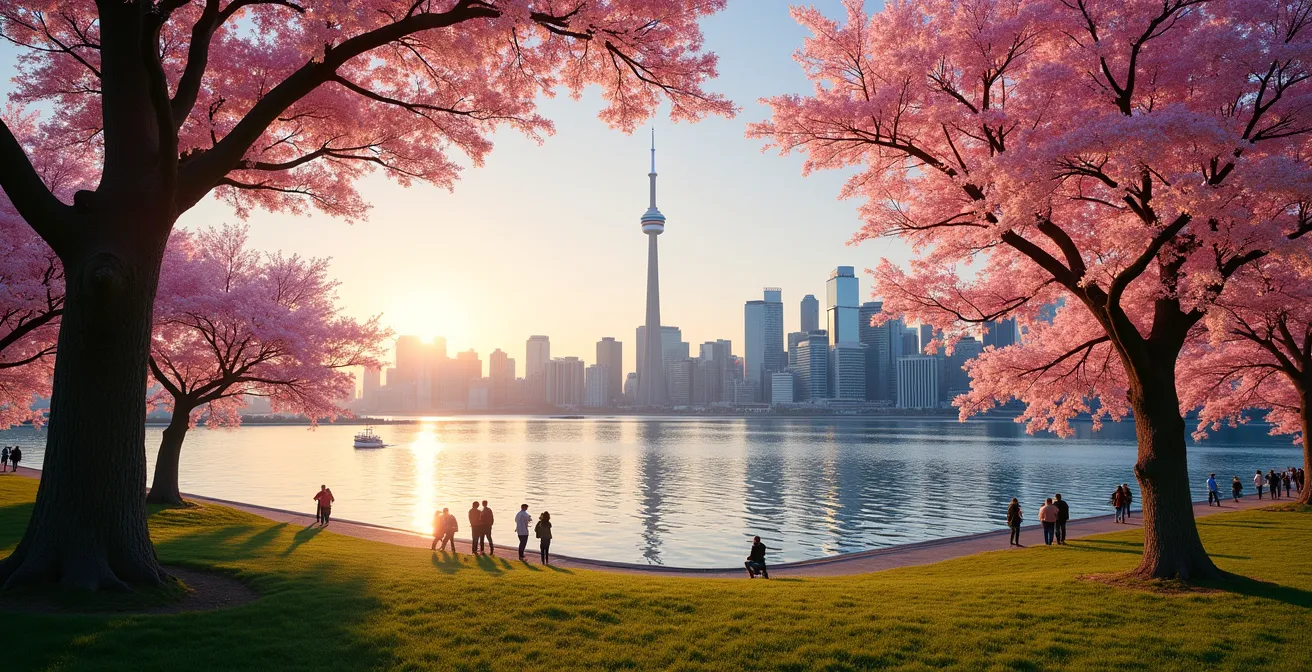
To make an informed decision, a logistical comparison of the main alternatives is essential. The following scorecard evaluates key locations based on tree count, transit access, crowd levels, and the all-important parking situation.
This table offers a logistical scorecard for alternative cherry blossom viewing locations across Toronto, focusing on factors crucial for planning a visit.
| Location | Tree Count | TTC Access | Crowd Level (1-5) | Parking |
|---|---|---|---|---|
| Trinity Bellwoods Park | 38 trees | 511 Bathurst streetcar | 3/5 | Street parking only |
| Toronto Islands | 30 trees | Ferry from Jack Layton Terminal | 2/5 | N/A |
| Robarts Library (UofT) | 70 trees | St. George Station | 2/5 | Paid campus parking |
| York University | 250 trees | Pioneer Village Station | 1/5 | Free visitor parking |
Summer Garden vs. Winter Conservatory: Which Wedding Date Offers Better Value?
While this section title references weddings, the underlying question of “value” is critically relevant to any visitor. Is the high-stress, high-crowd experience of the ten-day cherry blossom bloom truly the best “value” High Park has to offer? From a logistical and experiential standpoint, the answer is often no. The intense focus on the sakura overlooks the fact that High Park is a vast, year-round destination. The park offers much more than cherry blossoms across its 399 acres of diverse parkland, including a zoo, extensive trail systems, and beautiful gardens that peak in other seasons.
A cost-benefit analysis of visiting during different times of the year reveals a stark contrast. The cherry blossom season offers a unique spectacle but comes at the cost of extreme crowds, access restrictions, and a very limited activity set. In contrast, a visit during the summer or fall provides a much more relaxed and varied experience for the same price of entry: free.
This analysis compares the overall experience value of visiting High Park during the frantic cherry blossom season versus other, more relaxed times of the year.
| Season | Cost | Crowds | Activities | Experience Value |
|---|---|---|---|---|
| Cherry Blossom (Late April) | Free entry | Extremely high | Blossom viewing only | High stress, limited time |
| Summer (June-August) | Free entry | Moderate | Zoo, splash pads, picnics, trails | Relaxed, full-day experience |
| Fall (October) | Free entry | Low | Fall colours at Grenadier Pond | Peaceful, photography-friendly |
| Winter (December-February) | Free entry | Very low | Greenhouse visits, winter trails | Serene, contemplative |
For families with children or anyone seeking a peaceful day in nature, the summer months offer far greater value with access to splash pads, the zoo, and ample space for picnics. For photographers, the fall provides stunning colours with a fraction of the crowds. By de-coupling your visit from the sakura frenzy, you can enjoy the full breadth of what the park has to offer without the logistical battle.
Polson Pier vs. Riverdale Park: Which Offers the Superior Skyline Shot?
While Polson Pier and Riverdale Park are Toronto’s undisputed champions for a classic skyline photograph, the question changes when the objective is to capture the cherry blossoms. A superior shot in this context requires either integrating the blossoms with the cityscape or finding unique, compelling angles within High Park itself. For the former, neither Polson Pier nor Riverdale Park is the answer. The best location for combining the CN Tower and cherry blossoms in a single frame is actually Broadview Park. This lesser-known vantage point in the Beaches allows photographers to frame the downtown skyline through a foreground of blooming trees, a composition that High Park simply cannot offer.
However, for those who have made the journey into High Park, the mission shifts to capturing the best possible images within the park’s boundaries. This requires moving beyond the obvious, crowded clearings and seeking out advanced angles that tell a more interesting story. A skilled operator knows where to position themselves for maximum effect with minimal interference. These advanced positions can yield professional-quality results while avoiding the main throngs of visitors.
Here are several advanced angles to capture superior shots within High Park:
- Grenadier Pond West Side: Use a telephoto lens (70-200mm) from the western shore. This allows you to compress the perspective, layering the blossoms, the crowds, and the pond for a dynamic, deep composition.
- Hillside Gardens Upper Path: Go in the early morning (8-9 am) when the sun is behind the blossoms. This backlighting creates a beautiful, translucent glow in the petals.
- Cherry Hill Summit: Position yourself near the Grenadier Cafe and use a wide-angle lens (24mm) to capture the entire expanse of the main grove in a single, sweeping landscape shot.
- Jamie Bell Playground Path: This quieter, lesser-known trail offers unique low-angle perspectives up into the canopy with far fewer people in your frame.
Key takeaways
- The vehicle ban in High Park is absolute; plan for a multi-modal journey starting with parking away from the park.
- The TTC’s Wheel-Trans is the only vehicular access permitted and must be booked in advance for those with mobility needs.
- Choosing a less-congested access point like Keele Station or visiting an alternative location like Centennial Park are superior strategies for drivers.
Riverdale Park Winter: How to Toboggan Safely on Toronto’s Steepest Hill?
The title of this section invokes a winter challenge, but the true “steepest hill” for a Toronto family to climb is navigating the logistical mountain of a peak bloom visit to High Park. The operation is fraught with potential pitfalls, from navigating immense crowds to managing family needs in a restricted environment. The cherry blossoms attract tens of thousands of visitors annually, creating a density that requires a clear and comprehensive operational plan to ensure a safe and positive experience. Success is not accidental; it is the result of meticulous preparation.
Failing to plan for this environment can lead to stress, anxiety, and a ruined day. A forgotten water bottle, a dead phone battery, or a lost child can quickly turn a beautiful outing into a crisis. Therefore, a final pre-mission checklist is not just helpful; it is essential. It ensures all foreseeable contingencies are accounted for before you even leave the house. This checklist is your final go/no-go review before embarking on your visit.
Your Final Pre-Visit Operational Checklist
- Pack Essentials: Confirm you have a portable phone charger, full water bottles, snacks, hand sanitizer, and sunscreen. These are non-negotiable for a long day.
- Verify Navigation: Download offline park maps to your phone. Take screenshots of your planned TTC routes and the locations of public washrooms. Do not rely on cell service.
- Establish Rally Points: Designate a clear, unmistakable family meeting point (e.g., the front entrance of the Grenadier Cafe) in case of separation.
- Confirm Timing: Re-check the bloom status. Plan to arrive before 10 am on weekdays or after 5 pm on any day for the lowest crowd density. Commit to your timeline.
- Identify Quiet Zones: Mentally note the locations of less-crowded areas, such as the trails west of Grenadier Pond or the Duck Pond, as potential zones for de-stressing if the main groves become overwhelming.
This checklist transforms you from a casual visitor into a prepared operator. By systematically preparing for the known challenges of the environment, you significantly increase the probability of a smooth and enjoyable experience for your entire group.
With this operational plan, you are now equipped to make an informed, strategic decision. The next step is to choose your strategy: brave High Park with a solid multi-modal plan or opt for a stress-free visit to an alternative location.
Frequently Asked Questions About Navigating the High Park Bloom
How do I keep track of children in dense crowds?
Use bright colored clothing for high visibility. Consider writing your phone number on their arm with a skin-safe marker. Before entering the busiest areas, establish a clear and simple meeting point, like the main entrance to the Grenadier Cafe, and ensure they know to go there if you get separated.
Where can I find moments of quiet during peak times?
To escape the most intense crowds, head towards the native plant gardens, the trails around Spring Creek, or the paths located on the western side of Grenadier Pond. These areas are typically much less congested than the main cherry tree groves and offer pockets of tranquility.