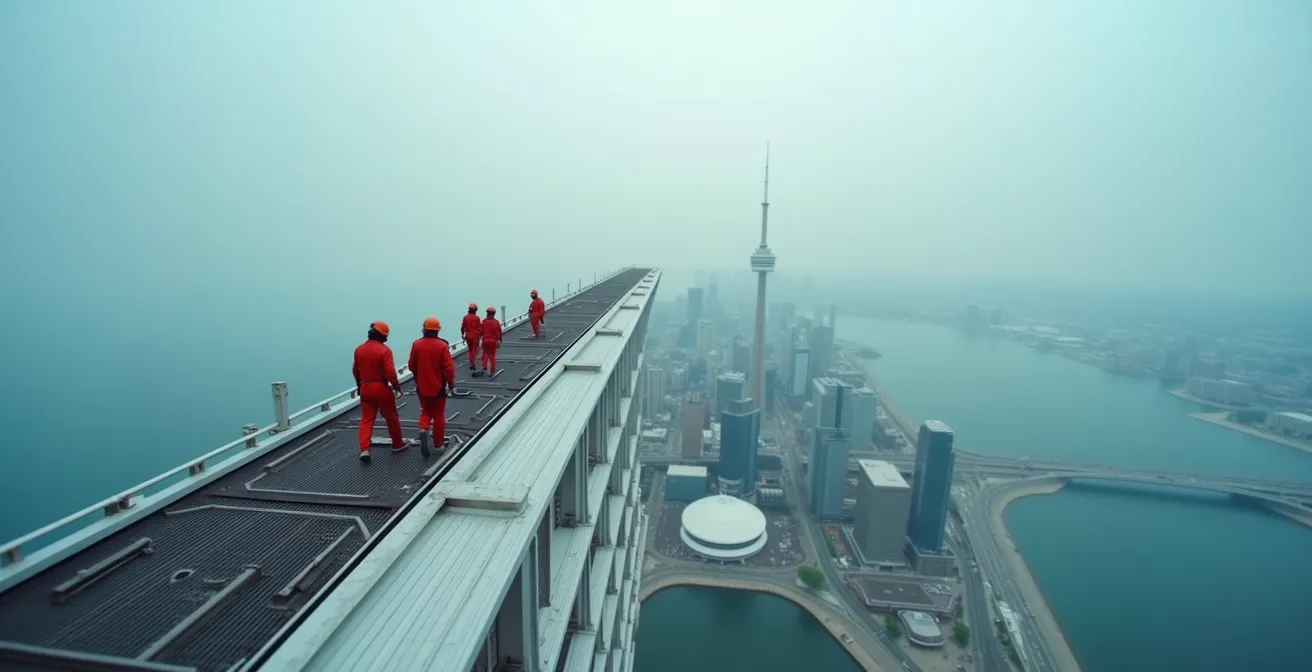
The $200+ EdgeWalk ticket is worth the price, but not just for the 30-minute thrill—its true value lies in the meticulously engineered safety and the bundled VIP access to the CN Tower.
- It’s statistically safer than your drive to the tower, a testament to its world-class safety engineering.
- The ticket includes line-skipping privileges and full Tower Experience access, representing a hidden value of over $53.
- The experience is psychologically designed to help you master fear, offering a genuine sense of accomplishment, not just a scare.
Recommendation: Evaluate the price not as a single expense for a walk, but as a full-day, queue-jumping VIP package for Toronto’s most iconic landmark.
That $200+ price tag for a 30-minute walk around the top of the CN Tower hangs in the air, almost as high as the platform itself. For thrill-seekers and gift-givers, the question is sharp: is this the ultimate Toronto bucket-list item, or is it an overhyped tourist trap? Many will tell you the views are incredible and that it’s a “once-in-a-lifetime” experience. But that doesn’t really help you decide if it’s a sound investment of your hard-earned cash.
Most reviews focus on the feeling of fear or the beauty of the skyline. They treat the experience as a simple transaction: money for adrenaline. But what if that’s the wrong way to look at it? What if the real value isn’t just in the scare, but in the meticulous psychological and safety engineering designed to help you conquer that fear? This isn’t just about dangling 356 metres above Toronto; it’s about understanding the vast, calculated gap between your perceived risk and the statistical reality of your safety.
This guide deconstructs the EdgeWalk value proposition. We’ll analyze the safety systems that make it safer than city driving, explore the mental techniques to transform terror into triumph, and break down the hidden financial perks that are often overlooked. By the end, you’ll be able to judge the price not on the thrill alone, but on the total, engineered experience it delivers.
To help you make a fully informed decision, this article breaks down every critical aspect of the EdgeWalk experience, from its unparalleled safety to the strategic mistakes you must avoid. Explore the sections below to get a complete picture.
Summary: Deconstructing the EdgeWalk Experience and Value
- Why is the EdgeWalk Harness System Statistically Safer Than Driving?
- How to Overcome the Fear of Heights Before Stepping Onto the Ledge?
- Day Walk vs. Night Walk: Which Offers the More Intense Visual Experience?
- The Shoe Mistake That Will Get You Banned from the EdgeWalk Deck
- How to Pose for the EdgeWalk Photos to Look Brave Instead of Terrified?
- The Elevator Mistake That Can Ruin Your Experience Before It Starts
- The E. Coli Mistake: Swimming in the Harbour After a Heavy Rainfall
- Visiting the CN Tower: How to Skip the 2-Hour Line on Weekends?
Why is the EdgeWalk Harness System Statistically Safer Than Driving?
The feeling of wind whipping past you 116 storeys above Toronto is designed to feel dangerous. Your brain screams “risk,” but the reality is a story of obsessive engineering. To put it in a local context, your drive to the CN Tower is statistically more hazardous. The province has a rate of just 3.4 fatalities per billion vehicle-kilometres in Ontario. The EdgeWalk, with its perfect safety record, sits at zero. This isn’t luck; it’s the result of a safety protocol that borders on paranoia.
The experience is built on a foundation of triple redundancy and constant verification. Before you even step outside, your harness is checked nearly 10 times by at least 4 different team members. You are tethered to the overhead rail by two connection points. The main front rope is strong enough to hold the weight of an elephant, and it’s backed up by a secondary safety clip. This system isn’t just checked occasionally; it’s a relentless cycle of oversight.
Consider the inspection schedule: daily checks by the on-site team, weekly reviews by engineers, and comprehensive, third-party X-ray inspections of every single component on a yearly basis. Every bolt, every cable, every carabiner is scrutinized to a level far beyond what most public infrastructure endures. The “danger” of EdgeWalk is a carefully crafted illusion; the safety is a statistical certainty.
How to Overcome the Fear of Heights Before Stepping Onto the Ledge?
Knowing you are safe and feeling safe are two different things. EdgeWalk’s brilliance lies in its psychological design, which guides you from terror to exhilaration in under 30 minutes. Your guide is trained not just in safety, but in fear management. They don’t just clip you in; they coach you through the process of fear acclimatization, where your brain gradually accepts the bizarre new reality.
One of the first challenges they give you is “Toes Over Toronto,” a simple exercise to lean forward over the edge. It acts as a gradual warm-up, teaching your mind that leaning into the void is secure. The key is to focus on the horizon—the vast expanse of Lake Ontario or the distant Scarborough Bluffs—rather than looking straight down. This simple trick reduces the sense of vertigo and helps you gain a feeling of control.
This is a journey you can prepare for, as a former acrophobe who conquered the walk explains. Their experience shows the power of mindset:
I am one of those people who grew up in Toronto and yet has never been up the CN Tower. My fear of heights also once left me stranded just three feet up a rock climbing wall. I was ready to be writing through blubbering tears of anxiety or from beyond the grave. But, having braved the CN Tower’s EdgeWalk, I really encourage anyone who’s maybe a little fearful to give it a try.
The final step is reframing your inner monologue. Instead of thinking “I’m so high and scared,” guides encourage you to adopt a power stance and think, “I own this city.” This cognitive shift is surprisingly effective, changing your body language and turning a passive experience of fear into an active moment of empowerment.
Day Walk vs. Night Walk: Which Offers the More Intense Visual Experience?
Choosing between a day or night EdgeWalk is a critical decision that tailors the intensity of your experience. It’s a choice between clarity and drama, expansive views and electric energy. Neither is definitively better; they simply offer two vastly different psychological and visual rewards.
The day walk is about scale and geography. On a clear day, the visibility is astonishing, stretching as far as Niagara Falls. You can trace the curve of the Scarborough Bluffs and see boats as tiny specks on the vast blue canvas of Lake Ontario. This is the choice for first-timers who want to grasp the full, sprawling layout of Toronto and its surroundings. The photos are clearer, capturing your facial expressions against a bright, detailed backdrop.
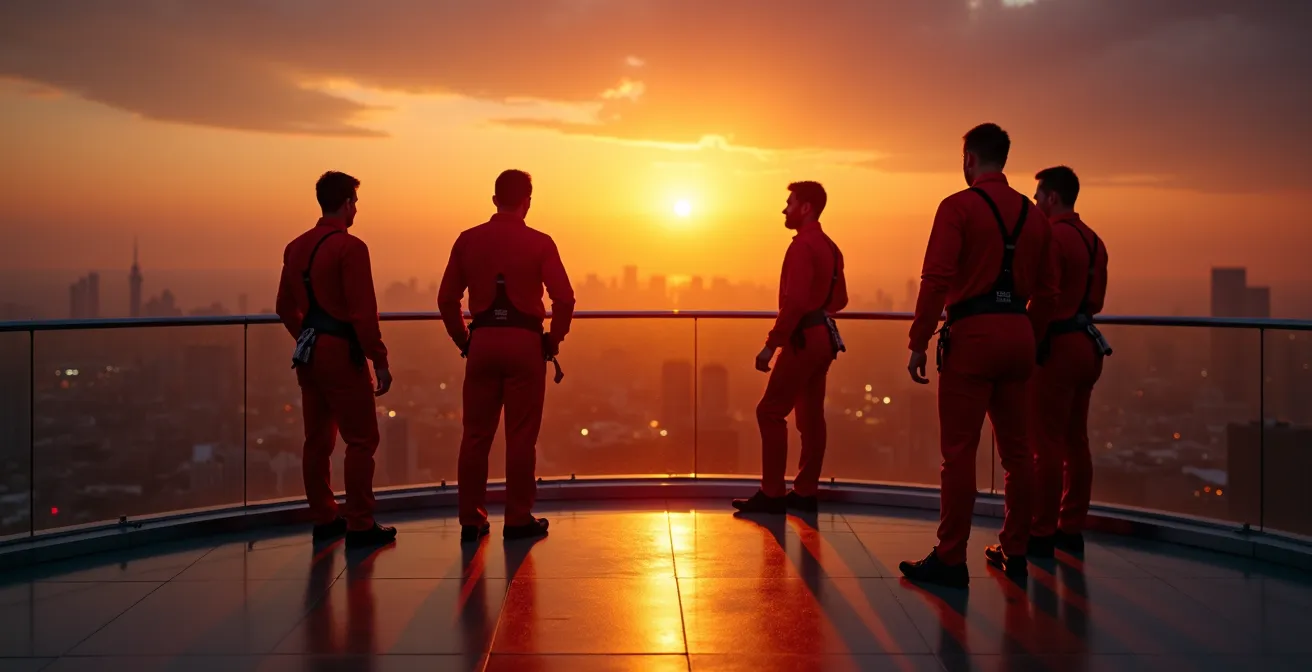
The night walk, however, is an entirely different beast. It’s an immersion into a living, breathing network of light. The city transforms into glowing neighbourhoods, with the buzz of the Entertainment District and the illuminated Rogers Centre right below your feet. The wind off the lake can be more biting, adding a physical intensity to the visual drama. Photos at night are striking, with your silhouette against the glowing city creating a more abstract, artistic memory of the event.
To help you decide which brand of intensity suits you best, this comparison breaks down the key differences:
| Aspect | Day Walk | Night Walk |
|---|---|---|
| Visibility | Can see as far as Niagara Falls on clear days | City lights create glowing neighborhoods |
| Photo Quality | Better for facial expressions and clarity | Dramatic ‘glowing city’ backdrop |
| Temperature | Warmer, with sun exposure | Cooler with biting wind off Lake Ontario |
| Landmarks Visible | Scarborough Bluffs, Toronto Islands, Lake Ontario expanse | Entertainment District buzz, illuminated Rogers Centre |
| Best For | First-timers wanting maximum visibility | Photography enthusiasts seeking dramatic shots |
The Shoe Mistake That Will Get You Banned from the EdgeWalk Deck
In an environment as tightly controlled as EdgeWalk, there is zero tolerance for anything that could compromise the safety system. While you might focus on the harness and ropes, the single most common reason participants are delayed or even initially barred from entry is their footwear. The wrong shoes are a non-starter, and showing up with them can throw off your entire schedule.
The rule is simple and absolute: you must wear fully enclosed, lace-up footwear. Standard running shoes or secure athletic shoes are perfect. Any open-toed shoes, sandals, flip-flops, Crocs, or slip-on shoes like loafers are strictly forbidden. There are no exceptions. This isn’t an aesthetic choice; it’s to ensure a secure footing on the metal grating and to guarantee that nothing can accidentally slip off and fall from 356 metres.
The staff performs multiple safety checks, and shoe verification is one of the very first. They are looking for a shoe that is securely fastened to your foot and cannot come off under any circumstance. If you arrive with inappropriate footwear, you won’t be sent home, but you will be delayed. EdgeWalk can provide loaner shoes, but this takes extra time and adds a layer of hassle right when your nerves are already kicking in.
For visitors to Toronto, it’s wise to plan ahead. If you don’t have suitable shoes, shopping centres like the Eaton Centre or the stores along Queen Street West are within a 15-minute walk and offer plenty of athletic footwear options. Making a quick stop there before heading to the tower is far better than being flagged at the check-in gate.
How to Pose for the EdgeWalk Photos to Look Brave Instead of Terrified?
The photos are a huge part of the EdgeWalk package, proof that you conquered the tower. But there’s a fine line between looking like a superhero and a person in the midst of a panic attack. The key to epic photos is body language, and much like overcoming the fear itself, it’s a skill you can learn in minutes. The guides are excellent photographers and will direct you, but having a few poses in mind will make all the difference.
Your goal is to project confidence, even if you’re faking it. Start with simple, strong poses to build momentum. The “tightrope walker” with arms outstretched is a classic starting point. It naturally opens up your posture and creates a sense of balance and control. From there, you can progress to the more daring moves. For the backward lean, the most dramatic shots happen when you briefly let go of the safety rope and trust the harness completely. A moment of release translates into a powerful photo.
Interestingly, many people find the “Superman” forward lean to be the least scary pose, as you are facing forward and can see where you’re going. This pose, leaning out over the city, is often the one that produces the most triumphant expressions. Remember to think “I own this city.” This thought instantly changes your posture, lifts your chin, and puts a look of determination on your face instead of terror.
Your Action Plan: Posing for Epic EdgeWalk Photos
- Start with confidence: Use the ‘tightrope walker’ pose with arms outstretched to establish balance and a strong posture.
- Commit to the lean: For the backward lean, briefly let go of the cable. Trusting the harness creates a much more dramatic and impressive photo.
- Embrace the ‘Superman’: Try the forward lean. It’s often less intimidating and results in a powerful, city-conquering shot.
- Frame your shot: Use distant landmarks like BMO Field or Billy Bishop Airport as your focal point to ensure a perfect Toronto skyline backdrop.
- Master your mindset: Actively think ‘I own this city’ instead of ‘I’m high up’. This mental switch immediately improves your body language and expression.
As one travel blogger noted after her experience, the transformation from fear to fun can be surprisingly quick when you engage with the challenge:
By the time our half hour on the tower was done I would’ve been happy to hang out there all afternoon
– Travel blogger, Suitcase and Heels EdgeWalk Review
The Elevator Mistake That Can Ruin Your Experience Before It Starts
The EdgeWalk experience is a tightly orchestrated 90-minute event, with only 30 of those minutes spent outside. Your ticket is valid for a specific time slot, and missing it can jeopardize your entire booking. The most common scheduling mistake visitors make is underestimating the pre-walk logistics and failing to arrive on time. The golden rule is to arrive at least 30 minutes prior to your scheduled walk.
One of the key perks of an EdgeWalk ticket is that you get to bypass all general admission and ticketing lines for the CN Tower. You proceed directly to the main entrance for check-in. However, this advantage is lost if you’re late. A late arrival creates a domino effect of stress, forcing the staff to rush your safety briefing and potentially delaying the next group. While they are accommodating, the schedule is firm.
It’s important to understand the ticket policy: your purchase is for a specific time and date and is generally non-refundable. While the CN Tower allows changes to be made 72 hours or more in advance, last-minute issues like Toronto traffic or subway delays are your responsibility. Aiming to be at the base of the tower 45 minutes early is a stress-free strategy, giving you plenty of buffer time.
Remember, the complete EdgeWalk experience timeline includes several indoor stages before you even see the sky: check-in, security screening, a breathalyzer test, changing into your walk suit, and multiple harness checks. These steps cannot be skipped. Rushing through them because you were late diminishes the sense of calm and preparation the staff works so hard to build.
The E. Coli Mistake: Swimming in the Harbour After a Heavy Rainfall
On the surface, this has nothing to do with EdgeWalk. But it has everything to do with how we perceive risk and value in Toronto. When you pay for EdgeWalk, you are paying a premium for a perfectly controlled risk. Every variable is managed, monitored, and mitigated. Now, consider a “free” summer activity: taking a dip in the Toronto Harbour. After a heavy rainfall, this carries a significant, invisible, and uncontrolled risk: E. coli contamination.
This stark contrast is central to understanding the EdgeWalk value proposition. The fear you feel on the ledge is a psychological illusion. The danger of swimming in the harbour after a storm, however, is a very real biological threat. The city’s aging sewer system can overflow into the lake, causing E. coli levels to spike to unsafe levels, a fact that swimmers must independently verify through public health reports.
You pay for EdgeWalk’s certainty. You know the equipment has been X-rayed and the staff is expertly trained. With a “free” swim, you are on your own, gambling on water quality reports and the timing of the last storm. The potential cost isn’t a ticket price, but a nasty infection and medical bills.
This table puts the two types of Toronto “thrills” side-by-side, highlighting the difference between a manufactured thrill and an accidental hazard:
This comparison is a powerful lens through which to view the cost, as detailed in a recent analysis of controlled versus uncontrolled risks.
| Risk Factor | EdgeWalk (Controlled) | Harbour Swimming (Uncontrolled) |
|---|---|---|
| Safety Inspections | Daily team checks, weekly engineering reviews | Variable water quality, especially after rain |
| Predictability | Equipment X-rayed yearly, triple-redundant systems | E. coli levels spike unpredictably post-storm |
| Cost Transparency | $199+ all-inclusive with safety guaranteed | Free but potential medical costs if infected |
| Professional Oversight | Trained guides, multiple safety checks | Self-monitored, no supervision |
| Risk Communication | Clear safety briefing and protocols | Must check SwimSafe reports independently |
Key Takeaways
- EdgeWalk’s value is not just the thrill, but the combination of engineered safety, psychological coaching, and bundled CN Tower access.
- The experience is statistically safer than driving in Toronto, thanks to obsessive, multi-layered inspection protocols.
- The ticket price includes a “fast pass” to the entire Tower, representing a significant hidden financial saving and turning it into a full-day experience.
Visiting the CN Tower: How to Skip the 2-Hour Line on Weekends?
This is perhaps the most misunderstood part of the EdgeWalk value proposition. The $200+ ticket is not just for the 30-minute walk. It’s a golden ticket to the entire CN Tower that lets you bypass the notoriously long queues. On a busy weekend, the general admission line can easily stretch to two hours. By booking EdgeWalk, you are essentially buying a VIP pass that grants you immediate access.
Let’s break down the financial arbitrage. The EdgeWalk pricing includes the full “Tower Experience” ticket, which itself is valued at over $53. This ticket grants you access to the main observation levels, including the world-famous Glass Floor. Furthermore, EdgeWalk participants often receive complimentary access to the SkyPod, the higher observation deck, which would be an additional upgrade cost. When you subtract these built-in values from the EdgeWalk price, the cost for the walk itself becomes significantly more reasonable.
To maximize this value, you need a strategy. Don’t just do the walk and leave. Plan your visit to leverage the included access after your EdgeWalk is complete. By booking an early morning walk, you avoid the biggest crowds and can then enjoy the rest of the tower at your leisure while others are still waiting in line outside.
Here is a strategic itinerary for an EdgeWalker:
- Book your EdgeWalk for an early morning slot, especially on a weekend.
- Arrive 30 minutes early, bypass all ticketing lines, and go straight to the Main Entrance for your check-in.
- Complete your 90-minute EdgeWalk experience.
- Immediately after, use your included Tower Experience ticket to explore the Glass Floor and main observation decks.
- Visit the SkyPod using your complimentary access.
- As an added bonus, your ticket often allows for re-admission within a certain timeframe, letting you see the city by day and night if you plan accordingly.
This turns a 90-minute activity into a half-day or even full-day premium experience, completely changing the cost-benefit analysis.
Ultimately, reframing the question is key. It’s not about whether 30 minutes of adrenaline is worth over $200. It’s whether a meticulously engineered, psychologically rewarding, line-skipping, all-access premium pass to one of the world’s most famous landmarks is worth it. For those who value their time and appreciate the art of a controlled thrill, the answer is a resounding yes. Your next step is to choose your date and prepare for an experience that’s far more than just a walk on the wild side.
Frequently Asked Questions About the CN Tower EdgeWalk
What type of shoes are required for EdgeWalk?
You must wear running shoes or similarly enclosed, lace-up footwear. According to the official guidelines on the CN Tower website, open-toed shoes, sandals, or slip-ons are not permitted for safety reasons.
What if I don’t have proper shoes?
Don’t worry if you arrive unprepared. EdgeWalk can provide appropriate footwear for you to use during your experience to ensure you don’t miss out.
Can you do EdgeWalk in the rain?
EdgeWalk operates in most weather conditions, including rain, as the suits are water-resistant. However, walks are subject to cancellation or postponement in cases of high winds, lightning, or other extreme weather conditions, as safety is the absolute top priority.
Where can I buy compliant shoes near CN Tower?
If you need to purchase shoes, the Eaton Centre and the shops along Queen Street West are both within a 15-minute walk of the CN Tower and offer numerous athletic footwear stores.