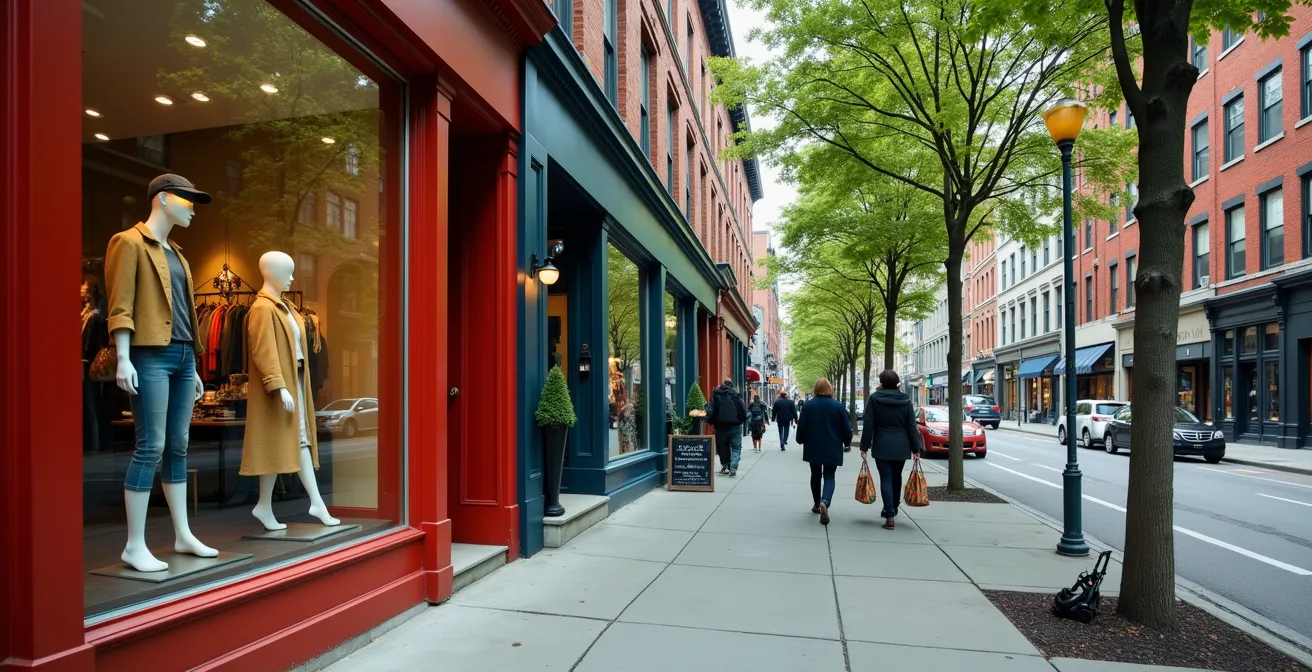
Supporting local on Queen West now requires a strategy, not just a stroll; your choices can directly preserve Toronto’s creative soul.
- Skyrocketing commercial rents are pushing authentic designers to neighbouring areas like Parkdale, changing the face of the core strip.
- “Local” boutiques can be deceptive, often selling rebranded fast fashion. Learning to spot the difference is crucial for impactful shopping.
Recommendation: Adopt a ‘conscious navigation’ mindset. Plan your route, question labels, and use tools to verify authenticity before you buy.
There’s a palpable tension on Queen Street West. What was once the undisputed epicentre of Toronto’s independent fashion and counter-culture now feels like a battleground. For every one-of-a-kind boutique, a global chain seems to rise, creating a homogenized landscape that threatens the very creativity that made the street famous. Conscious shoppers arrive wanting to support the city’s artists, but are met with a confusing mix of true local design, vintage, fast fashion, and clever imitations. The old advice to simply “walk the strip” is no longer enough.
Many guides will point you to the big names or offer vague tips like “look for ‘Made in Canada’ tags.” But this approach misses the bigger picture. It doesn’t address the economic squeeze forcing designers out, nor does it arm you against the rise of “retail camouflage”—boutiques selling mass-produced goods at an artisan premium. But what if the key to preserving Queen West’s spirit isn’t just about where you shop, but a fundamental shift in *how* you shop? What if becoming a conscious navigator is the most powerful tool you have?
This guide offers a new framework. We will explore the forces reshaping the neighbourhood, from rising rents pushing talent westward to the subtle art of spotting greenwashing. We will provide you with the tools to distinguish true local craftsmanship from deceptive fast fashion, and map out a strategy to explore the area with purpose and efficiency. It’s time to move beyond casual browsing and become an active participant in sustaining Toronto’s creative lifeblood.
This article provides a strategic path for navigating Toronto’s most iconic shopping district. The following sections break down the challenges and provide actionable solutions for the conscious shopper.
Summary: A Strategic Guide to Shopping Queen West and Beyond
- Why Are Independent Boutiques Moving to Parkdale?
- How to Tell if a “Made in Toronto” Label is Greenwashing?
- Vintage on Queen vs. New Local Design: Which Has a Lower Carbon Footprint?
- The “Boutique” Mistake: Buying Rebranded Alibaba Goods at Premium Prices
- How to Shop West Queen West to Ossington in One Afternoon Efficiently?
- Why Are Traditional Shops Disappearing from Little Italy?
- How to Navigate the Toronto Outdoor Art Fair to Find Hidden Gems?
- Eating Organic in Kensington Market: How to Fill Your Basket for Under $60?
Why Are Independent Boutiques Moving to Parkdale?
If you’ve noticed a subtle shift in the creative energy along Queen West, you’re not imagining it. The raw, independent spirit is migrating westward, and the primary driver is a stark economic reality. The ‘For Lease’ signs that pop up between global brand flagships tell a story of an intense economic squeeze. For small-scale designers and boutique owners, the cost of doing business on the main stretch has become untenable. The dream of a Queen West storefront is increasingly at odds with financial survival.
The numbers paint a clear picture. While data varies by exact location, the pressure is immense; according to Toronto Regional Real Estate Board data, commercial retail lease rates averaged $22.13 per square foot across the city in mid-2024, with prime locations like Queen West commanding significant premiums. This financial barrier is what makes neighbourhoods like Parkdale so appealing. It’s not just about cheaper rent; it’s about finding a community that actively fosters small business growth.
Organizations like the Parkdale Village BIA are a significant pull factor. They work to create a supportive ecosystem for tenants, offering programs and advocacy that are a lifeline for independent entrepreneurs. By establishing themselves in Parkdale, designers aren’t just escaping high rents; they are joining a collective of like-minded businesses focused on creating a thriving, competitive, and safe local economy. This westward shift represents a resilient adaptation, a search for a sustainable creative epicenter where artistry can still flourish without being crushed by overhead.
How to Tell if a “Made in Toronto” Label is Greenwashing?
In an era of conscious consumerism, the “Made in Toronto” label has become powerful marketing. But its power also makes it a prime target for greenwashing, where brands create a misleading impression of local, sustainable production. A simple tag is no longer enough; a savvy shopper must become a detective. True local production is about more than just a final stitch—it’s about a transparent supply chain, ethical labour practices, and a genuine connection to the city’s creative community. Separating authentic artisans from clever marketers is the first step in making your support count.
Brands that are genuinely committed to sustainability and local ethics often seek external validation. As Kristi Soomer, founder of the sustainable brand Encircled, explained in an investigation by Global News Canada, this commitment goes deep. It’s a philosophy embedded in the company’s core.
As a B Corp we’re certified in our bylaws to put people and the planet above profits. So, the paper we’re printing on, the cleaning products we use in our office — every detail around our business model has to be sustainable from how we pay our employees, to how we pay our suppliers, to how we interact with them.
– Kristi Soomer, Global News Canada – Fashion Greenwashing Investigation
This level of dedication is what separates a truly ethical brand from one using “local” as a buzzword. Vague claims are a red flag. True Toronto designers can tell you exactly where their studio is, who their partners are, and what materials they use. If a salesperson is evasive, trust your instincts. The following checklist can help you vet brands in real-time and ensure your money is supporting real local talent.
Your Toronto Authenticity Checklist: 5 Steps to Verify a Brand
- Verify manufacturing: Check if their sewing studios are within a 35km radius of Toronto, a model used by authentically local brands.
- Look for certifications: Ask about B Corp status or other third-party ethical certifications, which are rigorous and hard to obtain.
- Ask about community: Inquire if they mention connections to local artisan collectives, OCAD University alumni, or Toronto Design Offsite Festival.
- Request specifics: Ask staff for the designer’s name and the specific location of their Toronto-based studio.
- Cross-reference: Use your phone to check their name against databases like the Made in Canada directory or local artisan market listings.
Vintage on Queen vs. New Local Design: Which Has a Lower Carbon Footprint?
For the conscious shopper, the choice on Queen West often boils down to two ethical options: supporting the circular economy by buying vintage or investing in a new piece from a local designer. Both are vastly superior to fast fashion, an industry notorious for its environmental impact. Globally, the fashion industry is responsible for about 10% of global carbon emissions, a staggering figure driven by overproduction and disposable trends. Choosing either vintage or local design is a vote against this system, but they have distinct ethical footprints.
The image below captures this core dilemma: on one side, the rich, textured history of vintage garments waiting for a new life; on the other, the clean, focused creation of a new piece by a local artisan.
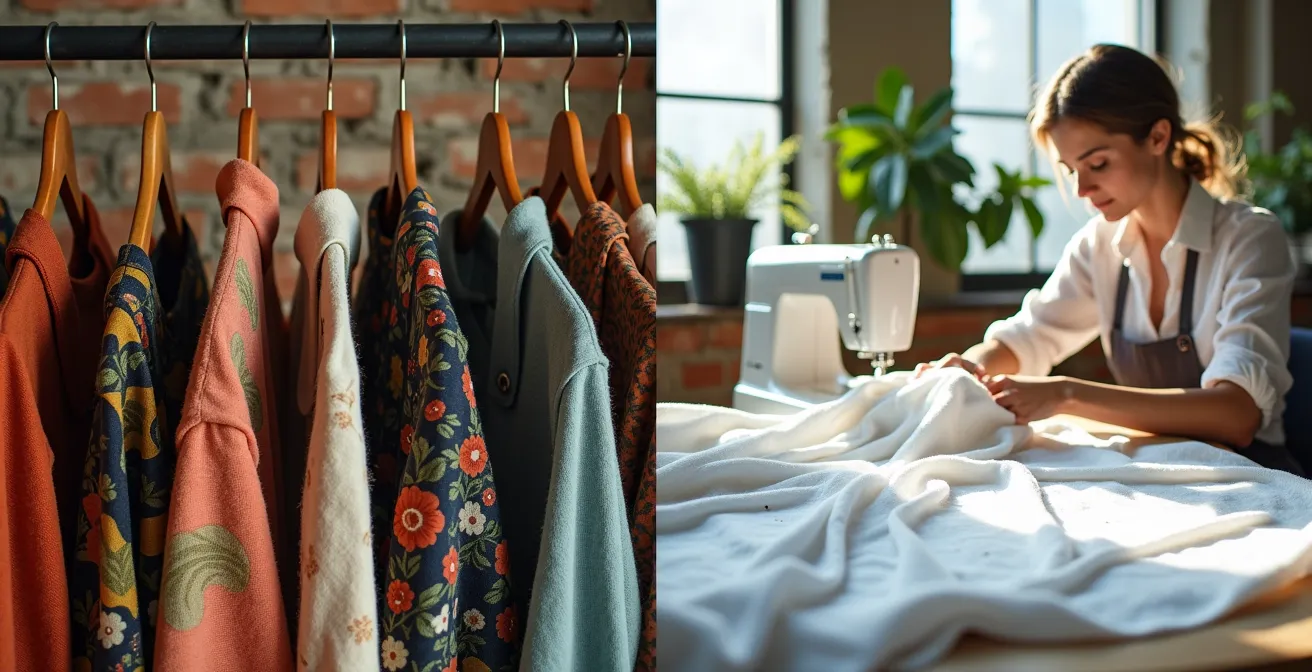
As this visual contrast suggests, the answer to which has a lower carbon footprint isn’t simple. Vintage clothing is the clear winner on direct environmental impact. The garment already exists; buying it requires no new resources, water, or dyes. Its footprint is primarily related to transportation and cleaning. However, supporting a new local designer has a profound economic and social benefit. You are directly funding a small Toronto business, sustaining artisanal skills, and contributing to the city’s creative economy. Often, these designers use sustainable materials and small-batch production methods that have a much lower impact than mass-market clothing. The choice isn’t about good vs. bad, but about prioritizing different ethical values: environmental preservation (vintage) or economic sustainability (local design).
The “Boutique” Mistake: Buying Rebranded Alibaba Goods at Premium Prices
Perhaps the most disheartening trap for a well-intentioned shopper is the “boutique” that isn’t one. This is the phenomenon of retail camouflage, where storefronts with curated aesthetics and premium price tags are actually selling mass-produced items dropshipped from platforms like AliExpress, Shein, or Alibaba. You walk in, drawn by the independent vibe, and walk out having paid a 500% markup on a piece of fast fashion you could have bought online for a fraction of the price. This practice not only deceives consumers but also directly undermines the true local designers who are trying to compete on the same street.
Learning to spot these operations is a critical skill for navigating Queen West today. The tell-tale signs are often subtle but consistent. The clothing may lack proper branding, featuring generic tags with vague international sizing (S/M/L) rather than specific Canadian or US numerical sizes. The fabric composition is often a dead giveaway—look for generic polyester blends without detailed information. Most importantly, the staff’s knowledge—or lack thereof—is your best clue. An employee in a legitimate local boutique can tell you about the designer’s story, their process, and where their studio is located. Staff in a dropshipping operation will often be unable to provide these specifics, because there are none.
To protect yourself and ensure your money goes to real artisans, you need a quick, in-store detection strategy. Here are five practical steps you can take before heading to the cash register:
- Use Google Lens in-store: This is your secret weapon. Discreetly take a photo of the item and do a reverse image search. If it pops up on a fast fashion site for a few dollars, you have your answer.
- Check the tags: Look for generic, poorly translated care instructions or flimsy tags that seem disconnected from the garment’s price point.
- Ask specific questions: “Who is the designer behind this piece?” or “Where in Toronto is this made?” A legitimate shop owner will be proud to answer. Silence or evasion is a major red flag.
- Examine the quality: Look at the stitching, seams, and fabric quality. Mass-produced items often have loose threads and inconsistent construction that don’t justify a boutique price.
- Trust your gut: If the store feels more like a showroom with a constantly rotating, trend-chasing inventory and less like a curated collection with a clear point of view, be skeptical.
How to Shop West Queen West to Ossington in One Afternoon Efficiently?
Tackling Queen West can be overwhelming. The stretch is long, and the gems are scattered. A successful shopping trip requires a plan, a form of conscious navigation that maximizes your time and energy while focusing on the stores that align with your values. Forget aimless wandering; a strategic itinerary allows you to hit the key creative clusters, skip the less dense retail sections, and build in moments for rest and reflection. The goal is to make your afternoon both productive and enjoyable, turning a shopping trip into a curated experience of Toronto’s culture.
The most efficient approach is to use a “hop-on, hop-off” method with the 501 Queen streetcar as your ally. Instead of walking the entire length, focus on key intersections and clusters of independent shops. The area around Trinity Bellwoods Park, for example, is a fantastic hub for locally-owned coffee shops and boutiques, making it an ideal place to start or end your journey. By planning your stops, you can devote your energy to exploring the stores themselves, rather than exhausting yourself on the pavement between them.
Here is a sample itinerary that blends iconic Toronto culture with ethical shopping, focusing on the vibrant stretch from the Gladstone Hotel to Ossington Avenue:
- Start West: Begin near Gladstone and Queen. This end has a grittier, more artistic feel. Explore the vintage stores and small galleries in this area first.
- Music & Culture Stop: Head east to Kops Records, a Toronto institution. Supporting an independent record store is part of the same ethos as supporting a local designer—it preserves the city’s cultural fabric.
- Thrift & Vintage Hub: Make a dedicated stop at Black Market Vintage. Known for its vast selection and reasonable prices, it’s a cornerstone of the Queen West second-hand scene.
- DIY Jewellery Break: Visit the iconic twin bead shops on Queen West. Even if you don’t buy a finished piece, the experience of seeing raw materials and having the option to create your own item is a powerful reminder of what goes into handmade goods.
- End at the Park: Use the streetcar to hop to the Trinity Bellwoods area. Finish your afternoon by browsing the boutiques around the park and rewarding yourself with a coffee from a locally-owned cafe, completing your conscious shopping loop.
Why Are Traditional Shops Disappearing from Little Italy?
The economic pressures transforming Queen West are not an isolated phenomenon; they are symptomatic of a city-wide affordability crisis impacting cherished neighbourhood high streets. Little Italy on College Street provides a poignant parallel. For decades, it has been defined by family-run bakeries, traditional cafes, and specialty food shops. Today, many of these legacy businesses are being replaced by chain restaurants, cannabis stores, and businesses that can withstand the mounting rental costs. The slow erosion of the neighbourhood’s character serves as a powerful reminder that the forces of gentrification and commercial rent hikes are reshaping Toronto’s cultural identity across the board.
The issue is a ripple effect from the city’s hyper-competitive commercial real estate market. While specific retail data for Little Italy can be elusive, the proximity to the downtown core tells much of the story. For context, in the first quarter of 2024, the net asking rent for office space in Downtown Toronto reached $37.20 CAD per square foot. This intense valuation in the core radiates outward, putting immense upward pressure on commercial rents in adjacent, desirable neighbourhoods like Little Italy. A small, family-run business with modest profit margins simply cannot compete with a national chain’s ability to absorb these costs.
What is lost in this transition is more than just a storefront; it’s a piece of the city’s soul. These traditional shops are living archives of Toronto’s immigrant history and community life. Their disappearance signifies a loss of cultural authenticity and diversity, replaced by a more uniform, less personal commercial landscape. The struggle in Little Italy underscores the urgency of conscious consumerism. Supporting a local butcher on College Street or an independent designer on Queen West are two sides of the same coin: a deliberate choice to invest in the businesses that give our city its unique character.
How to Navigate the Toronto Outdoor Art Fair to Find Hidden Gems?
While shopping on Queen West is a year-round activity, some of the best opportunities to discover emerging local talent are concentrated at key city events. The Toronto Outdoor Art Fair (TOAF) is chief among them. Every summer, Nathan Phillips Square transforms into Canada’s largest outdoor art fair, but its sheer scale can be intimidating. With hundreds of artists, navigating the fair to find true “hidden gems”—the next generation of influential Toronto creators—requires a strategy beyond aimless wandering. It’s a treasure hunt where the prize is discovering and supporting an artist at the very beginning of their career.
The most effective strategy is to think like a scout. Instead of getting lost in the main aisles, focus your attention on the areas dedicated to new talent. The fair’s “Student Zone” is a goldmine, featuring work from top art schools like OCAD University, Sheridan College, and Toronto Metropolitan University. These artists are often presenting their work to a large audience for the first time, and their prices are typically more accessible. Furthermore, paying attention to the TOAF awards—like ‘Best of Student’ or the ‘Founding Chairman’s Award’—can point you toward artists who have already been vetted for their exceptional potential by a panel of experts.
To make your visit to TOAF a successful scouting mission, follow this targeted plan:
- Scout Online First: Before you go, browse the TOAF online catalogue and filter specifically for artists in the ‘Student Zone’. Make a shortlist of booths you want to visit.
- Go Early or Late: Visit on Friday morning for the best selection and the chance to speak with artists before the weekend crowds descend. Alternatively, go on Sunday afternoon for potential deals as artists look to reduce their inventory before packing up.
- Engage with the Artists: Don’t be shy. Ask meaningful questions that go beyond “How much is this?” Try: “What’s your connection to Toronto in this piece?” or “What was the most challenging part of your process?” This dialogue enriches your purchase and helps you connect with the artist’s story.
- Follow the Awards: Keep an eye out for ribbons or signs indicating an award winner. These accolades are strong indicators of quality and future collectibility.
Key takeaways
- The “economic squeeze” from high commercial rents is the primary force pushing independent designers out of prime retail areas like Queen West.
- True local support requires vigilance; shoppers must learn to spot “retail camouflage” and greenwashing to avoid funding deceptive businesses.
- Conscious shopping involves strategic choices, whether it’s navigating an art fair with a plan or choosing between the environmental benefits of vintage and the economic support of new local design.
Eating Organic in Kensington Market: How to Fill Your Basket for Under $60?
The philosophy of conscious navigation extends beyond fashion. It’s a mindset that can be applied to all aspects of local consumption, and there is no better place to practice it than Toronto’s iconic Kensington Market. Just as with Queen West, an unplanned visit can be overwhelming and expensive. But with a strategic approach, Kensington can be an incredibly affordable place to buy high-quality, organic, and local goods, proving that supporting local doesn’t have to break the bank. The challenge is to fill your basket with healthy, organic food for under $60—a feat that is entirely possible with a bit of insider knowledge.
The key is to bypass the main tourist-facing shops and embrace the market’s core principles: buy in bulk, shop seasonally, and build relationships with vendors. Major grocery chains build their profits on convenience and pre-packaged goods. Kensington’s strength lies in its opposite: direct access to whole foods, often at a significant discount if you know where to look. The price difference between the market and a large chain can be substantial.
The following table illustrates the potential savings on common organic items, demonstrating how quickly the value adds up when you shop strategically in the market. As this comparative analysis shows, the savings are consistent across various categories.
| Organic Item | Kensington Market | Major Chain Store | Savings |
|---|---|---|---|
| Organic Eggs (dozen) | $5.50 | $7.99 | 31% |
| Organic Kale (bunch) | $3.00 | $4.99 | 40% |
| Organic Tofu (450g) | $3.50 | $5.49 | 36% |
| Organic Apples (3lbs) | $4.99 | $6.99 | 29% |
| Bulk Organic Quinoa (per lb) | $4.25 | $6.50 | 35% |
The $60 Kensington Blueprint Shopping Strategy
To put this into practice, adopt the “Kensington Blueprint.” Start by focusing on bulk goods at shops like House of Spice for your grains, nuts, and spices. Then, tour the outdoor fruit and vegetable stands towards the end of the day, when vendors often offer discounts on produce to clear stock. Don’t be afraid to ask, “What’s best today?” to find the most abundant and therefore cheapest seasonal items. Finally, explore the smaller side streets like Baldwin or St. Andrew, where smaller, less-trafficked shops often have even better prices than the main street vendors.
Ultimately, whether you’re buying a handmade dress on Queen West or organic kale in Kensington Market, you are making a choice. By applying a strategic, conscious approach, you can ensure those choices actively contribute to preserving the unique, independent, and creative character of Toronto’s most beloved neighbourhoods.