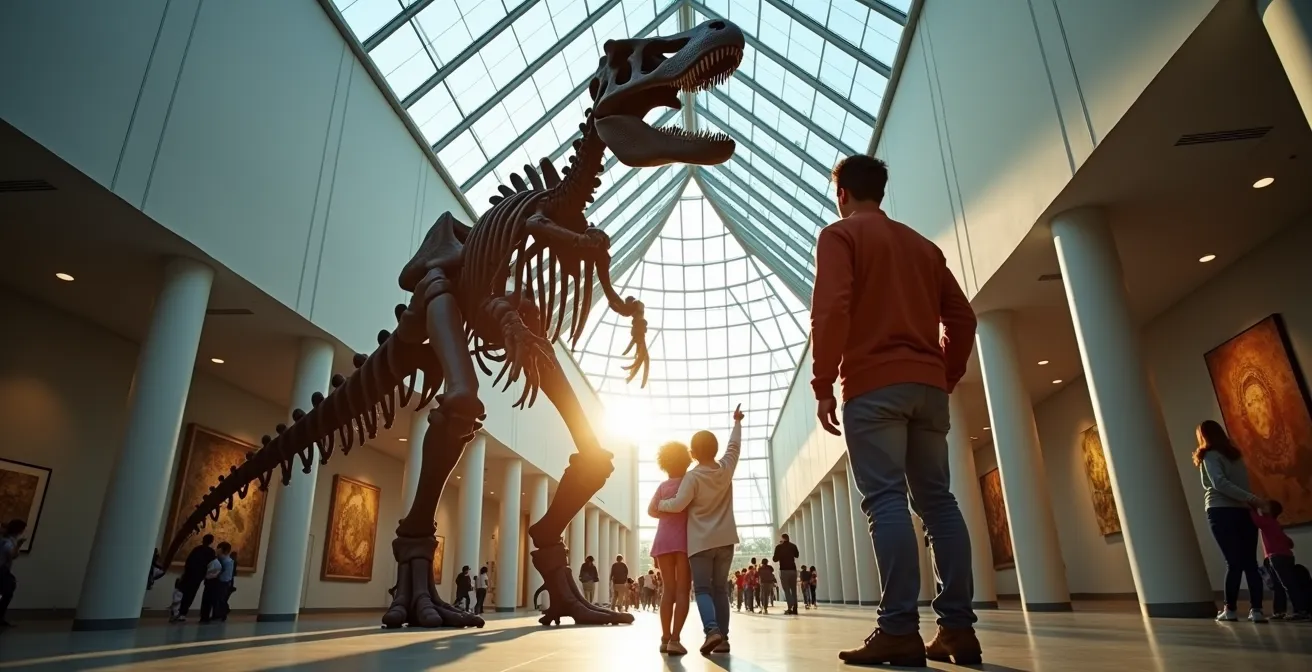
A ROM membership for a family of three breaks even on the third visit, but its true financial value lies in avoiding hidden costs and leveraging exclusive logistical perks.
- The membership’s cost is recovered faster when accounting for included special exhibitions, which carry a premium for non-members.
- Strategic use of membership benefits, like bringing your own lunch, can save an additional $50+ per visit compared to casual attendees.
Recommendation: If you plan to visit the ROM three or more times a year, the membership is a clear financial win, primarily for its ability to reduce secondary spending and improve the overall visit experience.
For any Toronto parent trying to manage a family budget, the question inevitably arises: is a Royal Ontario Museum (ROM) membership really worth the upfront cost? The simple answer often heard is that it “pays for itself in just a few visits.” While mathematically true, this overlooks the deeper strategic value. The real calculation isn’t just about admission fees; it’s a comprehensive analysis of time saved, stress avoided, and secondary costs completely eliminated. Standard advice focuses on entry discounts, but the genuine benefit for a practical family of three lies in logistical efficiency.
This analysis moves beyond the surface-level math. We will break down the cost-per-visit, but also factor in the high price of special exhibits, the common “lunch mistake” that can cost an extra $50, and the often-underestimated value of reciprocal entry to other institutions. It’s about viewing the membership not as a simple ticket bundle, but as an investment in a smoother, more cost-controlled cultural experience for your family throughout the year. We’ll explore how to maximize this investment, from planning the perfect two-hour trip to knowing the absolute quietest times to have the galleries to yourselves.
To help you make the most informed decision, this guide breaks down the key financial and logistical factors. We’ll examine every angle, from early access perks to a direct comparison with other city passes, providing a clear framework for determining the true return on investment for your family.
Summary: A Practical Guide to ROM Membership Value
- Why Is Early Access to Special Exhibits Valuable for Parents?
- How to See the Dinosaurs and Mummies in Under 2 Hours?
- ROM vs. Science Centre Membership: Which Offers Better Reciprocal Entry?
- The Lunch Mistake That Costs Families an Extra $50 at the Museum
- When Is the Absolute Quietest Time to Visit the ROM Galleries?
- What’s the Most Crowd-Free Way to Get to the ROM?
- How Does a Membership Accommodate a Multi-Generational Visit?
- Is a Bundled Pass a Better Deal Than Membership?
Why Is Early Access to Special Exhibits Valuable for Parents?
The primary value of a ROM membership crystallizes around special exhibitions. A single visit to a blockbuster exhibit for a family of three can often cost over half the price of an annual membership. The standard Family Membership, which according to family travel bloggers costs $161 per year for a family of up to 6 people, includes free admission to most of these premium events. This single benefit dramatically accelerates your break-even point. Without a membership, a family is faced with a per-visit calculation that can discourage them from seeing the museum’s most exciting, temporary offerings. With a membership, these become zero-cost opportunities.
Furthermore, the value extends beyond simple admission. Early access and member-only previews are a significant logistical advantage for parents. These events allow you to experience popular exhibits before the general public, meaning fewer crowds and a more relaxed environment for children. This avoids the stress of navigating packed galleries and long queues, a common pain point for family outings. As noted by experts in local family activities, the perks create a more holistic value proposition. According to Help! We’ve Got Kids, “With a membership, you also get discounts at the ROM Boutique and Druxy’s ROM Café and a 10% discount on classes and programs, including camps.” While these 10% discounts on food or gifts are secondary, they contribute to chipping away at the overall cost of a family day out over the course of a year.
Action Plan: Maximizing Your Membership’s Early Access Benefits
- Check your online member dashboard regularly to book member-only preview events for special exhibitions.
- Arrive 30 minutes before public opening on weekend mornings for the quietest gallery experience.
- Use the free member coat check to store bags and jackets, freeing up your hands to manage children.
- Even if you pack a lunch, use the 10% member discount at Druxy’s ROM Café for drinks or a small treat to reduce costs.
- Download the official ROM app before your visit for access to self-guided tours that you can enjoy during quiet member hours.
How to See the Dinosaurs and Mummies in Under 2 Hours?
For parents of young children, time is the most valuable currency. A membership encourages shorter, more frequent visits, removing the pressure to “get your money’s worth” in one marathon session. The key to a successful sub-two-hour trip is a focused mission. Instead of trying to see everything, target two high-interest galleries. The most popular combination is often the Age of Dinosaurs and the Galleries of Africa: Egypt. Start with the dinosaurs on the second floor while energy levels are high. The recently renovated James and Louise Temerty Galleries of the Age of Dinosaurs is designed for efficient navigation, with gallery-wide sightlines that help you spot iconic specimens like the T. rex and the massive Barosaurus without aimless wandering. Its layout allows families to move logically through different geological periods.
This visualization shows how a planned route can create a more efficient and enjoyable experience, minimizing backtracking and focusing time on key exhibits.

After the dinosaurs, head directly to the third floor for the mummies. By having a clear two-gallery plan, you create a sense of accomplishment for the kids and avoid the dreaded “museum fatigue.” A membership makes this strategy financially viable; you can leave after 90 minutes feeling successful, knowing you can come back next month to explore the Bat Cave and the biodiversity galleries without paying again. This turns the museum from a once-a-year epic journey into a regular, manageable part of your family’s routine.
ROM vs. Science Centre Membership: Which Offers Better Reciprocal Entry?
A crucial and often overlooked aspect of the membership calculation is the reciprocal admission program. This feature extends the value of your membership card far beyond the walls of the ROM. The ROM participates in the Reciprocal Organization of Associated Museums (ROAM) network, which provides access to over 500 museums and galleries across North America. This is a significant differentiator when comparing it to other local memberships, such as the Ontario Science Centre, which is part of the Canadian Association of Science Centres (CASC) network.
The key difference lies in the rules and scope. The CASC network generally has a “150km rule,” meaning you can’t get free admission to a participating science centre if you live within 150km of it. This makes it primarily a travel benefit for trips outside your region. The ROAM network, by contrast, often has fewer restrictions, and its partners can include local institutions. For a Toronto family, this creates tangible local value. The table below breaks down the core differences, highlighting the superior flexibility of the ROM’s network for both local and travel-based savings.
| Feature | ROM (ROAM Network) | Science Centre (CASC Network) |
|---|---|---|
| Network Coverage | 500+ museums across North America | Canadian science centres only |
| 150km Rule | No distance restrictions | Must live 150km+ from visited institution |
| GTA Partners | Art Gallery of Hamilton, Gardiner Museum | THEMUSEUM Kitchener |
| Special Exhibitions | Usually excluded from reciprocal benefits | General admission only |
| Family Membership Cost | $161/year or $291/2 years | Varies by institution |
For a family that enjoys diverse cultural experiences, the ROAM network provides a much broader and more practical benefit. Being able to visit the Art Gallery of Hamilton or the Gardiner Museum for free transforms the ROM membership from a single-institution pass into a regional cultural passport, significantly increasing its overall financial value.
The Lunch Mistake That Costs Families an Extra $50 at the Museum
One of the largest hidden costs of any family day trip is food. Relying on the on-site café can easily add $50 or more to your visit’s total cost. At the ROM, Druxy’s Café, while convenient, operates at a premium price point typical of major attractions. For a frugal family, this is a significant and avoidable expense. According to recent visitor reviews, a single meal can be quite costly, with some reporting around $20 for a single hamburger meal. For a family of three, a simple lunch could approach $60 with drinks.
A membership fundamentally changes this dynamic. By removing the per-visit admission cost, it alleviates the psychological pressure to splurge on other things. More importantly, it encourages the habit of packing your own lunch. The ROM facilitates this by providing a designated indoor eating area (The Eatery), a benefit that casual visitors may not be aware of or feel comfortable using. This simple act of preparation is the single most effective way to control costs on a museum day.

Bringing your own food and reusable water bottles (the museum has water fountains) turns a potentially expensive outing into a highly affordable one. The savings from just two or three avoided café lunches can amount to the entire cost of the membership itself. For families looking for alternatives, there are also more affordable quick-service options a short walk away on Bloor Street or at the Whole Foods in Yorkville Village.
When Is the Absolute Quietest Time to Visit the ROM Galleries?
For parents, a peaceful museum visit is priceless. A key benefit of a membership is the flexibility to choose your visiting time strategically to avoid crowds. The single biggest source of noise and congestion on weekdays is school trips. As family-focused guides like Help! We’ve Got Kids point out, “School trips are the primary source of weekday noise and crowds.” Therefore, the quietest time to visit during the week is typically after 2:00 PM, when most school groups have departed.
Weekend mornings, especially right at opening, can also be surprisingly calm, particularly for members who can arrive slightly before the general public. However, many families make a critical mistake by assuming free events are the best time to go. The ROM’s Third Tuesday Night Free admission (from 5:30 PM to 8:30 PM) is a perfect example. While it costs nothing, it attracts enormous crowds, making it arguably the worst time for a family seeking a calm experience with young children. The sheer volume of people can be overwhelming and counterproductive to enjoying the exhibits.
The most reliable strategy for a quiet visit is to leverage the membership for late afternoon weekday visits or early weekend mornings. A membership means you don’t have to dedicate a full day; a 90-minute visit at 3:00 PM on a Wednesday can be far more rewarding than a three-hour battle with crowds on a free night. This “visit optimization” is a core, non-financial benefit of being a member, trading a small annual fee for a significantly improved visitor experience.
What’s the Most Crowd-Free Way to Get to the ROM?
The logistical planning for a family trip to the ROM doesn’t stop at the museum doors; it begins with the journey there. For families in Toronto, navigating transit and parking is a major consideration. While driving is an option, there is no designated museum parking lot, and nearby paid lots can be expensive. The most cost-effective and direct route is undoubtedly the TTC. The ROM is uniquely positioned for transit access, but one option stands out for its convenience and crowd-avoidance potential.
The absolute best option is taking the subway. Museum Station on Line 1 is not just close—it’s directly connected to the museum. As the CityPASS visitor guide confirms, Museum Station directly connects to ROM via an underground PATH-like walkway. This is a game-changer for parents, especially during Toronto’s harsh winters or on rainy days. You can get from the subway platform to the museum entrance without ever stepping outside, avoiding weather-related hassles and street-level crowds entirely. St. George station is also a very short walk away.
For families looking to maximize savings, using public transit unlocks further discounts. The museum offers a 15% discount on admission for PRESTO cardholders and GO Transit riders. While this discount doesn’t stack with a membership, it’s a key piece of data for your initial break-even calculations if you are still weighing the decision. It reinforces that the museum is structured to reward transit users, making the subway the smartest choice from both a financial and logistical standpoint.
How Does a Membership Accommodate a Multi-Generational Visit?
The “family of 3” scenario often expands to include grandparents or other relatives. This is where a ROM membership’s value in accessibility and convenience becomes paramount. Planning a visit that is enjoyable for a toddler, a parent, and a grandparent with mobility challenges can be complex. The ROM’s infrastructure, however, is exceptionally well-suited for multi-generational groups. The museum is fully accessible, with spacious elevators providing access to all main galleries.
This isn’t just a matter of compliance; it’s a feature that ensures a shared family experience. An older family member doesn’t have to be left behind while the others explore the upper floors. The wide, open galleries are easy to navigate with mobility aids like walkers or wheelchairs, and there are ample seating areas for resting throughout the museum. A membership encourages a relaxed pace, which is crucial for groups with varying energy levels and mobility. There’s no pressure to rush, allowing everyone to enjoy the experience comfortably.

The Family Membership allows for up to 4 children and 2 named adults, or 1 named adult and 1 guest, offering flexibility for different family configurations. For larger multi-generational outings, this structure provides a solid financial base, significantly reducing the total cost for the group. It ensures that bringing Grandma or Grandpa along isn’t just possible, but easy and affordable, making the museum a truly inclusive destination for the entire family.
Key Takeaways
- A ROM family membership reaches its break-even point on the third visit, based on general admission prices alone.
- The true value is unlocked by avoiding premium charges for special exhibitions and on-site food, saving over $50 per visit.
- The membership’s reciprocal benefits (ROAM network) offer broader and more flexible local value than key competitors like the Science Centre.
Is a Bundled Pass a Better Deal Than Membership?
The final piece of the puzzle for a frugal family is comparing the ROM membership to an alternative: a bundled attraction pass like the Toronto CityPASS. On the surface, the savings offered by CityPASS can seem compelling. The pass bundles admission to several top Toronto attractions, and the museum’s own website highlights its value. As the Royal Ontario Museum states on its visitor information page:
Bundle ROM admission with 4 more top Toronto attractions and save up to 38% with Toronto CityPASS tickets.
– Royal Ontario Museum, Official ROM Visitor Information
This is an excellent deal for tourists or for a family planning to visit multiple major attractions within a short period (CityPASS is valid for 9 days). However, for a local family, the calculation is different. The value of CityPASS is concentrated in a brief, intense period of sightseeing. A ROM membership, in contrast, provides value spread throughout an entire year. It encourages repeat, low-stress visits and integration of the museum into your family’s regular life, rather than a single “tourist-in-your-own-city” week.
Ultimately, the choice depends on your family’s habits. If you plan one big week of local tourism a year, CityPASS may be the more economical choice. But if your goal is to have a reliable, educational, and cost-controlled destination you can return to again and again—for two hours on a rainy Saturday, for an afternoon after school, or to see every single special exhibit—the annual membership provides far greater long-term and logistical value. It’s an investment in recurring quality family time, not a one-off discount.
Frequently Asked Questions About ROM Membership
Can I get a discount with my PRESTO card?
Yes, PRESTO cardholders and GO Transit riders save 15% off regular Museum admission rates, including General Admission and Special Exhibitions. However, this discount cannot be combined with the free admission provided by a membership.
Is there parking at ROM?
The museum does not have its own designated parking lot. Paid parking is available at several nearby public lots, and limited street parking can be found in the area, but taking the TTC is often the most convenient and cost-effective option.
What’s the closest subway station?
Museum Station on the TTC’s Line 1 is the closest, featuring a direct underground connection to the ROM. This allows you to enter the museum without going outside, which is ideal in poor weather. St. George Station on Line 1 and Line 2 is also a very short walk away.