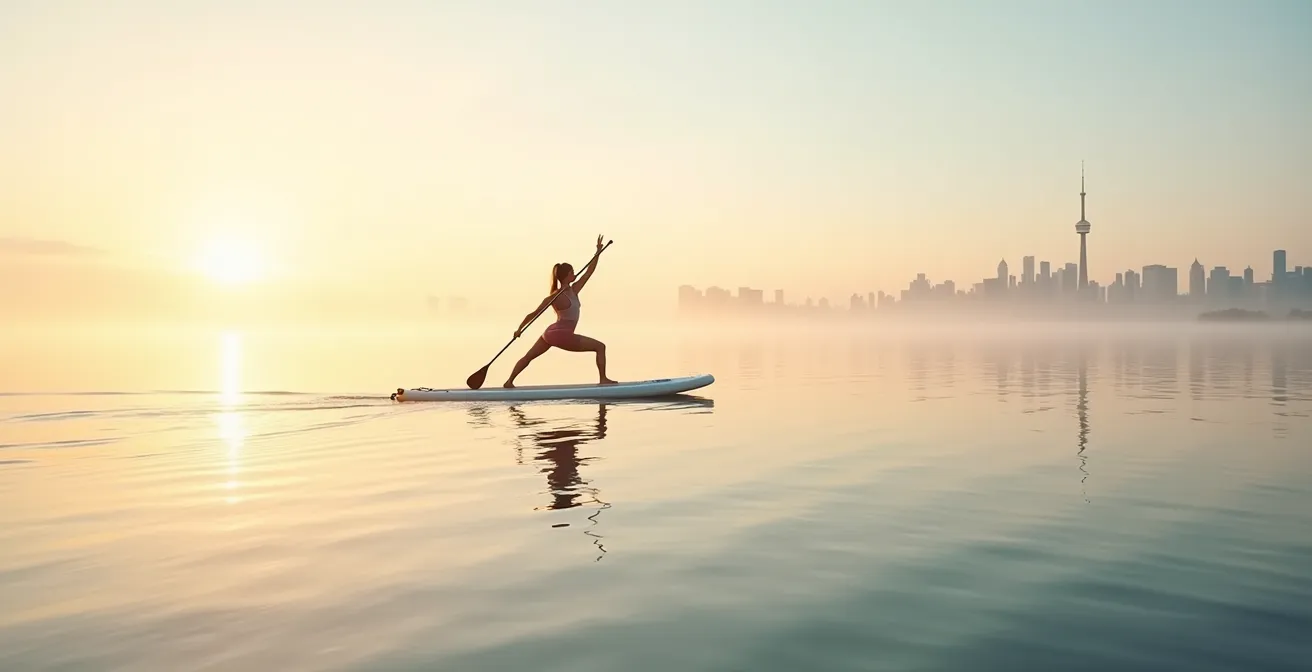
In summary:
- For the calmest water at Woodbine Beach, always paddle in the morning with a north wind to minimize ‘fetch’.
- Living in a Toronto condo, an inflatable SUP is superior for storage, elevator access, and TTC transport.
- Mastering balance in chop involves keeping your paddle on the water and fixing your gaze on the CN Tower.
- Always dress for Lake Ontario’s cold water temperature, not the air temperature, especially in May and October.
- Transform your paddle session into a wellness ritual by combining it with a mindful cold plunge and rest period.
For many Toronto fitness enthusiasts, the idea of a serene sunrise yoga session on a paddleboard is the ultimate dream. You picture still water, the soft glow of the sun, and the city skyline as your backdrop. But the reality of Lake Ontario can often be a choppy, wind-blown challenge that feels more like a battle than a moment of zen. The common advice is to just “check the weather” or “find a protected bay,” but this rarely accounts for the specific micro-climates and logistical hurdles of a city like Toronto.
What if the key to unlocking a truly profound SUP yoga experience wasn’t just about finding the right spot, but about deeply understanding and harmonizing with the city’s unique environment? This goes beyond simply avoiding waves. It involves learning to read the wind like a local sailor, choosing gear that aligns with the vertical reality of condo living, and embracing the lake’s cold embrace as a deliberate part of a powerful wellness practice. This is about transforming your paddleboard from a piece of sports equipment into a tool for a genuine urban detox ritual.
This guide will walk you through the essential strategies to achieve this. We’ll explore how specific wind directions create glassy conditions, what gear truly makes sense for city life, and how to safely turn the challenges of Lake Ontario into the cornerstones of your physical and mental well-being. By mastering these elements, you’ll move beyond simply paddling and start practicing with true intention.
This guide provides a structured path to mastering stand-up paddleboarding in Toronto’s unique environment. Below is a summary of the key areas we will explore to help you find your on-water sanctuary.
Summary: Mastering SUP Wellness in Toronto
- Why is a North Wind Best for Paddleboarding at Woodbine Beach?
- How to Progress from Kneeling to Standing on Lake Ontario Chop?
- Inflatable vs. Hard Board: Which is Better for Condo Living?
- The Leash Mistake That Could Cost Your Life on the Lake
- How to Join a SUP Social Group to Meet Like-Minded People?
- Why is the “Cold Plunge” Essential for Dopamine Release?
- The Clothing Mistake Paddlers Make in May and October
- Urban Detox: How to Maximize the Mental Health Benefits of a Nordic Spa Cycle?
Why is a North Wind Best for Paddleboarding at Woodbine Beach?
The secret to finding glassy, calm water at Woodbine Beach lies in a single, often overlooked meteorological detail: wind direction. While many paddlers focus only on wind speed, the direction is what truly dictates the water’s surface conditions. A north wind, even a moderately brisk one, creates an effect known as an offshore wind at this specific location. This means the wind is blowing from the land out onto the water.
The key principle at play here is “fetch”—the distance over which wind can blow across water without obstruction. When the wind comes from the north at Woodbine, the fetch is incredibly short, limited to the width of the beach itself. The wind simply doesn’t have enough distance to build up waves. In contrast, a south wind has the entire expanse of Lake Ontario to build up swell, resulting in the chop and waves that make SUP yoga nearly impossible. By targeting days with a north wind, you are essentially using the city itself as a massive windbreak.
For the ultimate zen experience, combine this knowledge with timing. The ideal window is often during the morning’s ‘thermal calm’, typically between sunrise and 9 AM. During this period, the temperature difference between the land and the lake is minimal, reducing the chance of localized lake breezes. Position yourself between the Leslie Street Spit to the west and the Scarborough Bluffs to the east, and you’ll find a naturally protected zone perfect for your practice. This understanding of micro-environments is the first step toward mastering your on-water experience.
By learning to read a marine weather forecast not just for speed but for direction, you transform your sessions from a game of chance into a planned, serene ritual.
How to Progress from Kneeling to Standing on Lake Ontario Chop?
Even with perfect planning, you will inevitably face days with unexpected chop on Lake Ontario. Instead of seeing this as a failed session, view it as an opportunity to build skill and confidence. Progressing from a stable kneeling position to standing in choppy water is a major milestone that requires technique, not just brute force balance. The first rule is to accept instability and work with it.
Your paddle is not just for propulsion; it’s your third leg. The ‘paddle as a third leg’ technique is your most powerful tool. When you feel unsteady, don’t lift your paddle out of the water. Instead, press the blade flat onto the water’s surface to one side. This creates a point of stability, much like a tripod, allowing you to regain your composure. Practice this bracing motion until it becomes an instant reflex. If you’re still struggling, get low. Paddling on your knees or even sitting down isn’t a sign of failure; it’s a smart way to lower your center of gravity and maintain control.
This image demonstrates the critical bracing technique that provides instant stability.
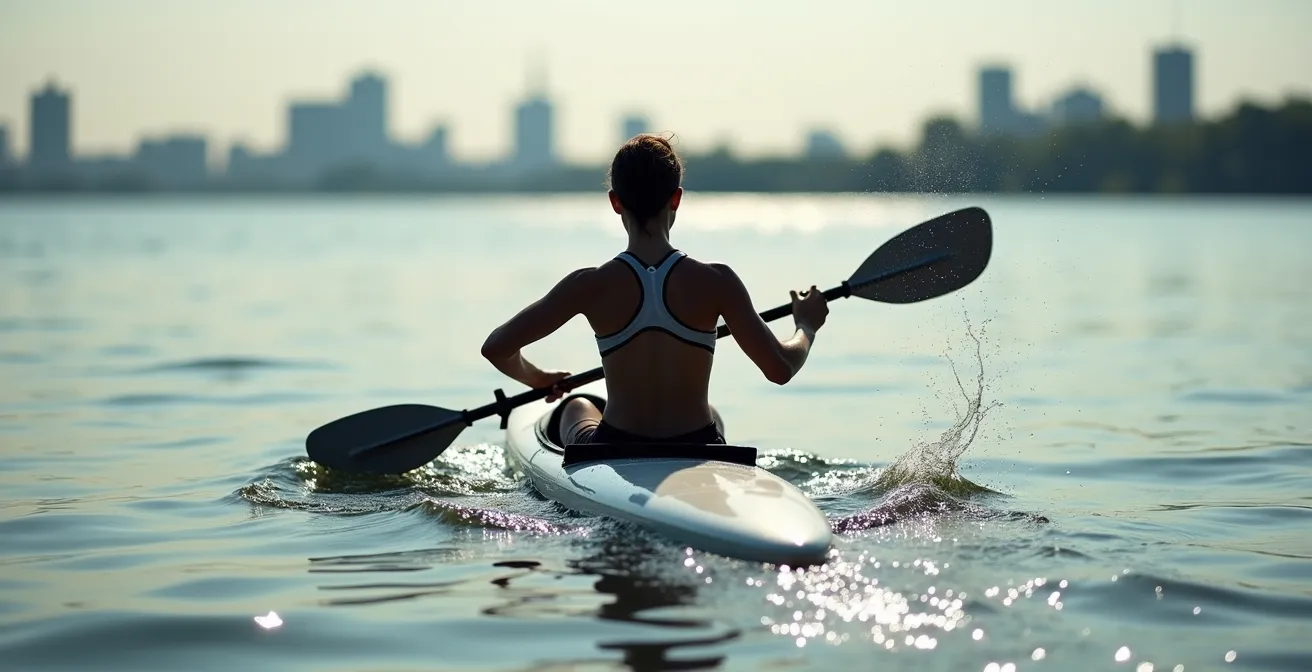
As you can see, maintaining contact with the water is key. Another crucial mental trick is to fix your gaze on a stable, distant landmark. In Toronto, the CN Tower is your perfect ‘drishti’ or focal point. Staring at the moving water at your feet will only confuse your inner ear and amplify feelings of instability. By looking at the horizon, you give your brain a fixed reference point, which dramatically improves your balance. Finally, always keep your board perpendicular to the waves, facing them head-on or with your back to them. Getting caught sideways by a wave is the quickest way to get knocked over.
Patience is key; start in more protected areas like the inner lagoons of the Toronto Islands or the lower Humber River before tackling the open lake.
Inflatable vs. Hard Board: Which is Better for Condo Living?
For the Toronto-based paddler, the choice between an inflatable stand-up paddleboard (iSUP) and a traditional hard (epoxy) board is less about on-water performance and more about off-water logistics. The reality of condo living—with its limited storage, narrow elevators, and reliance on public transit—makes an iSUP the overwhelmingly superior choice for most urban dwellers. The primary obstacle with a hard board is its size; a 10-to-12-foot board is simply not practical for most apartments or condos.
An iSUP, when deflated and rolled up, fits into a large backpack. This single feature solves multiple urban challenges. It can be stored in a closet or under a bed, completely eliminating the need for precious wall space. It can be easily carried onto the TTC, opening up access to paddling spots across the city without needing a car. And critically, it fits into any standard condo elevator, a hurdle that often makes transporting a hard board an impossible task. While a hard board is ready to go instantly, the 10-15 minute setup time for inflating an iSUP is a small price to pay for this immense logistical freedom.
Many aspiring SUP yogis worry that an inflatable board is less stable. However, modern, high-quality iSUPs designed for yoga (typically 33 inches or wider) are incredibly rigid and stable. In fact, many practitioners find the slightly softer surface of an iSUP more comfortable for yoga poses and forgiving on the joints. The consensus among paddling experts is that for most urban residents, the sheer practicality of an iSUP is a decisive factor, as noted by Active Weekender’s analysis that a hard board’s size is “definitely too big for a condo or apartment!” for many people.
This comparative table breaks down the key considerations for Toronto condo dwellers:
| Feature | Inflatable SUP | Hard SUP |
|---|---|---|
| Storage Space Required | Closet/under bed (rolled to backpack size) | 10-12 feet wall/ceiling space |
| Condo Elevator Access | Fits easily in standard elevators | Often too long for elevators |
| TTC Transportation | Can carry on streetcar/subway | Requires car with roof rack |
| Weight | 15-25 lbs | 25-35 lbs |
| Stability for Yoga (33″+ wide) | Excellent – softer, more comfortable surface | Good – harder surface |
| Setup Time | 10-15 minutes inflation | Immediate |
Choosing the right board is the foundation of a sustainable and enjoyable SUP practice in an urban environment.
The Leash Mistake That Could Cost Your Life on the Lake
Among all the safety gear, the SUP leash is arguably the most critical and most misunderstood, especially on the vast, cold waters of Lake Ontario. The common mistake is viewing the leash as optional or secondary to a PFD. On this lake, your leash is your lifeline. In an offshore wind—the very north wind that creates calm water—your board can be blown away from you faster than an Olympic swimmer can chase it. Without a leash, a simple fall can separate you from your only flotation device, turning a minor splash into a life-threatening situation.
The danger is compounded by the lake’s temperature. Even on a hot summer day, the water just below the surface can be shockingly cold due to a phenomenon called turnover. As the Toronto Police Service warns, this sudden immersion can trigger ‘cold shock’.
Anyone who unexpectedly falls into Lake Ontario will experience cold temperatures because the colder water near the bottom of the lake turns over to the surface. Cold water can dramatically affect your ability to swim or stay afloat. The best swimmers can experience the debilitating effects of a sudden cold-water immersion, also known as ‘cold shock.’
– Toronto Police Service, Water Safety Guidelines
Cold shock causes an involuntary gasp, hyperventilation, and can rapidly incapacitate even a strong swimmer. Your leash keeps your board—your large, stable float—within arm’s reach, allowing you to get out of the cold water quickly. The importance of this connection cannot be overstated. Both Transport Canada and Parks Canada support leash use, with Parks Canada highly recommending wearing a PFD and leash together for maximum safety. A coiled leash is ideal for flatwater yoga, as it stays on the board and is less likely to drag or snag.
This image highlights the simple but vital piece of equipment that connects you to your board.

Always attach your leash before you enter the water. It is not an accessory; it is a non-negotiable piece of safety equipment for any paddler on Lake Ontario.
Never underestimate the power of the wind and the cold of the lake; your leash is the simple tool that mitigates both risks.
How to Join a SUP Social Group to Meet Like-Minded People?
While the solitary nature of SUP yoga is a huge part of its appeal, practicing within a community can deepen your experience, enhance safety, and create meaningful connections. Toronto has a vibrant and welcoming SUP community with several groups and schools that organize social paddles, making it easy to meet like-minded people who share your passion for being on the water.
The easiest entry point is through platforms like Meetup.com. A simple search for “Toronto SUP” will reveal groups dedicated to social paddling. These groups, like the Toronto SUP Meetup, emphasize community, often organizing ‘Aprés SUP’ gatherings after a session, which is a perfect way to connect with others. These are not formal lessons but friendly group paddles where everyone looks out for each other.
Another excellent avenue is to connect with local SUP schools that offer social events. Toronto Island SUP, for example, runs social paddles that are semi-guided, creating a safe and supportive environment for all skill levels to explore the islands. Similarly, women-led schools like SUPGirlz offer a unique community focus, including socials and even night paddles with lights. These organized events remove the intimidation factor of paddling alone and provide a structured way to discover new routes and meet new friends.
Don’t underestimate the power of your existing networks. Many downtown and waterfront condo buildings have community Facebook groups or wellness channels on Slack. Posting a message to organize a “Condo SUP Morning” is a fantastic way to meet neighbors who share your interest. You might be surprised to find a whole community of paddlers living right in your building, all looking for the same on-water connection.
Whether through a formal group, a local school, or an informal meetup, paddling with others adds a rich social layer to your wellness journey.
Why is the “Cold Plunge” Essential for Dopamine Release?
The practice of integrating a cold plunge into a wellness routine, often associated with Nordic spas, has powerful scientific backing. The intentional, short-term exposure to cold water triggers a significant release of dopamine in the brain. Dopamine is a neurotransmitter linked to motivation, focus, and mood. This neurochemical surge is what creates the feeling of exhilaration and mental clarity that follows a cold dip, making it a perfect complement to the mindful state achieved during SUP yoga.
You don’t need a fancy spa to access this benefit; Lake Ontario is your natural, free-access cold plunge pool. The key is to approach it mindfully and safely. The goal is not to endure prolonged exposure but to create a brief, deliberate “shock” to the system. Even in the height of summer, the lake provides the necessary stimulus. During the swim season from May to September, water temperatures can range from 10°C to 24°C, with the lower end of that range being particularly effective for this practice.
To create your own natural Nordic cycle, think in three phases: heat, cold, rest. Your SUP yoga session serves as the “heat” phase, warming up your muscles and body. The “cold” phase is your post-paddle dip. Start slowly, especially if you are new to it. In the warmer months of July and August, begin by just dipping your legs for 30 seconds after your session. As you acclimatize, you can progress to a quick, full-body plunge. The final and equally important “rest” phase completes the cycle. After your plunge, return to your board for a floating Savasana or simply lie on the warm sand, allowing your body to regulate and your mind to absorb the flood of positive neurochemicals. This completes the urban detox ritual, leaving you feeling invigorated and mentally reset.
By reframing the cold as an intentional tool, you unlock a deeper layer of wellness that is freely available at Toronto’s waterfront.
The Clothing Mistake Paddlers Make in May and October
The single biggest clothing mistake paddlers make during Toronto’s shoulder seasons—May and October—is dressing for the air temperature instead of the water temperature. On a sunny 18°C day in May, it’s tempting to paddle in shorts and a t-shirt. However, the lake is still dangerously cold, often hovering around 8-12°C. A fall into water this cold can lead to cold shock and rapid hypothermia. The City of Toronto’s safety guidelines are unequivocal on this point, advising paddlers to “dress for the water temperature, not the air temperature.”
This means investing in thermal protection. A wetsuit is not just for surfers; it is essential safety equipment for cold-water paddling. It works by trapping a thin layer of water against your skin, which your body then heats up, providing insulation. The thickness of the wetsuit you need depends on the temperature, but for May and October paddling on Lake Ontario, a 2-3mm wetsuit is a standard recommendation. A “farmer john/jane” style (sleeveless) wetsuit paired with a merino wool base layer offers a great combination of core warmth and arm mobility for paddling.
Proper layering is the key to comfort and safety across the seasons. This table provides a general guide for gearing up based on Lake Ontario’s typical water temperatures:
| Month | Lake Ontario Temp | Recommended Layering |
|---|---|---|
| May | 8-12°C | Merino base + 2mm neoprene + windproof shell |
| June-August | 18-24°C | Quick-dry shorts/top + optional 1mm vest |
| September | 15-20°C | 1-2mm shorty wetsuit or neoprene leggings |
| October | 10-15°C | 2-3mm farmer john/jane + merino base layer |
By wearing the appropriate thermal gear, you extend your paddling season safely and can confidently enjoy the beauty of the lake in the quieter spring and fall months.
Key takeaways
- True SUP wellness in Toronto comes from mastering the city’s unique micro-environments, not just finding a location.
- Logistical harmony is key: for condo dwellers, an inflatable SUP’s portability outweighs a hard board’s convenience.
- Safety is paramount: always dress for the cold water temperature of Lake Ontario and use a leash as your non-negotiable lifeline.
Urban Detox: How to Maximize the Mental Health Benefits of a Nordic Spa Cycle?
You have now assembled all the components: you know how to find calm water, you have the right board for city life, you understand the core safety principles, and you’ve embraced the power of the cold plunge. The final step is to consciously weave these elements together into a complete urban detox ritual. This is how you maximize the mental health benefits of your time on the water, turning a simple paddle session into a practice as restorative as a day at a Nordic spa.
This practice is being championed by local, Indigenous-led wellness companies who understand the water’s deep healing potential. Their work exemplifies how to structure this urban detox experience.
Oceah Oceah – Indigenous-Led Wellness on Lake Ontario
The Indigenous-owned company Oceah Oceah, operated by sisters Jenifer, Sharon, and Lana, is on a mission to connect people with water. Offering SUP yoga, full moon sessions, and meditation paddles from Budapest Park and Bluffer’s Park, they demonstrate how to create structured urban detox experiences. Their sessions, like night paddles to Ontario Place, show how to combine paddling, meditation, and a deep connection with nature right in the heart of the city, turning the lake into a space for profound wellness. This approach is a powerful example of the growing trend of water activities being used for holistic health.
You can create your own version of this ritual. Bluffer’s Park, with its majestic cliffs and protected marina, offers a perfect setting. By combining a sunrise paddle with meditation, yoga, and a mindful cold plunge, you create a powerful sequence that resets both body and mind. It’s about being intentional with every step, from the moment you launch to your final moment of rest.
Your Action Plan: The Complete Bluffer’s Park Morning Ritual
- 6:00 AM – Launch: Launch your board from Bluffer’s Park Marina during the ‘thermal calm’ to find glassy water.
- 6:30 AM – Meditate: Paddle to the serene base of the Scarborough Bluffs and practice a 10-minute grounding meditation, focusing on the sounds of the water.
- 7:00 AM – Practice Yoga: Begin your SUP yoga sequence, using the distant CN Tower as your ‘drishti’ point to maintain balance and focus.
- 7:30 AM – Plunge and Rest: Conclude your practice with a brief, intentional cold plunge, followed by a 5-minute floating Savasana to complete the Nordic cycle.
- 8:00 AM – Mindful Walk: After paddling back, take a mindful walk along the Bluffs’ hilltop trail to integrate the experience and enjoy the panoramic views.
By consistently applying these principles, you transform your relationship with the city and the lake, finding a deep and accessible well of mental and physical health right at your doorstep. Start planning your next session not as a workout, but as a deliberate act of urban renewal.