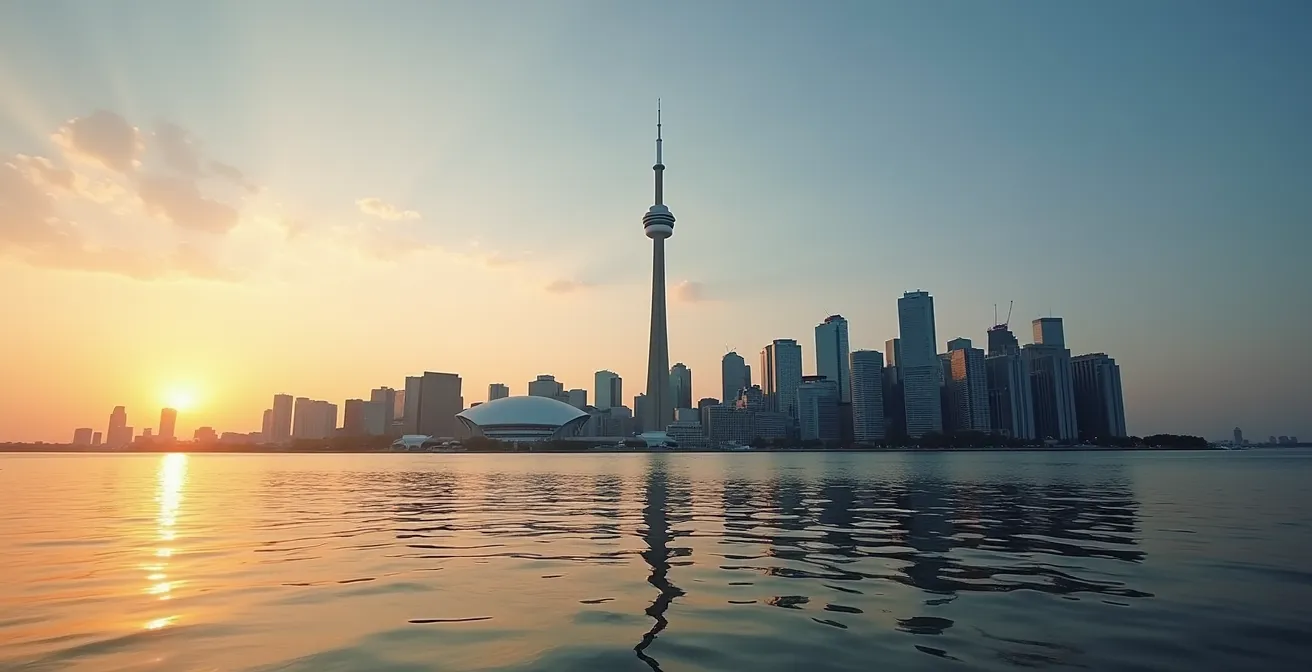
Most believe Toronto’s best skyline views are locked behind pricey cocktail bar tabs or found only in crowded, obvious parks. The truth is, the city is a puzzle box of opportunity. The real key to unlocking spectacular, free vistas lies not in your wallet, but in mastering the urban explorer’s art of navigating Toronto’s unique network of legally accessible, Privately Owned Publicly Accessible Spaces (POPS) and other hidden vantage points.
The Toronto skyline is an icon, a glittering promise stacked against the shores of Lake Ontario. But for locals and students, that same view often feels like a commodity, walled off and sold back to us for the price of a $30 cocktail. The common advice is predictable: jostle for space at a handful of well-known parks or resign yourself to paying the “view tax” at an exclusive rooftop bar. This guide rejects that premise. It’s not about finding a patch of grass; it’s about reclaiming the cityscape.
This isn’t a tourist pamphlet. This is a field manual for the urban explorer. We’ll move beyond the obvious and dive into the legal grey zones and clever workarounds that define the modern city. Forget the velvet ropes. We’re going to treat the concrete jungle as our playground, using knowledge and strategy as our all-access pass. The most breathtaking views aren’t always the highest; they’re the ones you’ve earned.
We will start by decoding the city’s biggest secret: the network of privately owned, publicly accessible spaces. From there, we’ll explore how to find that mythic parking garage shot without getting into trouble, dismantle the myth that paid views are superior, and learn the subtle behaviours that let you blend in anywhere. This is your guide to seeing your city in a way you never thought possible—without spending a dime.
To navigate this urban landscape effectively, this guide breaks down the essential strategies and locations. Explore the sections below to master the art of finding Toronto’s best-kept secrets.
Summary: Unlocking Toronto’s Hidden Skyline Vistas
- Why Are So Many “Public” Spaces Actually Privately Owned in Toronto?
- How to Find the Famous “Parking Garage View” Without Trespassing?
- Trillium Park vs. The One Eighty: Is the Paid View Really Better?
- The Behavior That Gets You Kicked Out of Office Lobbies Instantly
- When Does the Sun Set Directly Behind the CN Tower from the East?
- Riverdale Park East vs. Christie Pits: Which Has the Best Sunset Vibe?
- General Admission or SkyPod: Is the Extra Elevation Worth the Cost?
- Photographing Toronto: How to Capture Iconic Spots Without Tourist Crowds?
Why Are So Many “Public” Spaces Actually Privately Owned in Toronto?
The feeling is familiar: you see an inviting courtyard or a sleek, glass-walled lobby and hesitate, wondering, “Am I allowed to be here?” In Toronto, the answer is often a surprising “yes.” The city’s landscape is dotted with Privately Owned Publicly Accessible Spaces, or POPS. These are plazas, atriums, and even rooftop gardens that developers are required to provide and maintain for public use in exchange for zoning allowances, like permission to build taller towers.
This trade-off is the urban explorer’s master key. While these spaces are privately owned, your right to access them is legally protected. However, they are often poorly signed and intentionally designed to feel exclusive, deterring the very public they are meant to serve. Understanding the POPS system isn’t just a fun fact; it’s a fundamental shift in how you see the city. Every corporate tower or new condo development doesn’t just represent privatization; it could hold your next secret spot, a quiet place to read, or an undiscovered angle on the skyline. The first step to reclaiming the city is knowing the rules of the game.
These spaces are your right to use, but finding and accessing them requires a strategy. They are often hidden in plain sight, waiting for those who know what to look for. The following checklist provides a concrete plan for identifying and enjoying these valuable urban assets.
Action Plan: How to Find and Access Toronto’s POPS
- Visit the City of Toronto’s interactive POPS Map to locate over 200 spaces across the city.
- Look for official POPS signage and plaques at building entrances and public spaces; these markers are your legal invitation.
- Check site descriptions on the map for access hours and specific amenities available, such as seating or rooftop access.
- Remember these spaces are legally required to be publicly accessible during their stated hours; you have a right to be there.
- Report any access issues, hostile design, or being unfairly asked to leave to City Planning through 311 Toronto.
By mastering this system, you transform from a passive observer into an active participant in the city’s life, unlocking dozens of new spaces to experience the urban environment.
How to Find the Famous “Parking Garage View” Without Trespassing?
The “parking garage view” is a staple of urban photography, offering a gritty, framed perspective of the skyline that parks can’t match. But the fantasy often clashes with reality: “No Trespassing” signs, security patrols, and the general unease of being somewhere you shouldn’t. The secret isn’t to break the law; it’s to find the garages that, by design or circumstance, welcome observers. The key is to think like a customer, not a trespasser.
Many multi-story parking structures, especially those near major attractions or transit hubs, are open to the public for a fee. Paying for an hour of parking is a small price for legal, unhurried access to a top-floor vantage point. Consider it a ticket to your own private observation deck. For example, a well-known parking structure near Union Station offers photographers a legitimate spot where you can climb up and enjoy an incredibly close view of the CN Tower. This demonstrates that with the right approach, these concrete beasts become some of the best viewing platforms in the city.
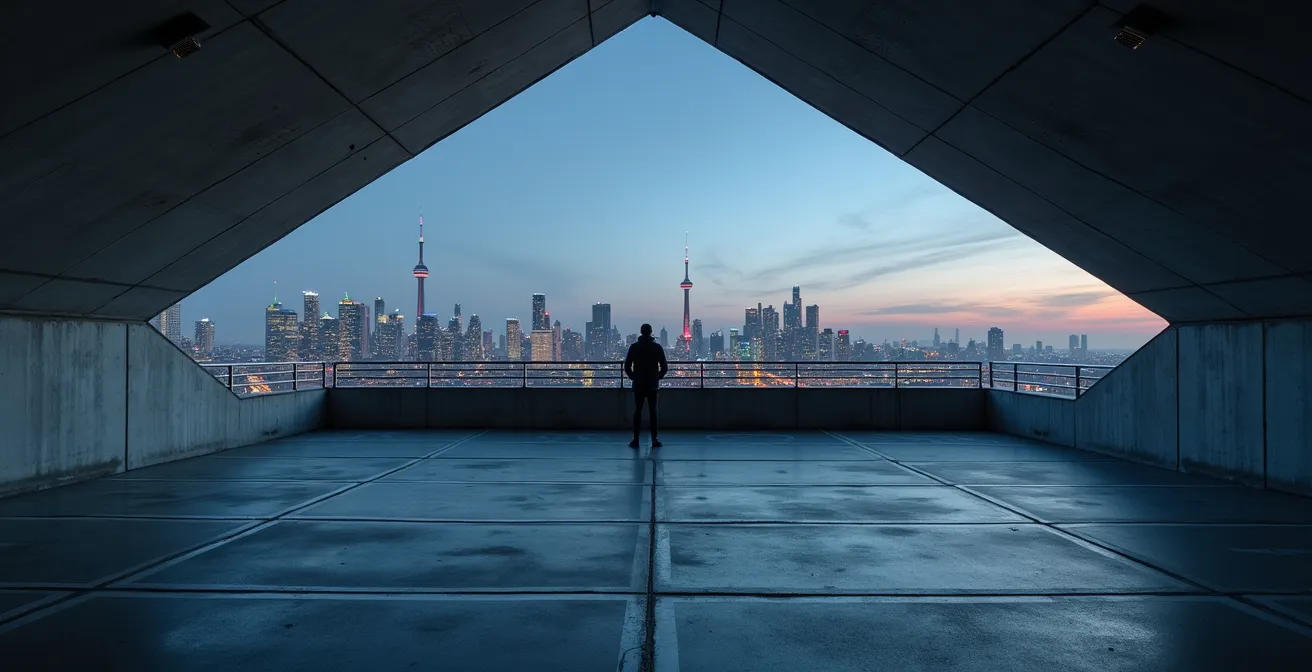
This approach transforms a potentially confrontational activity into a simple transaction. You’re a patron, not an intruder. The best garages are often attached to hotels, hospitals, or public venues. Scout them out during the day and look for open-air top levels. The raw, industrial aesthetic of these locations provides a powerful contrast to the polished gleam of the distant skyscrapers, creating a more compelling and authentic Toronto story.
It’s a form of “view hacking”—using the city’s existing infrastructure for a purpose it wasn’t designed for, but one it perfectly serves.
Trillium Park vs. The One Eighty: Is the Paid View Really Better?
The allure of an upscale rooftop bar is powerful. It promises exclusivity, luxury, and a view from on high. The One Eighty, on the 51st floor, is a prime example, offering a stunning panorama for those willing to meet a minimum spend. But does paying more automatically mean a better experience? When you place it side-by-side with a premier free location like Trillium Park, the answer becomes much less clear. The “best” view isn’t just about elevation; it’s about freedom, atmosphere, and purpose.
A paid experience like The One Eighty is controlled. It comes with a dress code, reservations, and the pressure of a ticking bill. It’s excellent for a specific kind of celebration, but it’s restrictive for spontaneous exploration or creative photography. Reflections on the glass and rules against tripods can frustrate even the most patient photographer. Trillium Park, by contrast, offers total freedom. It’s a ground-level view, but its location on a man-made peninsula provides a sweeping, unobstructed waterfront perspective that is arguably more iconic.
The following table breaks down the trade-offs, showing that what you gain in height at a paid venue, you often lose in accessibility and creative control. As this comparative analysis of Toronto views shows, the free option often provides a richer, more authentic experience.
| Aspect | Trillium Park (Free) | The One Eighty (Paid) |
|---|---|---|
| Cost | Free public access | $30+ minimum spend |
| Best For | Photographers, families, picnics | Special occasions, business meetings |
| Photography | Tripods allowed, ground-level variety | Window reflections, tripod restrictions |
| Atmosphere | Casual, outdoor, natural | Upscale, exclusive, dress code |
| View Height | Ground/water level | 51st floor elevation |
| Accessibility | 24/7 park access | Reservation required |
Ultimately, the choice reveals your priority. If you seek a curated, luxurious moment, the paid bar delivers. But if you seek creative freedom and a genuine connection to the city’s landscape, the free and open park wins every time.
The Behavior That Gets You Kicked Out of Office Lobbies Instantly
Infiltrating the ground floor of a downtown skyscraper is a delicate art. These are often POPS or feature public amenities like PATH connections and food courts, giving you a legal right to be there. But security is trained to spot those who don’t belong. The number one mistake? Hesitation and aimless loitering. Standing still, looking lost, or overtly taking photos with a large camera are red flags that will get you unwanted attention. The key to unlocking these indoor vistas is to master the art of “strategic loitering.”
You must move with purpose, even if your only destination is a window with a good view. The goal is to blend into the river of office workers. Dress in business casual attire, enter during peak hours (like the lunch rush between 12-1 PM) when security is overwhelmed, and walk confidently. Head towards a known public amenity—a coffee shop, a pharmacy, or the entrance to the PATH system. This gives you a legitimate “alibi” if questioned. While moving, you can scout for views and photo opportunities.
Your body language is your passport. Keep your head up, check your phone as if you’re confirming a meeting time, and never make direct, prolonged eye contact with security guards. Here are some tactics to adopt:
- Research the building beforehand to identify legitimate public amenities inside.
- Walk with a purpose, as if you’re slightly late for a meeting.
- Keep your camera discreet; a phone is less conspicuous than a DSLR.
- If you stop to take a photo, make it quick and act as if you’re sending a message.
- Never set up a tripod or block a walkway.
By adopting the persona of someone who belongs, you can transform these transient spaces into brief, but rewarding, observation points.
When Does the Sun Set Directly Behind the CN Tower from the East?
For photographers and skyline enthusiasts, capturing the sun setting perfectly behind the CN Tower is a holy grail. This phenomenon, often called “Toronto-Henge,” doesn’t happen every day. Due to the Earth’s axial tilt, the sun’s position at sunset shifts along the horizon throughout the year. From key eastern viewpoints like Polson Pier or Leslie Street Spit, the magic alignment only occurs during two specific windows. This isn’t about luck; it’s about celestial mechanics.
To witness the sun’s golden orb bisected by the tower’s spire, you need to be in the right place at the right time. For those shooting from the east, an analysis of Toronto’s best views suggests you should mark your calendar for late February and mid-October. These are the periods when the sunset aligns perfectly with the city’s grid from popular eastern vantage points. This knowledge transforms your approach from hopeful guesswork to precise planning.
Beyond knowing the dates, true preparation involves a few more steps. Arrive at least 30-45 minutes before sunset to claim a good spot and capture the changing “golden hour” light. Most importantly, use a tool like SunCalc.net. This free web app allows you to see the exact direction of the sunrise and sunset on any given day, from any location on a map. This lets you confirm the alignment for your chosen date and scout alternative locations, like Chester Hill Lookout, for different compositions. Planning for this event is the ultimate expression of the urban explorer’s ethos: using knowledge to capture a moment that most people miss entirely.
This combination of astronomical knowledge and on-the-ground scouting is what elevates a simple snapshot into a breathtaking photograph.
Riverdale Park East vs. Christie Pits: Which Has the Best Sunset Vibe?
Even within the realm of free, well-known parks, not all skyline views are created equal. The experience is shaped by the atmosphere, the crowd, and the foreground. Riverdale Park East is famous for a reason: its high, sloping hill offers the quintessential “postcard” view of the downtown core, a wide, unobstructed panorama. It’s a magnet for photographers with tripods, couples on dates, and tourists ticking a box. The vibe is one of reverent observation; people are there *for* the view.
Christie Pits, on the other hand, offers a completely different energy. The skyline view is more partial, peeking over the trees from the park’s northwest corner. But what you lose in panoramic perfection, you gain in authentic local character. Here, the skyline is the backdrop to life, not the main event. You’ll find yourself among local baseball games, families having picnics, and friends relaxing after work. The atmosphere is active and communal, not passive and observational. It feels less like a viewpoint and more like a neighborhood’s backyard.
Your choice depends entirely on the experience you’re seeking. One offers a cinematic, iconic shot, while the other provides a candid, lived-in scene. The proximity to vibrant neighborhoods like Greektown (Riverdale) or Bloorcourt and Koreatown (Christie Pits) also influences your post-sunset plans.
| Feature | Riverdale Park East | Christie Pits |
|---|---|---|
| View Type | Iconic postcard skyline view | Local community atmosphere |
| Crowd Type | Photographers, tourists, couples | Local residents, sports players |
| Best Feature | Elevated hill with running track foreground | Active baseball diamonds and community vibe |
| Nearby Dining | Greektown on Danforth | Bloorcourt and Koreatown |
| Transit Access | Broadview Station + 5 min walk | Christie Station direct access |
| Photography | Professional shoots common | More candid, lifestyle scenes |
Do you want to capture the perfect image of Toronto, or do you want to feel like a part of it?
General Admission or SkyPod: Is the Extra Elevation Worth the Cost?
Even if you decide to pay for the CN Tower experience, a strategic choice remains: is the SkyPod upgrade worth the extra money? The main observation deck (General Admission) is already dizzyingly high. The SkyPod promises an even more exclusive experience from what was once the highest observation deck in the world. The marketing is compelling, but let’s break it down. The upgrade buys you elevation, but is it a perceptibly better view?
According to Destination Toronto, the SkyPod sits at 447m compared to the main deck at 346m, offering an additional 101 meters of height. While this is a significant number, the law of diminishing returns applies. At such extreme heights, the additional elevation doesn’t radically transform the view as much as it simply makes things on the ground appear slightly smaller. For many, the main observation level, with its famous Glass Floor, already provides the full, awe-inspiring experience. The SkyPod is a quieter, less crowded space, which can be a benefit, but the visual gain is debatable for the steep price increase.
Case Study: The Billy Bishop Airport View Hack
For a truly unique aerial perspective that rivals paid attractions, consider a different approach. The view from planes flying in and out of Billy Bishop Airport offers an incredible, dynamic perspective of the skyline and Toronto Islands. By booking a window seat on a Porter Airlines or Air Canada flight facing the city, you get a moving panorama that is impossible to replicate from a static building. It’s a “view hack” that bundles a stunning aerial view with the price of a short-haul flight, often making it a better value proposition than a simple observation deck ticket for those already planning a trip.
The SkyPod is an upsell for completists. For the savvy explorer, the general admission ticket or a clever alternative like the airport view often provides 95% of the thrill for a fraction of the cost.
Key Takeaways
- Master the city’s POPS (Privately Owned Publicly Accessible Spaces) map to legally access hidden courtyards and atriums.
- Access parking garage views legally by paying for a short duration, transforming you from a trespasser to a customer.
- Blend into corporate lobbies by moving with purpose during peak hours to catch unique, ground-level perspectives.
Photographing Toronto: How to Capture Iconic Spots Without Tourist Crowds?
You’ve found the spots. You know the angles. Now you face the final boss of urban exploration: the crowd. Nothing ruins a perfect skyline shot faster than a sea of selfie sticks or a tour group blocking your frame. The conventional wisdom is to go at sunrise, but the true urban photographer has more tricks up their sleeve. The most powerful strategy is counter-intuitive: embrace bad weather. Fog, rain, and snow are your greatest allies. They naturally clear out the crowds and add a layer of drama and atmosphere to your images that a clear blue sky can never match.
Another advanced technique is to use lens compression. Instead of getting close, get far away. Shooting from a distant location like the Leslie Street Spit or even from across the Humber Bay with a telephoto lens (100mm or more) will compress the layers of the city, making the buildings appear tightly stacked and more monumental. This technique requires effort and planning but yields professional-looking results that are impossible to get from standard tourist spots.
Ultimately, avoiding crowds is about avoiding their schedule and mindset. Think differently and be prepared to be uncomfortable. Here are some field-tested techniques:
- Shoot during the “blue hour,” the magical period of twilight just after sunset or before sunrise, when the city lights are on but the sky still has colour.
- Visit classic spots like the Bathurst Street Bridge on a weekday morning or during a cold snap in winter when tourist numbers plummet.
- Instead of avoiding crowds at major events like the CNE or Caribbean Carnival, use them as a vibrant, dynamic foreground element to tell a richer story.
- A light rain can create stunning reflections on streets and sidewalks, adding depth and texture to your night shots.
Your best photograph of Toronto might be waiting for you on a foggy Tuesday morning or during the first snowfall of the year, long after the tourists have gone home.