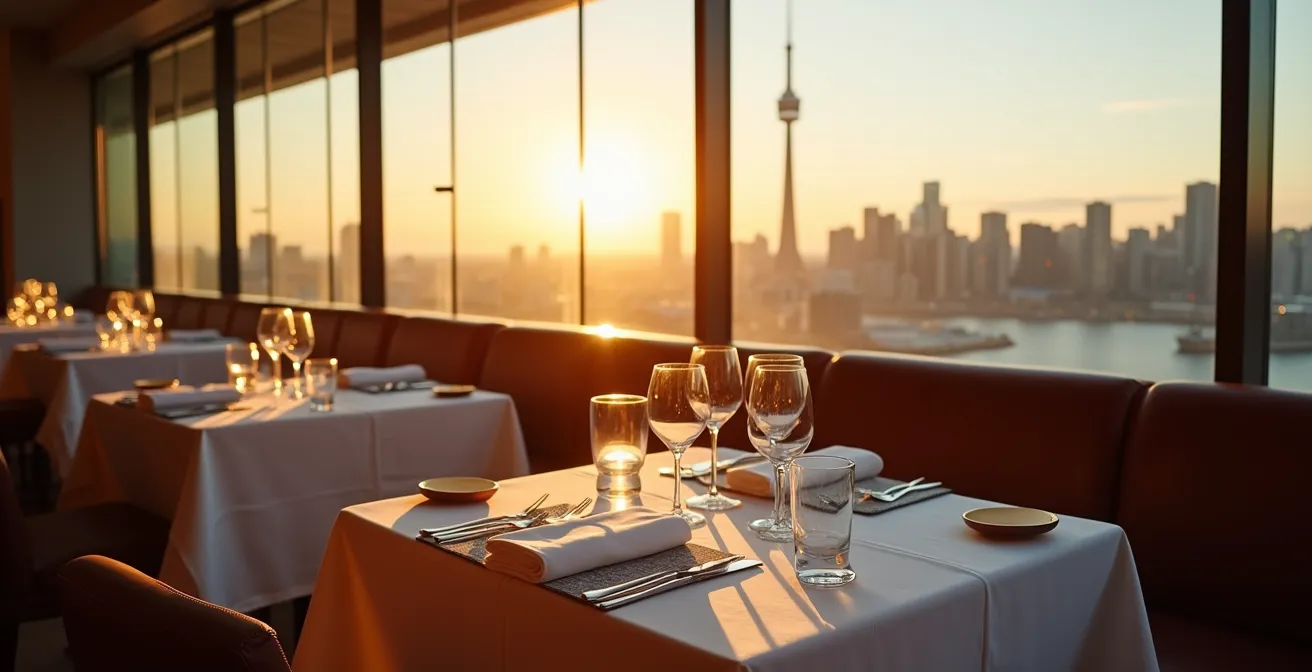
In summary:
- Securing a last-minute table is not about luck; it’s about systematically exploiting reservation platform mechanics and human psychology.
- Mastering the “Cancellation Window” (48-72 hours before a reservation) is the single most effective strategy for finding openings.
- Bar seating is not a downgrade; it often provides a superior, more interactive experience with unique menu options.
- Avoid costly no-show fees by understanding each restaurant’s strict policy and using a polite rescheduling script.
You see it every time you try: a wall of fully booked calendars for Alo, Edulis, or any of Toronto’s most coveted dining rooms. The frustration is palpable. For foodies, gaining access to these exclusive culinary experiences feels like a game of chance, with the odds stacked against you. The common advice—”be flexible” or “set an alert”—is well-meaning but ultimately insufficient in a city where the dining scene is this competitive. With 17 restaurants in the Greater Toronto Area holding Michelin stars as of 2025, the demand for these tables has never been higher.
But what if getting that impossible reservation wasn’t about luck at all? What if it was a solvable puzzle? The truth is that securing a last-minute table is a skill. It’s about understanding and systematically exploiting the loopholes, timing, and psychological triggers built into the city’s high-stakes dining ecosystem. It requires moving beyond simple notifications and embracing a more strategic approach, from mastering the technology of reservation drops to leveraging the very human habit of last-minute cancellations.
This guide acts as your personal dining concierge, revealing the insider strategies to navigate this complex landscape. We will deconstruct the systems, analyze the value propositions of top-tier tasting menus, highlight the costly mistakes to avoid, and uncover the hidden opportunities—like the often-superior bar experience. Get ready to turn your dining disappointments into celebrated reservations.
To help you navigate this exclusive world, this guide breaks down the essential strategies and insider knowledge needed to conquer Toronto’s fine dining reservation scene. Here’s what we’ll cover:
Summary: Mastering Toronto’s Michelin Reservation Game
- Why Does Resy Release Tables at Midnight and How to Be Ready?
- How to Use “Notify Me” Features Effectively to Get Cancellations?
- Alo vs. Don Alfonso: Which Tasting Menu Offers Better Value for Money?
- The Cancellation Mistake That Costs You $100 Per Person
- Why is Dining at the Bar Often Better Than the Main Dining Room?
- The View Tax: Do You Pay for the Scenery or the Food Quality?
- How to Secure a Patio Spot at El Catrin Without a 3-Hour Wait?
- Hosting a Dinner Party: How to Build a Charcuterie Board Using Only St. Lawrence Market Finds?
Why Does Resy Release Tables at Midnight and How to Be Ready?
The midnight or early morning table release on platforms like Resy and Tock isn’t arbitrary; it’s a system designed to create a fair, time-gated process that prevents bots and scalpers from hoarding reservations. By releasing inventory for a specific future date (typically 30-60 days out) at a precise time, restaurants create a level playing field. However, this “digital lineup” is won by the fastest clicker. Being ready isn’t just about being awake; it’s about having your digital tools optimized for speed. This is the foundational skill of reservation arbitrage: being prepared to act faster than anyone else when the opportunity arises.
Your success depends on eliminating every possible micro-delay. This means pre-logging into platforms, ensuring your credit card is saved for one-click confirmation, and using a desktop browser, which often processes requests faster than a mobile app. The difference between securing a table and seeing the dreaded “This table is no longer available” message can be a matter of milliseconds. Think of it like buying concert tickets for a superstar—the demand is immense, and only the most prepared succeed. By having multiple tabs open for different party sizes, you multiply your chances of snagging any available slot.
Your Action Plan: Pre-Drop Tech Setup Checklist for Toronto Michelin Reservations
- Pre-log into Resy and Tock platforms 30 minutes before release time.
- Save your credit card information in both platforms for auto-fill.
- Use a desktop browser with Chrome auto-fill over a mobile app for faster processing.
- Open multiple tabs for different party sizes (1, 2, 3, 4) to maximize chances.
- Set calendar alerts for specific restaurant release times (most release 30-60 days in advance).
Ultimately, the midnight release is the first gate. While it may seem daunting, a strategic and technical approach transforms it from a game of luck into a contest of preparation.
How to Use “Notify Me” Features Effectively to Get Cancellations?
Simply hitting the “Notify Me” button on Resy or Tock and hoping for the best is a passive strategy that rarely pays off. To use this feature effectively, you must understand the psychology behind cancellations. The most valuable openings don’t appear randomly; they cluster around what insiders call the “Cancellation Window”—typically 48 to 72 hours before the reservation time. This is when diners, faced with hefty cancellation fees, are forced to make a final decision. Your phone should be in your hand, ready to act, during this prime-time window.
A prime example of this dynamic is seen in Toronto’s high-demand restaurants. For instance, a case study on Yorkville’s dining scene reveals a powerful pattern: Osteria Giulia charges $75 per guest for cancellations within 48 hours. This strict policy creates a predictable surge of availability precisely at that 48-hour mark. Instead of waiting for a notification, proactively check the app during these windows, especially for popular dining times like Friday and Saturday evenings. The notification is your backup; your proactivity is your primary weapon. This is where you transform from a hopeful diner into a strategic hunter.
This image captures the feeling of anticipation, waiting for that notification that a table has opened up. Your goal is to be the first to respond when it does. Be prepared to confirm instantly, as these highly-sought-after tables are often gone in seconds. Setting notifications for a wide range of dates and times increases your surface area for luck, but focusing your manual checks during the Cancellation Window is what truly improves your odds.
By understanding the system’s pressures, you can be in the right place at the right time, turning another diner’s changed plans into your celebrated night out.
Alo vs. Don Alfonso: Which Tasting Menu Offers Better Value for Money?
When you’re investing in a Michelin-star experience, “value” isn’t just about the price tag; it’s about the entire package—ambiance, service, creativity, and the lasting memory. In Toronto, Alo and Don Alfonso 1890 represent two pinnacles of fine dining, but they offer distinctly different value propositions. Alo, with its French-inspired, technically precise tasting menu, is often seen as the more “classic” high-end experience. Don Alfonso, on the other hand, delivers modern Mediterranean flair with dramatic, art-like presentations and stunning city views.
An objective cost breakdown is the first step in any comparison. The tasting menus themselves are priced differently, but you must also factor in the expected wine pairings and gratuity structure to understand the true total cost per person. This is where the perceived value can shift dramatically.
The following table breaks down the estimated costs, giving you a clearer picture of the financial commitment for each experience. As you can see from this direct comparison of their offerings, Don Alfonso’s price includes gratuity, which simplifies the final bill, while Alo’s pricing structure is more traditional.
| Restaurant | Tasting Menu Price | Wine Pairing | Gratuity | Total Per Person |
|---|---|---|---|---|
| Alo | $225 per guest | $135 (estimate) | 18% expected | $425 |
| Don Alfonso 1890 | $285 (estimate) | $165 (estimate) | Included | $450 |
Beyond the numbers, the qualitative value is what truly matters. As one Michelin Guide Inspector noted, Alo’s strength lies in its balance of excellence and approachability. This sentiment is captured perfectly in their review:
Alo is the rare high achiever that never takes itself too seriously
– Michelin Guide Inspector, Michelin Guide Canada 2025
Ultimately, the “better value” depends on your priorities. If you seek impeccable, innovative cuisine in an intimate and focused setting, Alo likely offers more “food-first” value. If you desire a spectacular, all-encompassing sensory experience where the view is part of the main course, Don Alfonso’s slightly higher price tag may be well worth it.
The Cancellation Mistake That Costs You $100 Per Person
In Toronto’s high-stakes dining scene, a reservation is a binding contract, and the most common mistake diners make is underestimating the financial consequences of breaking it. Cancellation policies are no longer a slap on the wrist; they are a significant revenue-protection tool for restaurants that operate on razor-thin margins. Forgetting to cancel, or cancelling too late, can easily result in charges of $100, $200, or even the full price of the tasting menu per person. These fees are not just for no-shows; they apply to cancellations made inside the strict policy window, which can be as long as a week for larger parties.
The city’s most exclusive restaurants have some of the most stringent policies, reflecting the immense preparation that goes into each service. As detailed in reports on Toronto’s dining scene, these fees are a necessity. At Kaiseki Yu-zen Hashimoto, which has only three tables, a no-show on the day of the reservation incurs a full charge of $350 per person. At Toronto’s only two-star establishment, Sushi Masaki Saito, cancelling a party of two with less than 48 hours’ notice triggers a staggering $400 per person charge. These aren’t penalties; they are the cost of a seat that the restaurant can no longer fill.
If you find you can’t make a reservation, immediate and polite communication is key. Waiting until the last minute is the costliest error. Instead, adopt a proactive approach. The moment you know your plans have changed, call the restaurant. A polite and honest conversation can sometimes lead to a fee waiver or, more likely, a successful reschedule. Here’s a simple script to follow:
- Call immediately when you know you can’t make it—don’t wait.
- Start with: “I have a reservation this [day] and unfortunately need to reschedule due to unforeseen circumstances.”
- Offer alternative dates immediately: “Would you have availability next week on [specific days]?”
- Acknowledge the inconvenience: “I understand this affects your planning and apologize.”
- Ask about moving to bar seating as an alternative if dining room rebooking isn’t possible.
Treat your reservation with the same seriousness as a theatre ticket. By being mindful and communicative, you protect both your wallet and your relationship with the city’s finest establishments.
Why is Dining at the Bar Often Better Than the Main Dining Room?
For many, bar seating is seen as a consolation prize—the last resort when a proper table isn’t available. This is a critical misunderstanding in the world of fine dining. At Toronto’s top restaurants, the bar is not a waiting area; it is a distinct and often superior experience. The Bar Seating Advantage is threefold: it offers greater accessibility for walk-ins or last-minute bookings, a more intimate and interactive experience, and sometimes, access to an entirely different, more flexible menu.
Many Michelin-starred restaurants, including the famed Alo, dedicate their bar area to a unique culinary program. It’s a space where the kitchen can experiment or offer à la carte portions of their celebrated dishes, freeing you from the commitment of a full tasting menu. This flexibility is a huge advantage for a spontaneous weeknight indulgence. Furthermore, sitting at the bar puts you face-to-face with the masters of their craft—the bartenders and sometimes even the chefs. This proximity provides a “behind-the-scenes” look at the artistry and precision that goes into every plate and cocktail, creating a more dynamic and engaging meal.
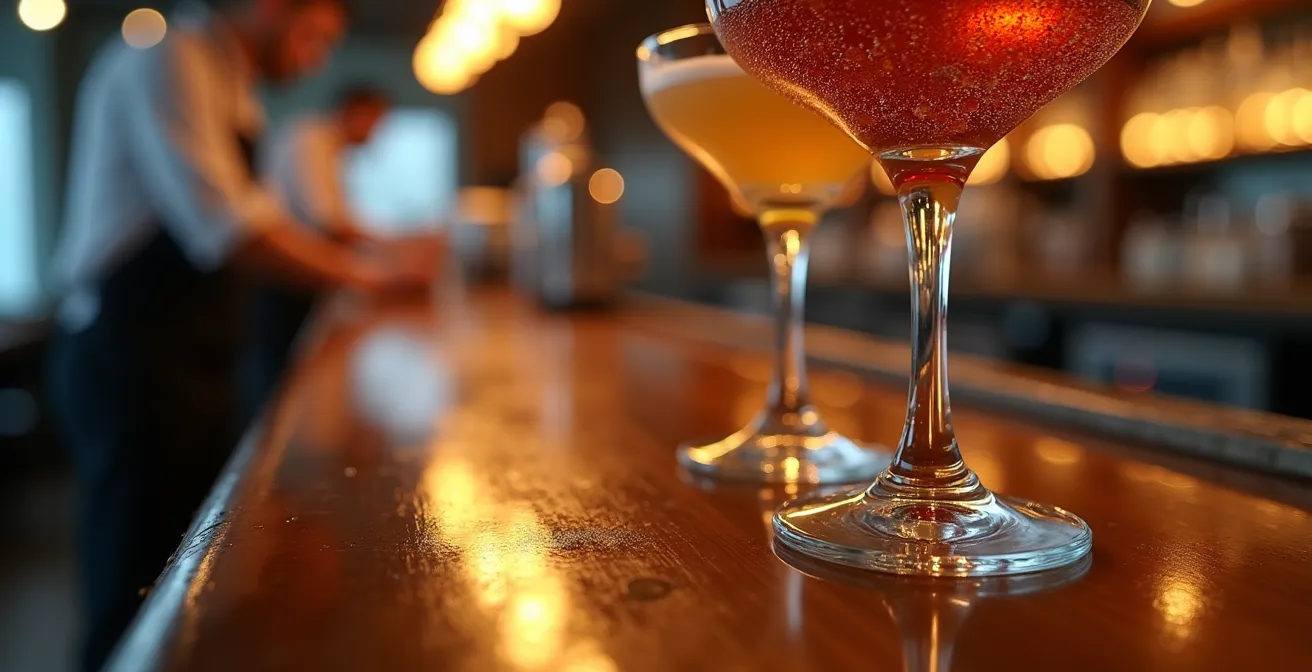
The experience is confirmed by the restaurants themselves. As Alo highlights on its official website, the bar is a curated experience in its own right, not merely an overflow area. This distinction is crucial for any discerning foodie.
The Bar at Alo features a seasonal six course tasting menu alongside à la carte options from Alo’s award winning dining room menu
– Alo Restaurant, Official Alo Website
So, the next time you’re searching for a reservation, don’t just filter for “dining room.” Inquire about the bar. You may find that the best-kept secret in Toronto’s fine dining scene was hiding in plain sight all along.
The View Tax: Do You Pay for the Scenery or the Food Quality?
In a city with a skyline as iconic as Toronto’s, it’s inevitable that some restaurants will monetize their vista. This leads to an important concept for discerning foodies: the “View Tax.” This is the undeclared premium you pay for a meal in a restaurant with a breathtaking view, like Canoe or Don Alfonso 1890. The critical question to ask is whether this “tax” is subsidizing a subpar culinary experience or simply adding to an already excellent one. In the best-case scenario, the food is as spectacular as the scenery. In the worst case, you’re paying top dollar for an average meal with a great backdrop.
Dissecting the value proposition is key. A restaurant’s price point is a complex equation of food cost, labor, rent, and perceived brand value. When a restaurant occupies a prime location on the 54th floor of a downtown tower, its rent is astronomical. That cost is invariably passed on to the consumer. Your job as a strategic diner is to determine if the kitchen’s output justifies that inflated price. Read reviews that focus specifically on the food, ignoring comments about the view. Does the chef have a pedigree? Are the ingredients top-tier? Is the technique precise?
The presence of a Michelin star at a “view” restaurant is often a good sign that the food quality meets a global standard, ensuring you’re not just paying for a pretty picture. The guide’s expansion into Toronto has helped provide this benchmark. However, the View Tax can still exist, even in decorated establishments. The most astute diners learn to recognize when the price reflects true culinary artistry and when it’s simply the cost of admission for a great Instagram photo. Sometimes, the best “value” is found in a less scenic, food-focused establishment in a quiet neighborhood.
Ultimately, there’s nothing wrong with paying for a stunning view, as long as you do so with open eyes. Understand what you’re paying for, and decide if that panoramic cityscape is a worthwhile addition to your tasting menu.
How to Secure a Patio Spot at El Catrin Without a 3-Hour Wait?
During Toronto’s precious summer months, securing a spot on a top patio like El Catrin in the Distillery District can feel more challenging than getting a Michelin reservation. The infamous three-hour waits are legendary. However, applying a strategic, data-driven approach can cut that wait time EPFO dramatically or eliminate it altogether. The key is to think like a restaurant manager and target periods of lower demand. This means avoiding the obvious peak times: sunny Friday and Saturday evenings.
The most effective strategy is timing. Demand for patio seating is highly predictable. By understanding and exploiting these patterns, you can gain a significant advantage. For instance, the “post-lunch, pre-dinner” lull is your golden hour. Arriving between 3:00 PM and 4:00 PM on a weekday often results in minimal to no wait. Additionally, weather is a massive factor; a slightly overcast or cooler day can deter the casual crowd, creating opportunities for the dedicated patio-seeker. Don’t underestimate the power of technology, either; using an app like SevenRooms to join a virtual waitlist before you even leave home can save you hours of standing in line.
Here are some field-tested hacks for conquering the El Catrin patio line and others like it in the Distillery District:
- Target the Lull: Arrive between 3:00 PM and 4:00 PM on weekdays for the shortest wait.
- Be a Mid-Week Diner: Tuesday through Thursday offer the best availability compared to the weekend rush.
- Use the Virtual Waitlist: Check if the restaurant uses an app like SevenRooms to join the queue remotely.
- Split to Win: For groups of 5 or more, you’ll often be seated faster if you are willing to split into two smaller tables.
- Become a Weather-Watcher: Cloudy days can reduce patio demand by as much as 40%, making them a perfect time to strike.
Instead of letting the queue dictate your plans, take control. A little bit of strategic planning is all it takes to enjoy your margarita under the sun, not in a line.
Key takeaways
- Master reservation tech by pre-saving your details on Resy/Tock for midnight table drops.
- The “48-Hour Cancellation Window” is your best chance for last-minute openings as diners avoid fees.
- Don’t dismiss bar seating; it’s often a more flexible and interactive fine dining experience.
Hosting a Dinner Party: How to Build a Charcuterie Board Using Only St. Lawrence Market Finds?
After experiencing the precision of a Michelin-starred meal, you might be inspired to bring that level of quality and curation into your own home. Hosting a dinner party with a show-stopping charcuterie board is the perfect way to do so. And in Toronto, there is no better place to source your ingredients than the historic St. Lawrence Market. Building a world-class board is about applying a chef’s mindset: focusing on hyper-local sourcing, variety, and quality over quantity. With over 120 specialty food stalls in the historic South Market building, you have a culinary playground at your fingertips.
A great board is a journey of textures and flavors. Forget the generic grocery store selection and instead, curate your components by visiting the market’s legendary vendors. Start your journey at Scheffler’s Delicatessen & Cheese for a diverse selection of cured meats. Then, head to a cheese specialist like Alex Farm or Olympic Cheese. The secret is to let the experts guide you; tell them what you like, and ask for a recommendation. For instance, Alex Farm is known for its friendly, knowledgeable staff who can introduce you to gems like a Truffle Trove aged cheddar. Finally, don’t forget the accompaniments that elevate a board from good to great: artisanal mustards from Kozlik’s Canadian Mustard, fresh bread from a market bakery, and unique preserves or olives.
Your goal is to tell a story with your board—a story of Toronto’s best artisans. Here’s a simple framework for your St. Lawrence Market shopping trip:
- Cheeses (3-4 types): Aim for variety in milk type (cow, goat, sheep) and texture (hard, soft, creamy). Ask the cheesemongers at Alex Farm for njihov signature picks.
- Meats (2-3 types): Select a mix from Scheffler’s, such as a spicy soppressata, a delicate prosciutto, and a rich pâté.
- A Vehicle: Fresh baguette or artisanal crackers.
- A Sweet Element: Fig jam, honeycomb, or seasonal fruit from a produce vendor.
- A Savory Element: Cornichons, olives, or a bold mustard from Kozlik’s.
By sourcing your ingredients with intention from a place fichiers with culinary history, you’re not just serving food; you’re offering an experience that channels the very spirit of the Michelin chefs you admire.