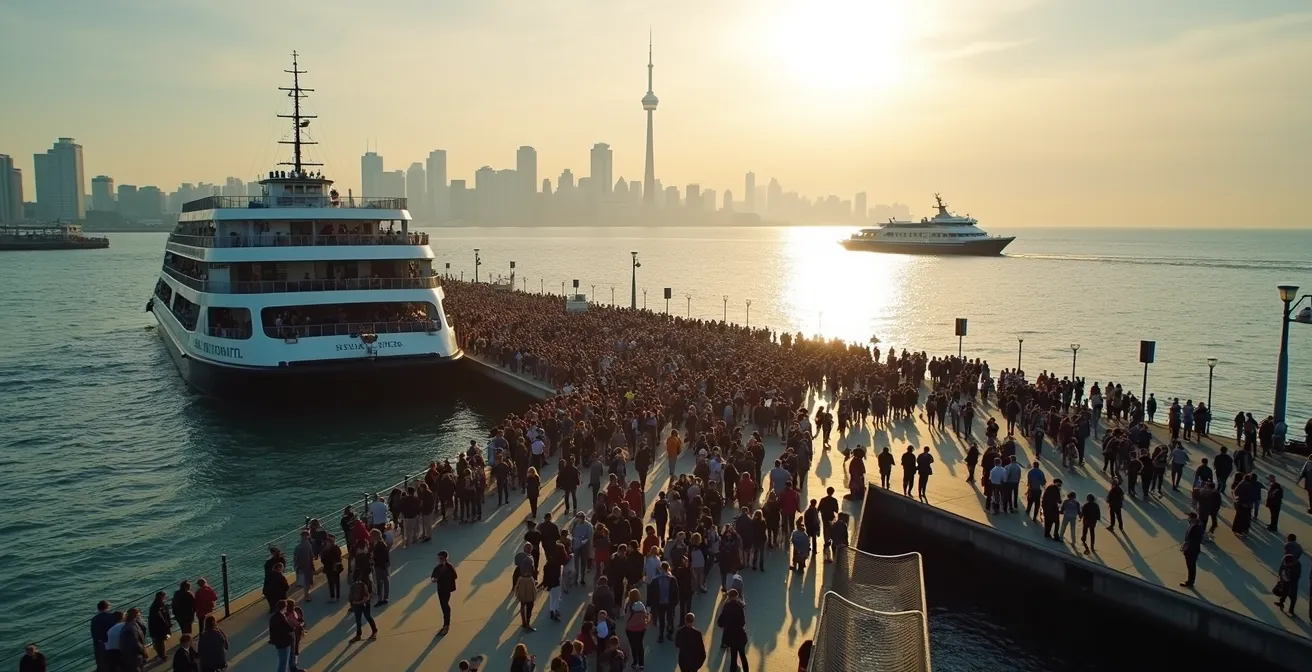
Beating the Toronto Island ferry line isn’t about buying a ticket online; it’s about outsmarting a series of predictable logistical chokepoints.
- Online tickets only let you bypass the ticket purchase queue, not the main boarding line which is the primary bottleneck.
- The two biggest crowd surges occur when people arrive between 9:30 AM – 2:00 PM and when they try to return immediately after the sun sets.
Recommendation: Combine an early-morning departure (before 9:30 AM) on the city ferry with a pre-booked return trip on a water taxi to guarantee a queue-free day.
You’ve seen the photos, the sprawling, sun-baked queue snaking back from the Jack Layton Ferry Terminal. For many Torontonians and tourists, a beautiful day trip to Centre Island begins with a frustrating, two-hour test of patience. The common advice is to simply “buy tickets online” or “go early,” but these platitudes fail to address the core of the problem. The ferry line is not a single entity; it’s a system of bottlenecks, each with its own rhythm and its own hack. Thinking you’ve solved the problem with a QR code is the first mistake that lands you in the same slow-moving crowd as everyone else.
The real issue isn’t just the ticket booth. It’s the confluence of arrival times, security screening, vessel capacity, and the predictable mass exodus at the end of the day. This is a logistics challenge, and it requires a logistical solution. Forget the vague tips. The key is to stop thinking like a tourist waiting in line and start thinking like a strategist identifying and bypassing chokepoints. It’s not about waiting more patiently; it’s about not waiting at all.
This guide breaks down the ferry experience into its critical components. We will dissect the queue dynamics, quantify the value of alternatives, and provide a clear, actionable playbook for your arrival, your departure, and your transport to the terminal itself. We’ll explore why your timing is more important than your ticket type and how a small investment in an alternative can buy you hours of your day back. This is your plan to reclaim your summer weekend from the queue.
This article provides a complete strategic breakdown for navigating the Toronto Islands transportation system. Below, you’ll find a detailed look at each logistical chokepoint and the specific tactics you can use to bypass them, ensuring your trip is about the island, not the wait.
Summary: Your Guide to Hacking the Toronto Island Ferry System
- Why is 11 AM the Worst Possible Time to Arrive at the Docks?
- How to Use Online Tickets to Bypass the Ticket Booth Line?
- City Ferry vs. Water Taxi: Is the Extra $10 Worth the Speed?
- The Return Trip Mistake: Waiting Until After the Fireworks to Leave
- How to Bring Your Bike on the Ferry Without Hassle?
- TTC Streetcar vs. Parking Lot: Which is Less Stressful for a Day Trip?
- Why is Flying into Porter Airlines Worth the Extra Ticket Cost?
- Cycling in Toronto: How to Commute on the Martin Goodman Trail Safely?
Why is 11 AM the Worst Possible Time to Arrive at the Docks?
The chaos at the Jack Layton Ferry Terminal isn’t random; it’s a predictable wave of humanity that crests between 9:30 AM and 2:00 PM on any sunny summer weekend. Arriving at 11 AM places you at the absolute peak of this logistical chokepoint. This is the moment when late-risers, organized families, and optimistic tourists all converge, creating a perfect storm of demand that overwhelms the ferry system’s capacity. The queue you see isn’t just for one boat; it’s the accumulated backlog of several ferry cycles, meaning you could be waiting for two or three departures before you even step on board.
Understanding the queue dynamics is the first step to beating them. The period before 9:30 AM is relatively calm, populated by early-bird locals and cyclists. This is your golden window for a stress-free departure. By the time 10 AM hits, the lines are visibly forming. After 2:00 PM, the initial surge begins to subside as most day-trippers have already made it to the island. A late-afternoon arrival after 4 PM can be surprisingly pleasant, offering a completely different, less crowded island experience as the morning crowds start thinking about their return trip. The City of Toronto often posts real-time crowd warnings on its social media channels, which can serve as a last-minute indicator, but the most effective strategy is proactive scheduling, not reactive avoidance.
Your Pre-Trip Crowd Avoidance Checklist
- Assess your timing: Are you planning to arrive between the peak hours of 9:30 AM and 2:00 PM? This is the primary chokepoint to avoid.
- Monitor official channels: Before leaving, check the City of Toronto’s social media for any real-time crowd advisories or service disruptions.
- Prepare your ticket: Have you purchased your ticket online and, crucially, taken a screenshot of the QR code for fast, offline access?
- Analyze your return: What is your exit strategy? Waiting until the evening rush is the second major bottleneck; plan to leave before 4 PM or use an alternative.
- Consider alternatives: If your timing is inflexible, have you researched water taxi locations and pricing as a viable backup plan?
How to Use Online Tickets to Bypass the Ticket Booth Line?
The most common piece of advice for the Toronto Island ferry is to “buy tickets online.” This is good advice, but it’s dangerously incomplete. An online ticket is not a magic pass to the front of the line; it is a tool to bypass only the first chokepoint: the ticket purchasing queue. At the terminal, you’ll see two lines. The longer, slower one is for people buying tickets. The typically shorter one on the left is for those who already have their QR code. This is where your online purchase pays off, potentially saving you 20-30 minutes.
However, once you are scanned through this initial gate, you merge into the main boarding queue with everyone else. This second line is dictated by ferry capacity and security screening, and it’s where the real wait happens during peak hours. Believing your online ticket exempts you from this is the crucial mistake that leads to frustration. The true value of the online ticket is realized when combined with a “screenshot strategy.” Internet service at the crowded terminal can be spotty. Immediately after purchasing your tickets from the official city website, take a clear screenshot of the QR code. Save it to your phone’s photo gallery for instant, offline access. Fumbling for an email or waiting for a webpage to load holds up the line and adds unnecessary stress.

As the image illustrates, the system is designed to separate ticket purchasers from ticket holders at the entrance. The goal is to get into that faster-moving holder line with your QR code ready to be scanned. The parent bypassing the long queue with their phone represents the small but significant victory of proper preparation. This simple act of having your screenshot ready ensures you move through the first gate as efficiently as possible, getting you into the main boarding queue that much sooner.
City Ferry vs. Water Taxi: Is the Extra $10 Worth the Speed?
When you’re staring at a 90-minute wait for the city ferry, the nearby water taxi barkers start to sound very appealing. But is the extra cost worth it? This isn’t a question of luxury; it’s a calculation of time arbitrage. You’re trading a small amount of money for a significant amount of your day back. A one-way trip on a water taxi costs around $13, compared to the ferry’s round-trip price of about $9.11. While this seems like a steep premium, the value becomes clear when you factor in the wait time.
During peak summer weekends, the wait for a water taxi is typically 5-15 minutes, versus 30-90 minutes for the city ferry. The trip itself is also faster, taking 5-10 minutes compared to the ferry’s 13-15 minutes. Companies like Pirate Taxi and Toronto Harbour Tours operate frequently from multiple points along the waterfront, offering flexibility the single-terminal ferry can’t match. They also often allow bikes for free and have simple payment systems, though some may have a small surcharge for credit cards. The real win is the near-elimination of the queue. For a family of four, an extra $40-50 for a round trip on a water taxi could reclaim over two hours of their day—time spent on the island, not on the asphalt.
This table breaks down the core differences, but the most important metric is the time saved during peak periods. As this comparative analysis of harbour transport shows, the value proposition of water taxis increases dramatically as ferry wait times grow.
| Service Type | Cost (One-way) | Wait Time | Travel Time | Frequency |
|---|---|---|---|---|
| City Ferry | $9.11 (return) | 30-90 min peak | 13-15 minutes | Every 15-30 min |
| Water Taxi | $13 | 5-15 min | 5-10 minutes | Every 15 min |
| Time Value Difference | +$3.89 | Save 45-75 min | Save 5 min | More flexible |
The Return Trip Mistake: Waiting Until After the Fireworks to Leave
You’ve had a perfect day on the island. The sun is setting, casting a beautiful glow on the Toronto skyline. The universal instinct is to linger, to soak up every last moment, and to head back only when it’s truly dark. This is the biggest mistake you can make. The return trip is the second major logistical chokepoint of the day, and the crowd surge after sunset is often worse than the morning rush. Everyone has the same idea, creating a massive, chaotic queue at the Centre Island dock, especially on Canada Day or after other events with fireworks.
The peak return period is predictable. According to a City of Toronto advisory from June 2024, the hours between 5:30 PM and 9 PM are the busiest for return ferries. To avoid this, you have several strategic options. The simplest is to leave before 4 PM, beating the rush entirely. A more creative hack is to walk or bike 15-20 minutes east to the Ward’s Island ferry dock. It’s a primarily residential area, and its ferry line is almost always significantly shorter than the one at Centre Island. Another option is to pre-book a return trip on a water taxi, locking in your departure time and price before the evening surge begins. For photographers, taking the 7 PM ferry offers the best of both worlds: you get stunning golden hour photos of the skyline from the water and still beat the main exodus.
Finally, always be aware of the last departure times, which are typically around 11:45 PM from Centre Island and Ward’s Island, but earlier (around 11:00 PM) from Hanlan’s Point. Missing the last boat means an expensive water taxi is your only way home.
How to Bring Your Bike on the Ferry Without Hassle?
Cycling is arguably the best way to explore the Toronto Islands, but bringing your own bike on the ferry requires navigating a specific set of rules and logistical hurdles. The first thing to know is that cyclists have a dedicated process. You don’t just join the main pedestrian queue. Look for a designated bike waiting area, usually to the side of the main line. This is your official staging zone.
The golden rule of ferry cycling is that bicycles board last. You must wait until all foot passengers have boarded before the crew signals for cyclists to proceed. You are required to walk your bike onto the main deck of the ferry and secure it away from doorways and emergency exits. This process is reversed upon arrival; you disembark after all other passengers. Trying to rush this process or board with the pedestrian crowd will only cause delays and earn you a stern warning from the crew. It’s also critical to note that while personal bikes are welcome, Bike Share Toronto bikes are not permitted on the ferry. The system is designed to be used on either the mainland or the island, but not transported between the two. Similarly, e-scooters are prohibited.
If bringing your own bike seems like too much hassle, using the Bike Share stations on the island is a viable alternative. There are docks conveniently located near all three ferry terminals (Ward’s, Centre, and Hanlan’s). However, be aware that on a busy day, finding an available bike can be a challenge, just as finding an empty dock to return one can be. The ultimate decision depends on your preference for your own ride versus the convenience of a grab-and-go option.
TTC Streetcar vs. Parking Lot: Which is Less Stressful for a Day Trip?
Your island trip strategy begins before you even see the water. The journey to the Jack Layton Ferry Terminal can be a significant source of stress, and your choice of transport sets the tone for the day. For many, the decision comes down to taking the TTC versus driving and parking. Each has a clear trade-off between cost, time, and stress.
Driving offers personal freedom but comes at a steep price. Finding a parking spot in downtown Toronto on a weekend is a challenge in itself. The lots closest to the ferry terminal can charge anywhere from $30 to $45 for a full day of parking. Even street parking is costly, with an analysis of Toronto parking rates showing prices around $3.00-$4.25 per hour, assuming you can even find a spot. The time spent circling blocks looking for parking can easily add 30 minutes of stress to your trip before you even join the ferry queue.
In contrast, the TTC is the most direct and cost-effective option. The 509 Harbourfront and 510 Spadina streetcars drop you off directly in front of the terminal. From Union Station, the ride is a mere 10 minutes for a standard $3.35 fare. While the streetcar can be crowded during peak times, it eliminates all parking-related anxiety. An even better, stress-free option is a simple 15-minute walk from Union Station. This route is straightforward, entirely free, and allows you to bypass any traffic or transit crowding. For those coming from outside the city, taking the GO Train to Union and walking from there is often the most efficient and least stressful combination.
| Option | Cost | Stress Level | Time from Union Station |
|---|---|---|---|
| 509/510 Streetcar | $3.35 | Medium (crowded) | 10 minutes |
| Walk from Union | Free | Low | 15 minutes |
| Downtown Parking | $30-45/day | High (finding spot) | Variable |
| GO Train + Walk | Variable | Low | 15 min walk |
Why is Flying into Porter Airlines Worth the Extra Ticket Cost?
For tourists visiting Toronto, the choice of airport can be the ultimate logistical hack for accessing the islands. While most travelers default to Toronto Pearson (YYZ), choosing to fly into Billy Bishop Toronto City Airport (YTZ) with Porter Airlines offers a massive, overlooked advantage. Billy Bishop Airport is located on a small peninsula at the western end of the harbour, physically separate but strategically adjacent to the Toronto Islands. This unique location allows you to completely bypass the chaos of the Jack Layton Ferry Terminal.
The key is the free pedestrian tunnel operated by PortsToronto, which connects the airport to the mainland at the foot of Eireann Quay, near Bathurst Street. This tunnel is open 24/7 and takes just a few minutes to walk through. Upon emerging on the mainland, you are a mere five-minute walk from several water taxi stands. This means you can go from your flight to a boat heading for the islands in under 15 minutes, without ever going near the main ferry terminal. This strategy not only saves you from the queue but also saves a significant amount of money; a taxi from Pearson to the downtown core can easily cost over $60, a cost you entirely avoid by landing right in the heart of the waterfront.
While the ticket price for Porter might sometimes be higher than other airlines flying into Pearson, the savings in ground transportation costs, time, and stress can easily make it the more valuable option for any tourist whose primary goal is to enjoy the city’s waterfront and islands.
Key Takeaways
- The Toronto Island ferry line is a series of predictable chokepoints, not a single queue. Your strategy must address arrival time, ticket type, and return time.
- Online tickets are crucial but only let you skip the ticket purchase line, not the main boarding queue. A screenshot of your QR code is essential for efficiency.
- Water taxis offer significant time savings during peak hours. The extra cost is a direct trade for avoiding a 1-2 hour wait.
Cycling in Toronto: How to Commute on the Martin Goodman Trail Safely?
For local cyclists, the Martin Goodman Trail is the city’s waterfront superhighway, offering a scenic and efficient route to the ferry terminal. However, navigating it safely and effectively during the peak of summer requires some awareness. The trail becomes extremely congested on weekends, particularly between 1 PM and 4 PM, with a mix of fast-moving road cyclists, leisurely tourists on rental bikes, pedestrians, and families. Maintaining a predictable line and using your bell when passing is crucial for safety.
When approaching the Jack Layton Ferry Terminal from the west, your two main exit points from the trail are Lower Simcoe Street or Bay Street. Both intersections have designated pedestrian crossings to get you safely across the busy Queens Quay. From there, you’ll walk your bike through the park space directly to the terminal entrance. Always check the City of Toronto’s website for trail construction updates, as detours are common in the summer and can add unexpected time to your journey. The key is to treat the final leg of your ride as a “dismount zone” and proceed on foot for safety.
A final logistical consideration is Bike Share. While there is a large Bike Share Toronto station in Harbour Square Park right by the terminal, it is frequently full during peak arrival times, leaving you with nowhere to dock your bike. You may need to use alternative docks a 5-minute walk away at York Street and Queens Quay or on Lower Jarvis Street. This can add an unexpected delay, so if you’re on a tight schedule, factor in this potential “dock hunting” time. Planning your route and docking strategy is just as important as planning your ferry time.
Your trip to the Toronto Islands doesn’t have to start with a test of endurance. By adopting a strategic mindset and treating the journey as a series of logistical puzzles to be solved, you can bypass the chokepoints and reclaim your day. The ultimate solution is to combine these tactics into a seamless plan. Assess your options, make a decision, and execute it with confidence.