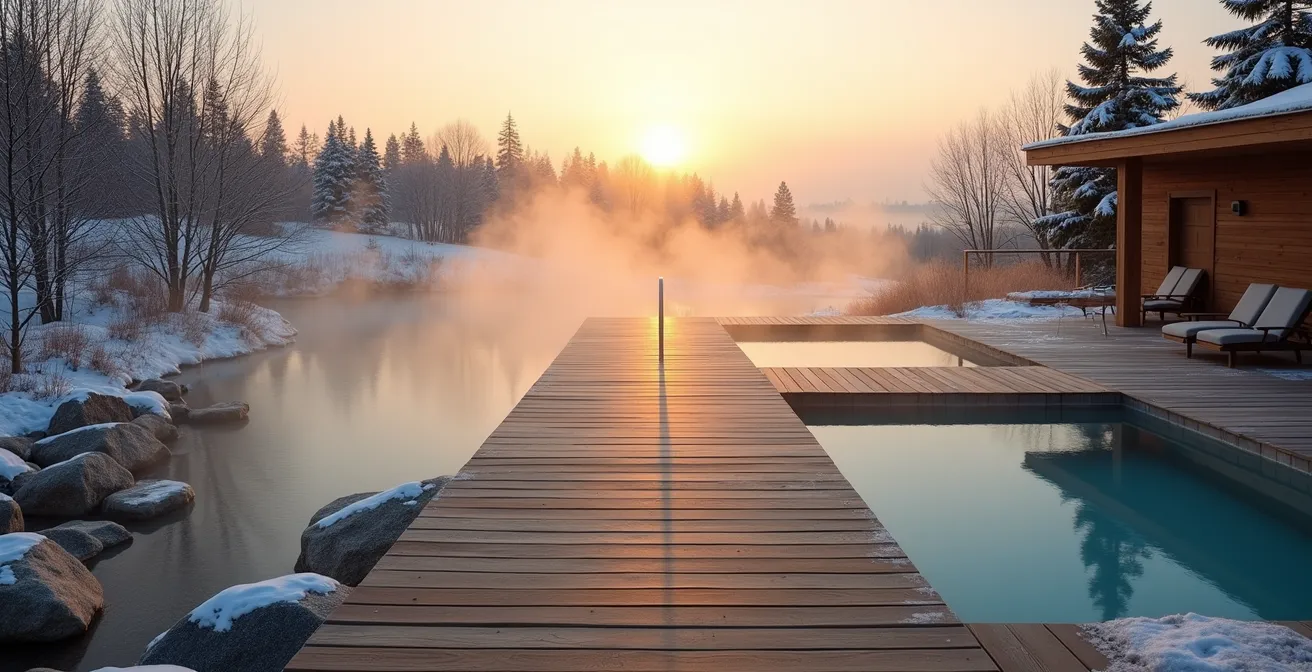
To truly benefit from a Nordic spa, Toronto professionals must treat it as a form of neurochemical engineering, not just passive relaxation.
- The key is mastering specific protocols for timing, hydration, and digital disconnection to deliberately trigger positive hormonal responses like dopamine release.
- Your choice between a social spa like Othership or a silent one like Scandinave directly impacts your ability to achieve mental clarity versus social connection.
Recommendation: Before your next spa visit, create a simple plan detailing your timing intervals, hydration strategy (including electrolytes), and a firm intention for disconnecting from your devices.
For the stressed Toronto professional, a trip to a Nordic spa is often prescribed as the ultimate urban detox. You book a session at a trendy spot like Othership or escape to a wellness village like Thermëa, expecting to emerge renewed. Yet, for many, the mental chatter doesn’t cease, and the promised bliss is fleeting, quickly replaced by a post-sauna headache or the familiar pull of digital anxiety. We’re told to simply “enjoy the hot and cold,” but this advice misses the point entirely.
The common approach treats the thermal cycle as a passive experience, a sort of human car wash. But what if the true power of the Nordic spa wasn’t just in the heat or the cold, but in the precise, intentional way you navigate them? What if, instead of just hoping for relaxation, you could actively engineer your own neurochemistry to build resilience, boost focus, and reset your dopamine baseline? This is the shift from passive relaxation to active recovery. It requires understanding the science behind the sensations.
This guide moves beyond the generic advice. It’s a strategic framework for the results-oriented individual who wants to leverage every minute of their wellness investment. We will deconstruct the process into specific, actionable protocols—from the exact duration of your cold plunge for optimal dopamine release to the critical hydration mistake you’re likely making. This is your manual for transforming a simple spa day into a powerful tool for mental performance and profound decompression.
To help you navigate these advanced techniques, this article breaks down the essential components of a truly effective Nordic spa cycle. From the science of the cold plunge to the art of digital disconnection, you will find a clear path to mastering your wellness experience.
Summary: A Strategic Guide to Engineering Your Mental State with a Nordic Spa Cycle
- Why is the “Cold Plunge” Essential for Dopamine Release?
- How to Time Your Sauna and Cold Plunge Intervals for Best Results?
- Social Sauna vs. Silent Spa: Which Experience Fits Your Introversion Level?
- The Hydration Mistake That Leads to Headaches After the Sauna
- How to disconnect from your phone for 3 hours without anxiety?
- The Overtime Trap: What Happens When You Ignore Ontario’s Employment Standards?
- Why is a North Wind Best for Paddleboarding at Woodbine Beach?
- Remote Work: Which Organic Cafe in Toronto Offers the Best WiFi and Power Outlets?
Why is the “Cold Plunge” Essential for Dopamine Release?
The cold plunge is more than just a bracing shock to the system; it’s a potent biochemical trigger. When your body is rapidly exposed to cold water, it initiates a powerful survival response. One of the most significant effects is the release of norepinephrine and dopamine, two key neurotransmitters for mood, focus, and motivation. This isn’t just a feeling; it’s a measurable physiological event. In fact, some studies have shown dopamine levels increasing by up to 250% following cold water immersion. This surge is sustained, meaning you don’t just feel good for a moment, but you can experience an elevated mood and sharper focus for hours afterward.
The key is understanding that the intensity and duration matter. As research highlighted in the Huberman Lab podcast suggests, the benefits are scalable. A study showed that spending about an hour in cool water (around 15°C/60°F) led to significant and prolonged dopamine increases. However, even very short exposures to much colder water can be effective. Other research describes a massive spike in epinephrine (adrenaline) from just 20 seconds in water around 4°C/40°F. This initial jolt is what wakes up your system, and the subsequent, more controlled exposure is what helps stabilize and elevate your dopamine baseline.
For beginners, the goal is not to endure for as long as possible but to be consistent. Start with a temperature you can tolerate, around 10-15°C (50-60°F), for just 1 to 3 minutes. The primary challenge is to control your breathing, consciously slowing your exhale to override the initial gasp reflex. As you adapt, you can gradually increase your duration or decrease the temperature, aiming for a total of around 11 minutes of cold exposure spread across the week to achieve a lasting impact on your mental state. This practice transforms the cold plunge from a test of endurance into a precise tool for neurochemical engineering.
How to Time Your Sauna and Cold Plunge Intervals for Best Results?
Once you understand the power of the cold, the next step is mastering the rhythm of the entire thermal cycle. A successful Nordic spa session is a dance between heat, cold, and rest. Simply alternating between them isn’t enough; the timing of each stage is what dictates the outcome, whether you’re seeking mental clarity, physical recovery, or deep relaxation. Using a waterproof fitness tracker can be an invaluable tool to monitor your heart rate, ensuring you’re pushing your system effectively during the heat and allowing it to recover fully during the rest periods.
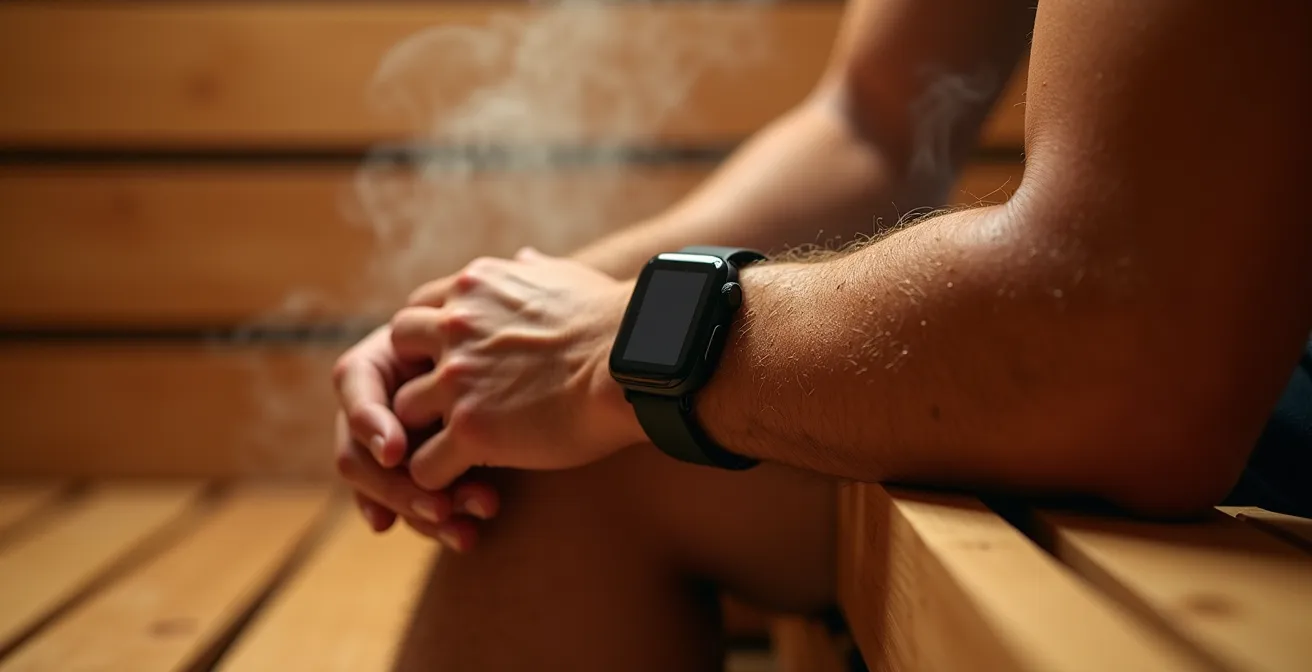
As the image suggests, tracking your body’s response in real-time allows you to move from generic guidelines to a personalized thermal protocol. Your heart rate elevates in the sauna, signalling the cardiovascular workout. The cold plunge then constricts blood vessels, and the subsequent rest period is when your system re-establishes equilibrium, or homeostasis. The magic happens in these transitions. Without proper timing, you risk either under-stimulating your body or, more commonly, not allowing enough time for the rest and integration phase, which is where many of the neurological benefits are cemented.
The optimal timing protocol depends entirely on your goal for the session. A general approach may not yield the specific results you’re after. For a more structured approach, you can follow goal-specific protocols that adjust the duration of each phase. A session aimed at enhancing mental clarity will have different intervals than one focused on muscle recovery after a workout.
This table, based on common practices at leading Canadian spas, provides a starting point for structuring your session. Notice how the rest period is often the longest component, highlighting its importance in the cycle.
| Goal | Sauna Duration | Cold Plunge | Rest Period | Cycles |
|---|---|---|---|---|
| Mental Clarity | 15 min | 30 sec | 20 min meditation | 2-3 |
| Physical Recovery | 20 min | 2 min | 10 min | 3 |
| Urban Decompression | 10-15 min steam | 1 min | 15 min quiet zone | 2-3 |
| Evening Relaxation | 20 min | 30 sec | 30 min | 2 |
As a leading Canadian spa, Thermea emphasizes that the rest period is as crucial as the hot and cold stages for achieving profound health benefits. Use these protocols as your starting blueprint. Pay attention to how your body feels and adjust the times. The goal is to find the rhythm that leaves you feeling invigorated and clear-headed, not depleted.
Social Sauna vs. Silent Spa: Which Experience Fits Your Introversion Level?
With your protocol in mind, the next critical decision is the environment. In Toronto and the GTA, the spa landscape offers two distinct philosophies: the social journey and the silent retreat. Your choice will fundamentally shape your experience and results. For instance, downtown Toronto’s Othership has redefined the spa as a vibrant, social gathering place. Born from a backyard project, it now hosts up to 50 people for guided sessions often featuring musical performances and themed events. It’s a space for connection, communal energy, and shared experience—an extrovert’s ideal for decompression.
In stark contrast, Scandinave Spa Blue Mountain enforces a strict code of silence. Here, the experience is intensely personal and introspective. With expansive views of the UNESCO World Biosphere Reserve, the focus is turned inward, encouraging a meditative state. It is a sanctuary for introverts or anyone seeking to disconnect from social demands and reconnect with themselves. The middle ground can be found at places like Thermëa Spa Village in Whitby, a 45-minute drive from Toronto. Its large, campus-like layout with eight different saunas and multiple pools allows you to curate your experience, moving between social and quiet zones as you see fit.
Understanding your own needs is key. Are you looking to process your thoughts in solitude, or are you seeking to de-stress through community and shared energy? There is no right or wrong answer, but an introvert attempting to find peace in a high-energy social sauna may leave feeling more drained than restored. Conversely, an extrovert might find the enforced silence of a traditional spa isolating. For many, a hybrid approach offers the best of both worlds.
Your Hybrid Spa Session Strategy: A Practical Checklist
- Start in a social zone for your first thermal cycle to decompress and connect with friends.
- After 60-90 minutes, transition to a designated quiet zone for a more introspective experience.
- Utilize on-site bistros or social areas for meal breaks, keeping them separate from your deep rest periods.
- Dedicate your final one or two cycles to silent areas for deep reflection and integration before you leave.
- Ensure you book a session of at least three hours to allow ample time to experience both atmospheres without feeling rushed.
The Hydration Mistake That Leads to Headaches After the Sauna
You’ve perfected your timing and chosen the right environment, yet you still walk away with a dull, throbbing headache. The culprit is almost always the most overlooked aspect of thermal therapy: hydration architecture. The common advice to “drink plenty of water” is dangerously simplistic. During a sauna session, you don’t just lose water; you sweat out crucial electrolytes like sodium, potassium, and magnesium. Replenishing with plain water alone can further dilute your body’s electrolyte balance, leading directly to headaches, fatigue, and muscle cramps—symptoms that negate the very benefits you came for.
The cost of severe dehydration highlights the seriousness of this issue. In extreme cases, people turn to professional services where mobile IV therapy services in Toronto typically cost between 500-650 CAD to rapidly restore fluid and electrolyte balance. This should serve as a wake-up call: proactive and intelligent hydration is not optional. Your strategy must begin long before you enter the sauna and continue after you leave. It’s about providing your body with the raw materials it needs to manage the thermal stress you’re about to put it through.
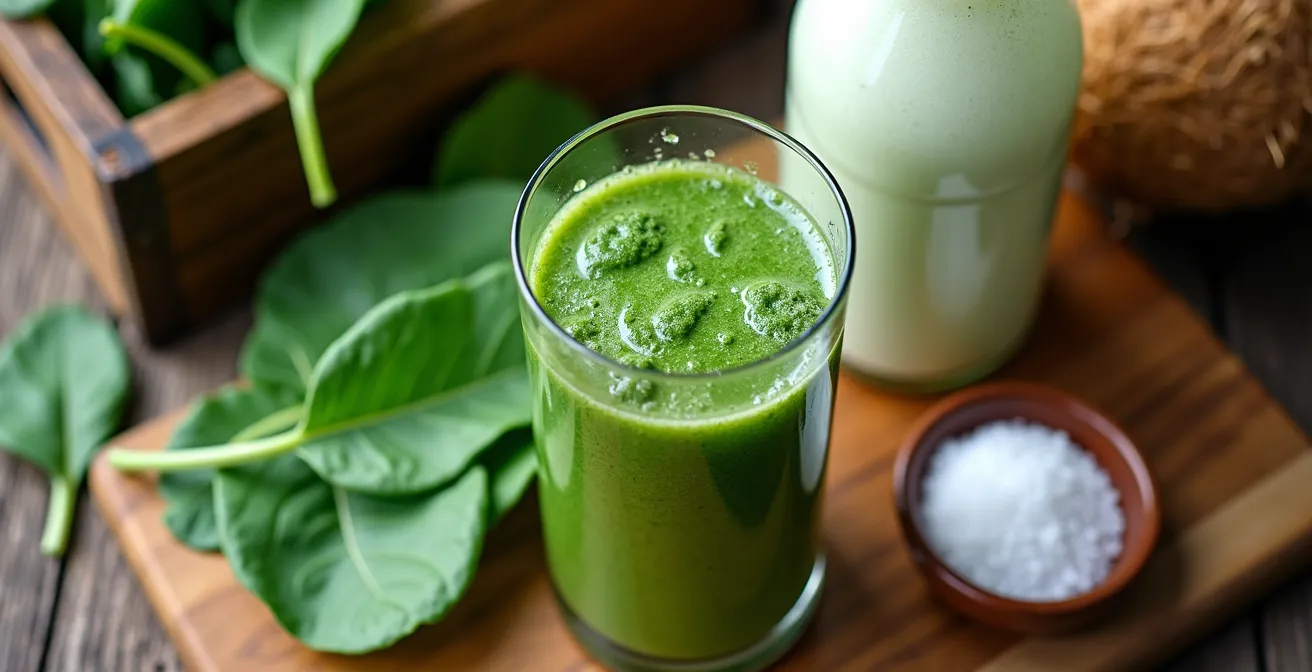
The solution is to think like a holistic nutritionist. Instead of just water, focus on mineral-rich fluids. As pictured, simple ingredients can make a world of difference. Before your session, a glass of water with a pinch of high-quality sea salt and a squeeze of lemon can pre-load your system with essential minerals. During your rest periods, sipping on coconut water or a diluted electrolyte drink is far more effective than plain water. After your final cycle, a recovery drink containing ingredients like spinach (rich in magnesium) or even a warm cup of mineral-rich bone broth can replenish what was lost and prevent the dreaded post-spa energy crash. This is what transforms hydration from a passive chore into a cornerstone of your hydration architecture.
How to disconnect from your phone for 3 hours without anxiety?
You can perfect every physical aspect of your spa cycle, but if your mind is tethered to your phone, you’ve lost the battle for mental detox. The anxiety of being disconnected—the fear of missing an important email or notification—is a real barrier for many professionals. Simply locking your phone away isn’t a strategy; it often just amplifies the anxiety. The solution is to create a ritual of intentional disconnection. As one Canadian spa expert noted, the primary goal is mental relaxation, which is only possible when the body is fully relaxed first. A distracted mind prevents the body from ever reaching that state.
The ultimate goals with Nordic spas are relaxation and meditation. Through the various thermal healing-based practices, your body can relax incredibly well which allows your mind to as well.
– Canadian spa wellness expert, 5 Best Nordic Spas In Ontario
This quote highlights the mind-body link that a constantly checked phone severs. To truly disconnect, you must give your mind a new task to replace the habit of checking for notifications. This involves creating a structured “wind-down” ritual before you even enter the spa. By externalizing your worries and setting a clear intention, you provide your brain with the closure it needs to let go. It’s not about ignoring your responsibilities; it’s about consciously and temporarily setting them aside in a controlled way.
Follow these steps to build your own digital wind-down ritual:
- Set a clear boundary with an auto-reply: Before you leave for the spa, set an out-of-office email and text message. A simple “I am at a wellness session with no access to my phone and will respond after [time]” manages expectations and removes the pressure to be available.
- Perform a ‘brain dump’: On a piece of paper, write down the 3-5 lingering tasks, worries, or ideas that are occupying your mind. The physical act of writing them down signals to your brain that they are captured and can be attended to later.
- Choose a single sensory focus: Set an intention for your session. For example, “For the next three hours, I will focus only on the sensation of the water on my skin,” or “I will focus on the sound of the waterfall.” This gives your “monkey mind” a simple, present-moment task.
- Commit to the locker: Place your phone in the locker, preferably on “Do Not Disturb” or completely off. The physical separation is a powerful symbolic act.
- Use transitions as mindfulness checkpoints: Each time you move from the sauna to the cold plunge, or from the pool to the rest area, use it as a moment to check in. Ask yourself, “Am I present?” and gently bring your focus back to your chosen sensory anchor.
This ritual transforms the act of putting your phone away from a source of anxiety into a declaration of presence, allowing you to finally access the deep mental benefits the spa offers.
The Overtime Trap: What Happens When You Ignore Ontario’s Employment Standards?
In the professional world, Ontario’s Employment Standards Act sets clear limits on work hours to prevent burnout and protect well-being. Ignoring these rules leads to diminishing returns, mental exhaustion, and physical strain. This principle serves as a powerful metaphor for your wellness practice. The “overtime trap” in a Nordic spa context is the misguided belief that “more is better.” It’s the temptation to stay in the intense heat of the sauna for 30 minutes instead of 15, or to endure a five-minute cold plunge when your body is signaling it’s had enough after two.
Just as with workplace overtime, exceeding your body’s “employment standards” during a thermal cycle leads to negative consequences. Pushing too hard can over-stress your nervous system, leading to a state of depletion rather than rejuvenation. This can manifest as dizziness, extreme fatigue, or even a paradoxical feeling of being “wired and tired.” You are essentially asking your physiological systems to work overtime without proper compensation (i.e., rest).
The solution is to become your own best manager, respecting the internal signals your body sends. Your breath becoming short and panicked in the sauna, or an uncontrollable shiver that doesn’t subside after the cold plunge, are your body’s version of a notification that you’ve reached your limit. Honouring these signals by moving to the next stage of the cycle—especially the all-important rest period—is how you avoid the wellness overtime trap. True optimization comes from listening to your body’s standards, not by imposing punishing expectations upon it.
Why is a North Wind Best for Paddleboarding at Woodbine Beach?
For a paddleboarder at Toronto’s Woodbine Beach, the direction of the wind is everything. A north wind blows from the shore, flattening the water and creating a glassy, calm surface ideal for a smooth journey. A south wind, however, blows in from the open lake, creating chop and waves that make balancing difficult and progress a struggle. This provides a perfect analogy for managing your internal environment during a spa session. The “wind” represents your stream of thoughts and emotions.
Your goal in a silent spa or during the quiet phases of your cycle is to cultivate an internal “north wind.” You want to create conditions where your thoughts are calm and your mind is a smooth, reflective surface. This state allows for deep introspection and mental clarity. However, often an internal “south wind” kicks up. This is the ‘chop’ of intrusive thoughts: replaying a work conversation, worrying about your to-do list, or planning your evening. This mental turbulence makes the ‘paddle’ of mindfulness feel like a constant struggle.
You cannot stop the wind from blowing, but you can learn to navigate it. Recognizing that this mental chop is arising is the first step. Instead of fighting it, you can use techniques like focusing on your breath or the sensory details of your surroundings (the smell of eucalyptus, the sound of water) to act as an anchor. This doesn’t stop the thoughts, but it prevents them from knocking you off balance. By mastering your response to this internal weather, you ensure your mental journey is as smooth as a paddleboard on a calm day, regardless of which way the wind is blowing in your mind.
Key Takeaways
- The cold plunge is a non-negotiable step for triggering a significant, sustained dopamine release that enhances mood and focus.
- Your spa protocol must be goal-oriented; timing for mental clarity differs from timing for physical recovery, with the rest period being the most critical phase.
- Your personality dictates your ideal environment: choose social spas like Othership for connection and silent spas like Scandinave for introspection.
Remote Work: Which Organic Cafe in Toronto Offers the Best WiFi and Power Outlets?
The search for the perfect remote work cafe in Toronto is a familiar quest for many professionals. It’s not just about the quality of the coffee; it’s about finding an environment with the right blend of quiet focus, reliable infrastructure (WiFi, outlets), and a pleasant ambiance. This search for an ideal “third space”—a place that is neither home nor work—is directly parallel to the function of the rest areas within a Nordic spa. The spa’s quiet lounges, fireside patios, and meditation rooms are the ultimate “organic cafes” for your mind.
Think of the rest period in your thermal cycle as a dedicated session of mental “remote work.” After the intense ‘meetings’ of the sauna and cold plunge, your mind needs a space to process, integrate, and consolidate the experience. This is where the benefits are truly downloaded. In this “cafe,” there is no need for WiFi or power outlets because the goal is to connect to your own internal server, not the internet. The “work” you are doing is purely internal: observing your thoughts, noticing the sensations in your body, and allowing your nervous system to downshift.
Choosing your rest spot within the spa is like choosing your table at a cafe. Do you need the focused solitude of a silent meditation room (the quiet corner table)? Or the gentle, anonymous hum of a communal area with a fireplace (the main cafe floor)? The best spas in the Toronto area, like Thermëa or Vettä, are designed with a variety of these “mental workspaces.” Treating these rest periods with the same intentionality as finding the right cafe to be productive is the final step in maximizing your session. It is in these moments of structured idleness that the true detox and mental reset occurs.
Frequently Asked Questions on a Nordic Spa Cycle
Should I drink alcohol at spa bistros during my thermal cycle?
You should avoid alcohol as the heat-focused segments can lead to dehydration. Many spas will have water and hot tea stations around the pools instead.
What should I drink 2 hours before my spa visit?
Consume 16-20 oz of water with a pinch of sea salt and lemon for natural electrolyte balance
What’s the best recovery drink after thermal therapy?
A mineral-rich bone broth or coconut water with added magnesium helps prevent the post-spa energy crash
Now that you are equipped with a strategic framework, your next spa visit can be a powerful exercise in self-regulation and mental optimization. Begin today by planning your next session not as a simple escape, but as a deliberate and productive investment in your mental well-being.