In summary:
- Ferry and water taxi wakes are not uniform; pontoon boats create dangerous, unpredictable “square waves.”
- Dressing for the air temperature in spring and fall is a critical mistake; the water is cold enough for hypothermia.
- Standard navigation lights are often insufficient due to Toronto’s bright skyline creating “invisibility zones.”
- Specific, calm-water sanctuaries exist, but only if you know where and when to find them (e.g., before 9:00 AM).
- Mastering the harbour is less about general caution and more about learning the specific rules and physics of this unique urban environment.
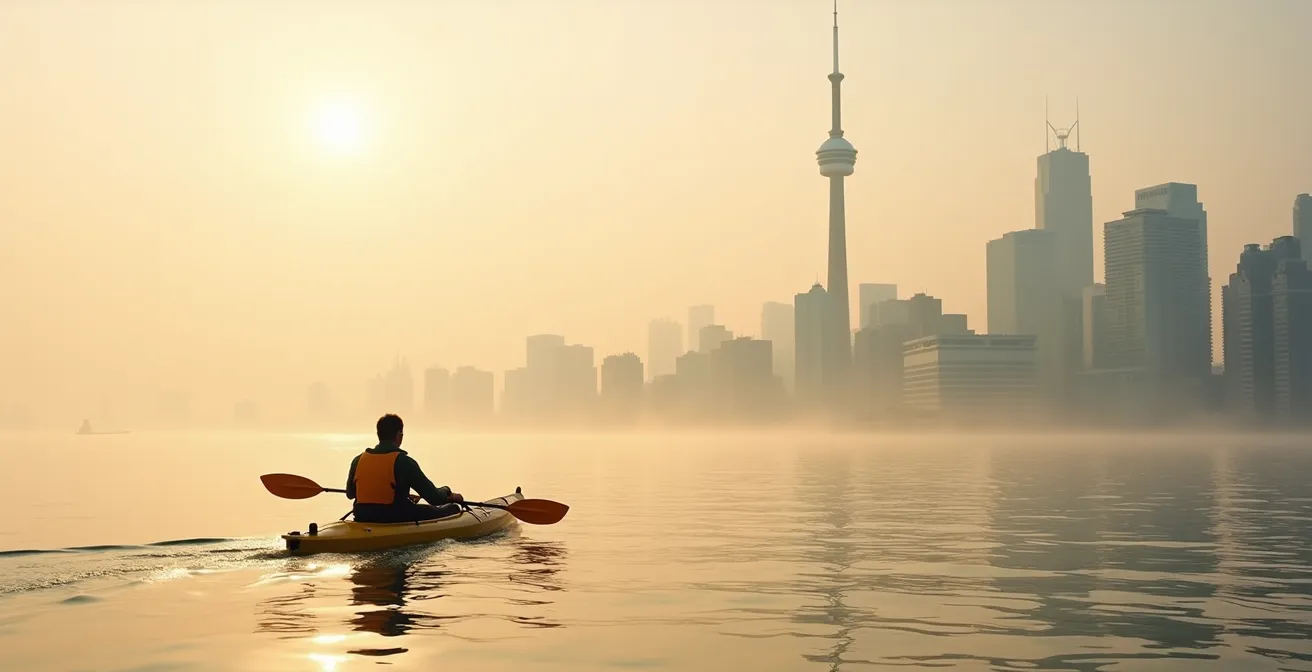
The dream is simple: launching your kayak into the waters of Toronto’s harbour, paddling toward the iconic skyline, and finding a peaceful spot on the Islands. The reality, for many, is a wall of anxiety. The constant churn of ferries, the buzz of water taxis, and the sheer volume of boat traffic can make the Inner Harbour feel more like a highway than a paddling paradise. Many kayakers, especially those new to the area, feel intimidated and stick to sheltered rivers, missing out on one of the city’s best experiences.
The common advice—”be aware,” “stay visible”—is true, but it’s dangerously incomplete. It fails to capture the unique challenges of this specific body of water. The key to paddling here with confidence isn’t just about caution; it’s about developing a higher level of situational awareness rooted in understanding the harbour’s specific physics and unwritten rules. This isn’t your average lake paddle.
But what if the secret to safety wasn’t about avoiding the traffic, but about understanding precisely how it behaves? This guide moves beyond the basics. We’ll dissect the real, specific dangers like the unpredictable wake from a Tiki Taxi, the legal requirements for night paddling versus the practical necessities, and how to navigate the intimidating exclusion zones. You’ll learn to read the water not just for weather, but for the patterns of an urban marine ecosystem.
By the end of this article, you will have a strategic framework for navigating the Inner Harbour. You’ll know which rental location is truly safer for a beginner, how to dress for survival in the deceptive shoulder seasons, and where to find tranquility amidst the urban hustle. It’s time to trade intimidation for expertise and unlock the full potential of urban kayaking in Toronto.
This guide breaks down the essential knowledge you need to paddle the harbour safely. Explore the topics below to build your confidence one specific skill at a time.
Summary: Mastering the Unique Challenges of Toronto’s Inner Harbour
- Why is the Tiki Taxi Wake Dangerous for Novice Kayakers?
- How to Launch Your Own Kayak at Cherry Beach for Free?
- Harbourfront Centre vs. Humber River: Which Rental Spot is Safer for Beginners?
- The Clothing Mistake Paddlers Make in May and October
- How to Rig Your Kayak with Lights for a Legal Night Paddle?
- How to Navigate the “Keep Out” Buoys Near the Island Airport?
- Why is the “Golden Hour” Shorter in Downtown Toronto Canyons?
- SUP in Toronto: How to Find the Calmest Water for Morning Yoga?
Why is the Tiki Taxi Wake Dangerous for Novice Kayakers?
To a new kayaker, all boat wakes might seem the same: a rolling wave to be pointed into. This assumption is a critical error in Toronto’s Inner Harbour. The most dangerous wakes don’t come from the large, predictable ferries, but from the flat-bottomed pontoon boats, like the popular Tiki Taxis. Unlike a traditional V-shaped hull that creates a rolling, predictable wake, these vessels create something far more hazardous: square waves.
As local paddling expert David Johnston describes it, the channel can become a “minefield of monster reflection waves and double-overhead haystacks.” These waves are steep, chaotic, and they don’t dissipate quickly. When they hit a seawall, they reflect back and collide with incoming waves, creating a washing machine effect known as clapotis. For a small kayak, this is incredibly destabilizing. You’re not dealing with a single wave front, but multiple, sharp-crested waves coming from several directions at once.
The danger is compounded by their frequency. On a busy weekend afternoon, these pontoon boats run constantly, meaning the water in narrow channels like the Western Gap never has a chance to settle. A novice paddler expecting a simple, rolling wake can be easily caught off guard and capsized by these unpredictable “haystacks” of water. Mastering the harbour means learning to identify these specific boats and giving them a much wider berth than you would a standard vessel, anticipating that the water will remain chaotic long after they’ve passed.
How to Launch Your Own Kayak at Cherry Beach for Free?
For paddlers who own their gear, Cherry Beach offers one of the best free launch points with direct access to the Toronto Islands and Outer Harbour. Located at the foot of Cherry Street, it provides ample parking and a sandy beach that makes for an easy entry into the water. However, a safe launch from here requires a clear plan, as it positions you directly adjacent to a major commercial shipping route.
The designated launch area is on the west end of the sandy beach, well away from the marked swimming zones. From here, the safest route to the Islands involves first paddling west, hugging the shoreline to round the point of the Eastern Channel. This is the most critical part of the journey. You must cross the approximately 300-metre Eastern Channel as quickly and directly as possible. This channel is used by everything from giant freighters to tour boats and sailboats, many of which may not see a small kayak.
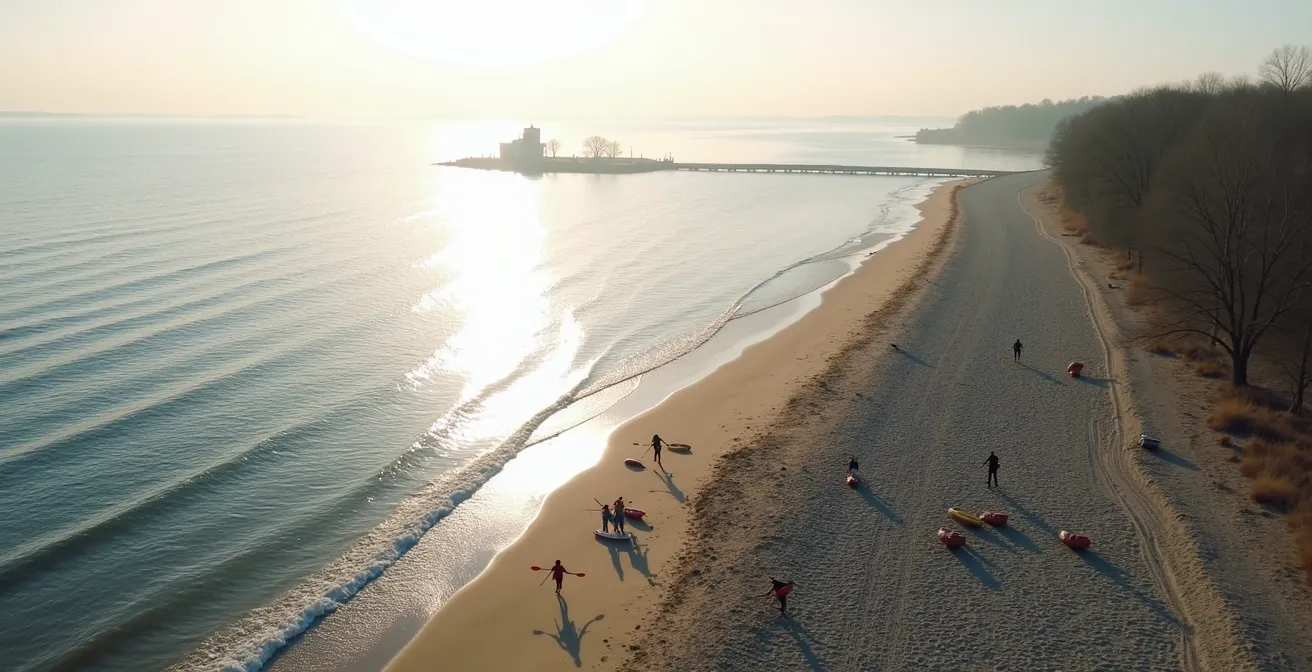
As the image shows, the launch area is relatively protected, but it opens directly into the active harbour. The key is to wait for a clear window in traffic, cross the channel perpendicularly to minimize your time in the danger zone, and then turn north into the Inner Harbour or continue west towards the Islands’ sheltered lagoons. Do not linger in the channel. Your goal is to be a predictable, efficient, and temporary presence in this high-traffic area. Once across, the reward is the vast, beautiful network of waterways the Islands have to offer.
Harbourfront Centre vs. Humber River: Which Rental Spot is Safer for Beginners?
For those looking to rent a kayak in Toronto, the choice often comes down to two popular spots: the Harbourfront Canoe & Kayak Centre and rental outfits on the Humber River. While both offer great experiences, they provide drastically different environments for a beginner. The choice you make should depend on what skill you want to build: pure paddling technique or real-world boat traffic navigation.
The Humber River is a protected, calm environment. Traffic is minimal, limited almost exclusively to other paddlers. The gentle current and abundant shoreline make it an ideal classroom for mastering the fundamentals: your forward stroke, turning, and bracing. Wind and waves are rarely a significant factor. In contrast, the Harbourfront Centre launches you directly into the deep end—the busy Inner Harbour. Here, you are immediately sharing the water with ferries, tour boats, and constant water taxi traffic.
As one Harbourfront instructor, Eric, noted, “Paddling in Toronto Harbour is a beautiful vantage point… while learning how to navigate a high traffic area. You will be sharing the water with power boats, water taxis, ferries, so it really builds your awareness.” The experience is invaluable, but potentially overwhelming for a true first-timer. The following table breaks down the key safety differences, based on an analysis of Toronto paddling locations.
| Safety Factor | Harbourfront Centre | Humber River |
|---|---|---|
| Vessel Traffic Density | High (ferries, water taxis, tour boats) | Minimal (occasional canoes/kayaks) |
| Wind/Wave Exposure | High exposure to Lake Ontario winds | Protected river environment |
| Bail-Out Points | Multiple docks and harbours | Frequent shoreline access |
| Safety Briefing Focus | Ferry routes, harbour navigation rules | Basic paddle safety, river hazards |
| Emergency Response | Harbour Police constantly present | More isolated, slower response |
| Best For | Controlled exposure to boat traffic | Mastering paddle strokes in calm water |
“Paddling in Toronto Harbour is a beautiful vantage point to see the Toronto skyline, while learning how to navigate a high traffic area. You will be sharing the water with power boats, water taxis, ferries, so it really builds your awareness.”
– Eric, Instructor, TripAdvisor Review – Harbourfront Canoe & Kayak Centre
Ultimately, the “safer” choice depends on your goal. For your very first time in a kayak, the Humber River is unequivocally safer. However, if you have some basic skills and your goal is to become competent in the Inner Harbour, renting from Harbourfront provides a crucial, supervised introduction to the traffic you will inevitably face.
The Clothing Mistake Paddlers Make in May and October
In May, the sun is shining and the air feels warm. In October, the fall colours are brilliant and a light jacket feels like enough. This is the shoulder-season trap, and for a Toronto kayaker, it’s one of the deadliest mistakes you can make. The air temperature is a seductive lie; the real danger lies in the water. Paddlers often dress for the air, but they must always prepare for immersion in the water.
During these months, when Lake Ontario’s water temperature ranges from just 4-10°C (39-50°F), an unexpected capsize is not an inconvenience—it’s a life-threatening emergency. At these temperatures, cold shock can cause an involuntary gasp, leading to drowning. If you survive that, hypothermia sets in within minutes, rendering you unable to perform a self-rescue or even hold onto your boat. Cotton and other casual clothing become dangerously heavy and useless when wet.
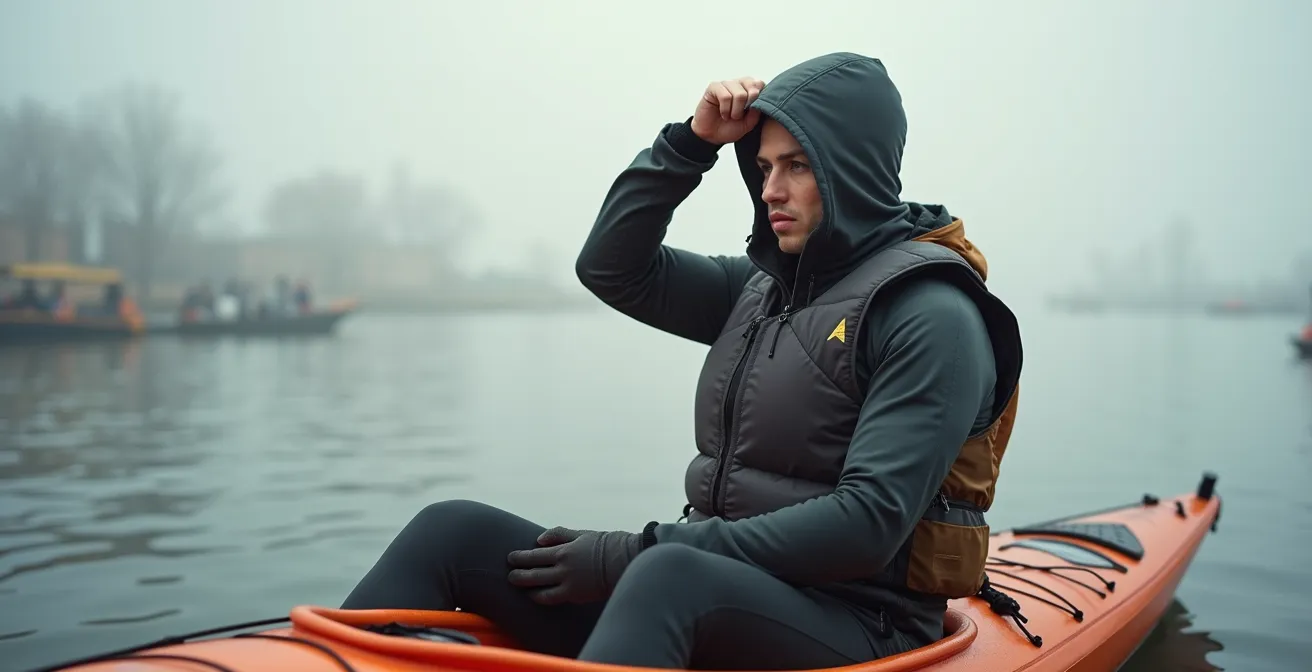
The only safe approach is to dress for the water temperature, not the air. This means investing in proper immersion gear. A wetsuit (minimum 3mm) or a drysuit is not optional; it is essential survival equipment. Your gear list should be built around core insulation and protection from cold water and wind.
- Base layer: Neoprene farmer john/jane wetsuit (minimum 3mm thickness) for core insulation
- Top layer: Windproof paddling jacket to block cold splashes from harbour seawalls
- Feet: Neoprene booties (not sandals) to prevent numbness from cold water
- Head: Warm neoprene hood or thermal toque, as significant heat loss occurs through the head
- Hands: Neoprene gloves or pogies to maintain paddle grip in cold conditions
Paddling in the spring and fall offers some of the most beautiful and serene conditions on the harbour, but it demands respect. Forgetting this single rule—dress for the water—can have the most severe consequences.
How to Rig Your Kayak with Lights for a Legal Night Paddle?
Paddling in the Toronto harbour at night, with the city skyline illuminated, is a breathtaking experience. However, it also places you in an environment of extreme risk if you are not properly lit. The key issue is not just being legal, but being *seen*. The two are not the same thing, especially in a city as bright as Toronto.
Let’s start with the law. According to Transport Canada’s Small Vessel Regulations, a human-powered vessel like a kayak “must have a watertight flashlight or a lighted lantern showing a white light which shall be exhibited in sufficient time to prevent collision.” This is the absolute bare minimum. Waving a flashlight when you see a boat coming is technically compliant, but in practice, it is dangerously inadequate for the Inner Harbour.
A human-powered vessel must have a watertight flashlight or a lighted lantern showing a white light which shall be exhibited in sufficient time to prevent collision
– Transport Canada, Small Vessel Regulations – Office of Boating Safety
The problem is Toronto’s unique light pollution. Local paddlers have identified specific “invisibility zones” where the bright, glittering background of the city skyline completely swallows a small, low-to-the-water light. From the perspective of a ferry captain, a kayaker’s headlamp or deck light blends in with the thousands of lights from condos, the CN Tower, and Rogers Centre. You become a floating piece of the background scenery, effectively invisible until it’s too late.
To be truly visible, you must go beyond the legal minimum. The expert consensus recommends a 360-degree, all-around white light mounted on a short mast behind your cockpit. This elevates the light above the water’s surface, distinguishing it from the shore lights and making it visible from any angle. It signals to other vessels that you are a boat on the water, not a distant apartment balcony. While red and green navigation lights are not required for a kayak, they can further increase visibility. For night paddling in Toronto, think less about a flashlight and more about turning your kayak into a small, unmistakable beacon.
How to Navigate the “Keep Out” Buoys Near the Island Airport?
One of the most intimidating areas for any paddler in the harbour is the water surrounding Billy Bishop Toronto City Airport. A series of large, well-marked “Keep Out” buoys defines a strict exclusion zone around the runway and taxiways. Violating this zone is not only illegal and dangerous, but it will also trigger an immediate response from airport authorities and the Toronto Police Marine Unit. Yet, navigating near it is a necessary part of paddling the Western Gap.
The key to navigating this area safely is not fear, but a clear understanding of the visual cues and boundaries. The rules are simple but absolute. Your primary task is to maintain a safe distance and always remain in the designated navigation channel. A common mistake for beginners is to focus so much on the buoys that they lose track of their position relative to the main channel.
Instead of hugging the buoys, focus on the main channel markers that guide all boat traffic through the Western Gap. By following this established “roadway,” you will naturally be kept a safe distance from the airport’s restricted waters. The exclusion zone is designed to provide a significant buffer; if you feel like you’re uncomfortably close, you almost certainly are. A good rule of thumb: if you can clearly read the airline logos on the planes at the terminal, you are dangerously close to, or already inside, the exclusion zone and must move away immediately.
To make this as clear as possible, here is a simple set of rules to follow when paddling anywhere near the airport.
Your Checklist for Navigating the Airport Exclusion Zone
- Visual Reference 1: Always keep the main Western Gap ferry channel markers (the red and green buoys) between your kayak and the airport runway.
- Visual Reference 2: Use the “airline logo” test. If you can read them, you are too close. Back away immediately.
- Distance Rule: Actively maintain at least 150 metres from any airport infrastructure or the line of “Keep Out” buoys.
- Navigation Tip: Do not cut corners. Follow the marked shipping channel as it naturally guides you safely away from all restricted areas.
- Emergency Protocol: If you believe you have accidentally entered the zone, do not panic. Stop, turn 90 degrees, and paddle directly away from the runway back into the main channel.
By treating the airport zone with respect and using the main channel as your guide, you can transit this busy area with the same confidence as any other vessel on the water.
Why is the “Golden Hour” Shorter in Downtown Toronto Canyons?
For photographers, the “golden hour”—that magical time just after sunrise or before sunset—is everything. The low, soft light creates stunning images. Many kayakers plan evening paddles specifically to capture the Toronto skyline in this beautiful glow. However, in the Inner Harbour, they often find that the golden hour ends long before the official sunset time. This isn’t a trick of the light; it’s a phenomenon created by downtown’s “urban canyons.”
The dense cluster of high-rise condominium and office towers along Queen’s Quay, such as the Harbour Square and One York buildings, creates a massive man-made wall. This wall casts a long shadow across the Inner Harbour, effectively causing a “premature sunset” on the water. For example, on a day in mid-July, the official sunset might be at 8:50 PM. However, due to the building shadows, direct sunlight can disappear from the water west of the Yonge Street slip as early as 7:15 PM. Paddlers waiting for that perfect sunset shot find themselves suddenly in deep shadow, the magical light gone.
This means you cannot rely on a standard weather app for your photography plans. You have to understand the geography of the skyline. To chase the light, you need a strategy. Experienced local paddlers know that to get a true golden hour experience, you have to move out of the shadow of the downtown core. This involves paddling to specific locations that have an unobstructed view to the west.
- Polson Pier area: This is the classic spot, offering the iconic sunset view of the skyline with a completely clear western exposure.
- East towards the Port Lands: By paddling east, you can get out of the shadow and photograph the skyline as it’s being illuminated by the setting sun.
- Outer Harbour near Leslie Spit: This area is wide open and free of tall structures, providing the longest possible golden hour on the water.
- Toronto Islands lagoons: While the skyline view is a silhouette, the protected waters here catch the colourful sky reflections beautifully.
- Centre Island south shore: After the sun has set, this is a prime spot to capture the city’s reflection during the “blue hour.”
Understanding this urban canyon effect is another layer of local knowledge that separates the casual paddler from the expert. It’s about reading not just the water and the traffic, but the city itself.
Key Takeaways
- Mastering Toronto’s harbour requires specific knowledge, not just general caution.
- Unique hazards like “square waves” from pontoon boats and “invisibility zones” from light pollution demand specific countermeasures.
- Always dress for the cold water temperature in spring and fall, not the deceptive air temperature, by wearing a wetsuit or drysuit.
SUP in Toronto: How to Find the Calmest Water for Morning Yoga?
While much of this guide focuses on navigating the harbour’s challenges, it’s also a place of incredible tranquility—if you know where and when to look. For stand-up paddleboarders (SUP), especially those practicing yoga, finding perfectly calm, “glass-like” water is the ultimate goal. In Toronto, this is entirely achievable, but it requires a strategic approach to avoid wind and boat wake.
The single most important factor is timing. The Inner Harbour is at its calmest in the early morning. The best, most reliable conditions occur before 9:00 AM on weekdays, before the first ferries begin their busy schedule and before commercial boat traffic picks up. The wind also tends to be lighter at dawn. This early window is your golden opportunity for a peaceful session.
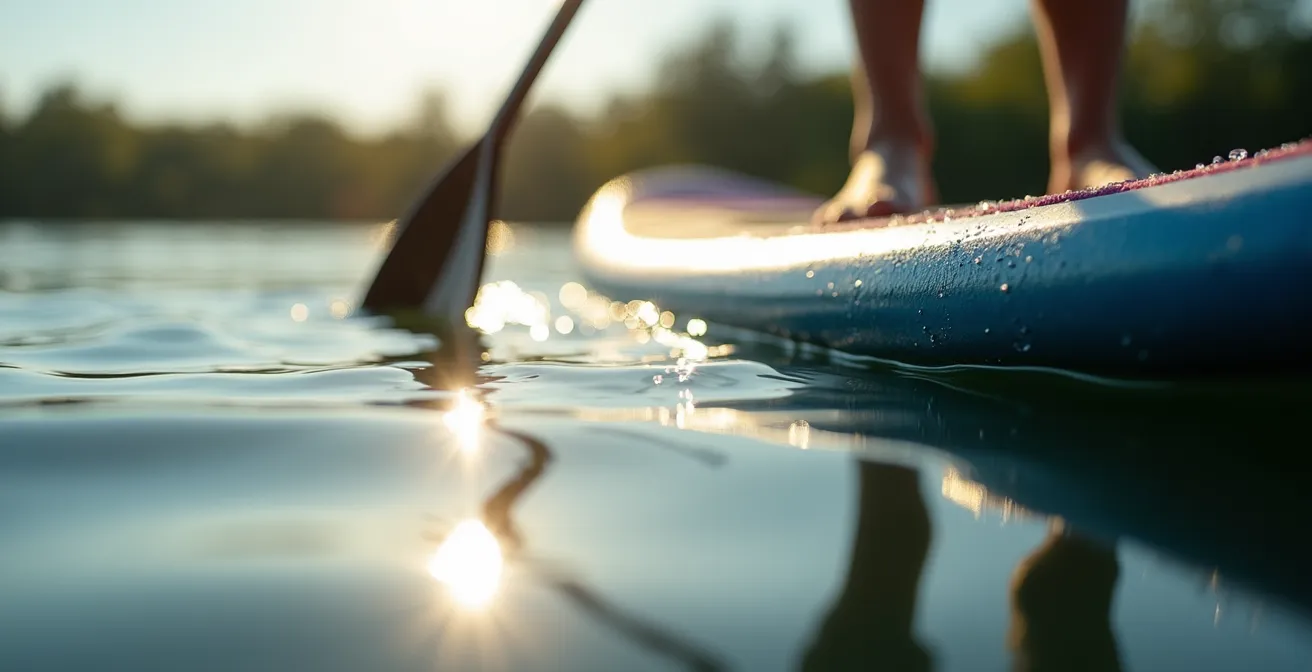
Location is the second critical element. You need to find spots that are naturally protected from both boat traffic and the prevailing winds. Toronto’s extensive system of breakwalls and islands creates several “SUP sanctuaries”:
- The lagoons behind Centre Island: This network of sheltered channels is the premier location. They are almost entirely protected from wind and completely isolated from the main harbour’s boat traffic.
- Ontario Place’s West Island: The basin inside the West Island offers another highly protected environment, shielded from Lake Ontario’s open water.
- Keating Channel (east end): On weekday mornings, the far eastern end of this channel can be surprisingly calm before industrial traffic begins for the day.
- Strategic use of breakwalls: Understanding wind direction is key. If there is a southwest wind, for example, the water on the east side of Ward’s Island will be perfectly flat, as the island itself acts as a massive windbreak.
Finding serenity on the water in the heart of Canada’s largest city is a unique and rewarding experience. It isn’t a matter of luck. It’s the result of applying your knowledge of the harbour’s rhythms—its traffic patterns and its relationship with the wind—to find the perfect moment of calm.
By internalizing these specific strategies—from understanding wave physics to reading the urban environment—you transform the harbour from an intimidating obstacle course into a dynamic and rewarding playground. The next step is to apply this mindset every time you dip your paddle in the water, building your confidence with each trip.