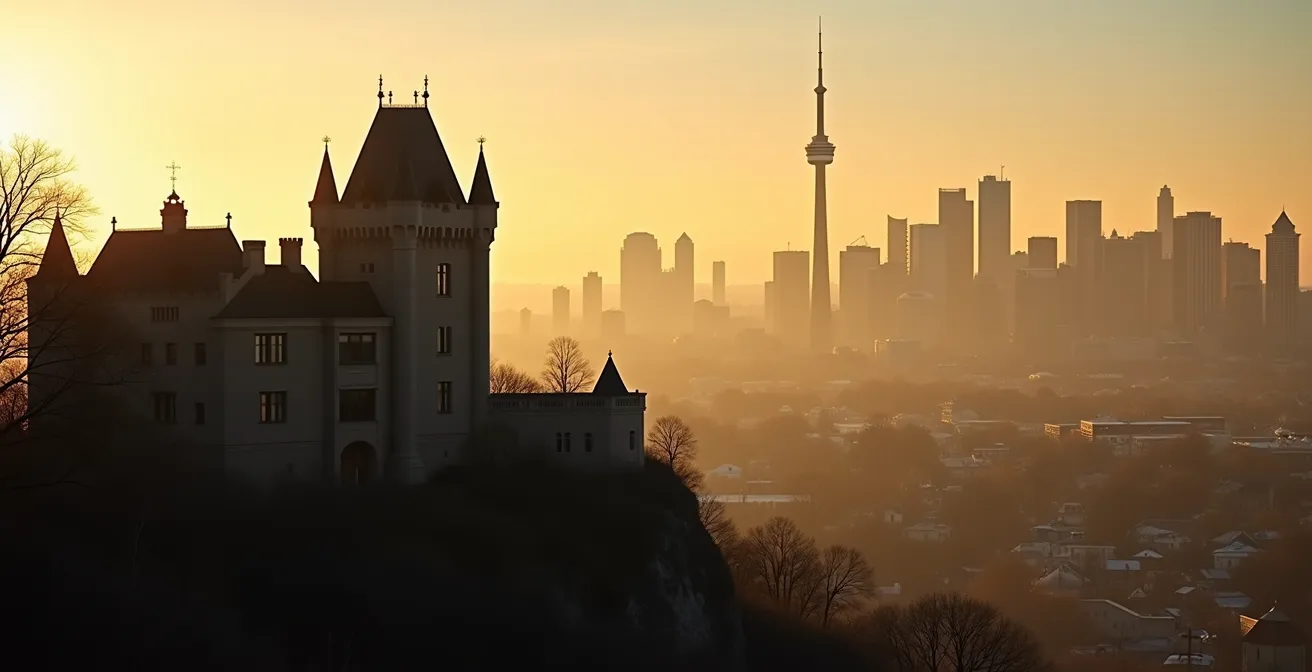
Sir Henry Pellatt’s loss of Casa Loma was not due to a single mistake but a systemic financial collapse, where his greatest strengths became his fatal weaknesses in post-war Toronto.
- The end of his electricity monopoly and a post-war recession decimated his income just as his expenses skyrocketed.
- A crippling property tax hike by the City of Toronto turned his dream home into an unsustainable financial liability.
- The failure of the unregulated Home Bank, to which he was deeply indebted, was the final, irreversible blow.
Recommendation: To truly understand Casa Loma, look beyond the architecture and see it as a monument to a perfect financial storm that reshaped Toronto’s history.
Sir Henry Pellatt, a titan of Canadian finance, stood at the pinnacle of Toronto’s high society. His wealth, built on shrewd investments in the railway and, most notably, in hydroelectric power, seemed boundless. The ultimate expression of this power was Casa Loma, a majestic Gothic Revival castle overlooking the city, built between 1911 and 1914 at a cost of $3.5 million. Yet, a mere decade after its completion, Pellatt, the man who brought electricity to Toronto, was forced to abandon his palatial home, overwhelmed by debt and taxes. The common narrative often simplifies this downfall to mere overspending. Many assume he simply built a house too large to maintain, a classic tale of hubris.
However, this view misses the complex interplay of economic forces at work. Pellatt’s ruin was not a simple miscalculation but a case of an asset-liability inversion, triggered by a brutal economic whiplash following World War I. His story is deeply intertwined with the financial and political landscape of early 20th-century Toronto. It involves a national energy strategy, municipal tax policy, and the fragile, unregulated nature of the Canadian banking system at the time. To understand why Casa Loma was seized is to dissect the anatomy of a fortune undone by the very systems it helped to build.
This analysis will deconstruct the financial catastrophe that befell Sir Henry Pellatt. We will explore the specific economic pressures of the post-war era, the architectural significance that made the castle so costly, and the myths that still surround this iconic Toronto landmark. By moving beyond the simple story of a man who overspent, we uncover a more compelling cautionary tale about wealth, ambition, and the unforgiving nature of economic change.
Summary: Why Was Casa Loma Seized for Taxes Despite Sir Henry Pellatt’s Wealth?
- Why Did the Post-WWI Economy Destroy Pellatt’s Fortune?
- How to Access the Original Blueprints of Toronto’s Historic Estates?
- Gothic Revival vs. Edwardian: What Makes Casa Loma Unique in North America?
- The “Secret Tunnel” Myth: What Were the Underground Passages Really Used For?
- How to Use the Audio Guide to Uncover Hidden Details in the Library?
- Why Do Downtown Toronto Rents Fluctuate So Drastically in the Fall?
- Heritage Home Insurance vs. Standard Policy: What is the Premium Difference?
- Planning a Casa Loma Wedding: What Are the Hidden Costs Beyond the Rental Fee?
Why Did the Post-WWI Economy Destroy Pellatt’s Fortune?
Sir Henry Pellatt’s financial demise was not a singular event but a perfect storm of collapsing income and exploding liabilities, triggered by the post-WWI economy. His primary source of wealth, the Toronto Electric Light Company, was built on a near-monopoly. However, the creation of the publicly owned Hydro-Electric Power Commission of Ontario effectively nationalized his business. He was forced to sell his company, and his income plummeted from a peak of $170,000 in 1911 (a colossal sum at the time) to just $66,000 by 1920. This happened just as his expenses were reaching untenable levels.
The most direct blow came from the City of Toronto itself. In a move that many saw as punitive, the City of Toronto increased Casa Loma’s property taxes from a manageable $600 per year to a staggering $1,000 per month. This transformed his greatest asset into his most significant liability. Simultaneously, Pellatt had invested heavily in land speculation, but the post-war recession caused land values to crash, leaving him with illiquid assets and mounting debt. The final nail in the coffin was his deep entanglement with the Home Bank of Canada. As his financial situation deteriorated, he owed an immense $1.7 million to the Home Bank, which collapsed in 1923 amidst its own financial irregularities. The systemic collapse was complete; with his income gone, his assets devalued, and his credit obliterated, he had no choice but to auction his possessions and abandon his castle.
How to Access the Original Blueprints of Toronto’s Historic Estates?
For history buffs fascinated by the architectural genius behind Toronto’s grand estates, accessing original documents like blueprints is a journey into the past. The architect of Casa Loma was the celebrated E.J. Lennox, a man responsible for many of the city’s most iconic structures, including Old City Hall. His detailed plans and drawings are not lost to time; they are preserved and accessible to the public, offering a direct link to the vision of their creators. The primary repository for these invaluable records is the City of Toronto Archives.
Accessing these documents requires a methodical approach, but it is a rewarding process for any dedicated researcher or historian. The Archives have a systematic process for viewing these materials, ensuring their long-term preservation while allowing public access. Here are the steps involved:
- Visit the City of Toronto Archives online catalogue: Start your search on their official website to explore the digital collections.
- Search for key names: Use terms like ‘E.J. Lennox’ or the names of specific estates such as ‘Casa Loma’, ‘Gooderham’, or ‘Massey’ to find relevant collections.
- Note reference numbers: As you find architectural drawings in the Building Plans collection, be sure to write down their specific reference numbers.
- Schedule an in-person appointment: Viewing original documents requires a scheduled visit to the archives facility at 255 Spadina Road.
- Complete registration on-site: You will need to bring a photo ID and fill out a researcher registration form upon your arrival.
- Request digitization services: If you wish to have copies for personal research, you can request digitization, though fees will apply for this service. You can find more details at the City of Toronto Archives website.
Gothic Revival vs. Edwardian: What Makes Casa Loma Unique in North America?
Casa Loma stands as a singular architectural statement in North America, primarily because it is a faithful and large-scale interpretation of a Gothic Revival castle, constructed during the Edwardian period. While many mansions of the era drew from European styles, few attempted to replicate a medieval fortress with such commitment to detail and scale. The sheer ambition of the project was staggering; records indicate that the construction workforce required for Casa Loma involved 300 men over nearly three years to complete the 98-room structure. This was not a house with castle-like features; it was conceived as a castle that could function as a modern home.
Its uniqueness is highlighted when compared to other prominent Toronto landmarks of the same period, even those designed by the same architect, E.J. Lennox. While Lennox’s Old City Hall is a masterpiece of Richardsonian Romanesque style, with its heavy, textured stone and grand clock tower, Casa Loma embraces the soaring verticality, turrets, and battlements of the Gothic tradition. This commitment to a historical style, while incorporating modern Edwardian comforts like elevators and a central vacuum system, created a unique hybrid that sets it apart.
This table illustrates how Casa Loma’s specific style contrasts with other major architectural works in Toronto from that era, solidifying its distinct identity.
| Building | Architectural Style | Architect | Completion Year | Distinguishing Features |
|---|---|---|---|---|
| Casa Loma | Gothic Revival | E.J. Lennox | 1914 | 98 rooms, medieval turrets, secret passages |
| Old City Hall | Richardsonian Romanesque | E.J. Lennox | 1899 | Clock tower, carved gargoyles |
| Royal Ontario Museum (original) | Neo-Romanesque | Chapman & Oxley | 1914 | Yellow brick, terracotta details |
The “Secret Tunnel” Myth: What Were the Underground Passages Really Used For?
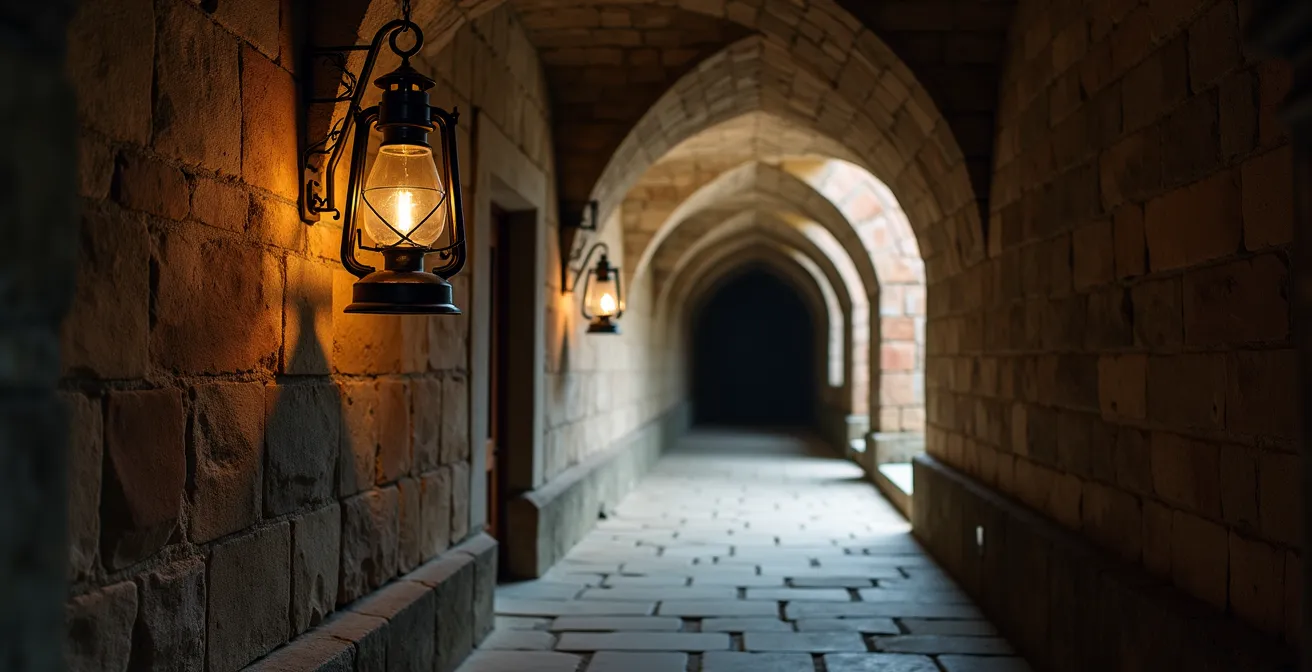
One of the most enduring legends of Casa Loma revolves around its “secret tunnels.” The word “secret” evokes images of clandestine meetings or dramatic escapes, but the reality is more practical, though no less fascinating. The primary underground passage is an impressive 800-foot tunnel connecting the main house to the Hunting Lodge and Stables. Its main purpose was mundane: it allowed Sir Henry Pellatt and his staff to move between buildings without being exposed to Toronto’s harsh winter weather. The tunnel contained plumbing and electrical conduits, making it a utilitarian corridor essential for the estate’s operation.
However, the history of the stables at the end of the tunnel holds a genuine secret, one tied to Canada’s role in World War II. Long after Pellatt had left, the estate found a new, clandestine purpose. As noted by historians, this seemingly innocuous part of the property became a vital, top-secret facility.
During World War II, the stables were used to conceal research and production of sonar, and for construction of sonar devices (known as ASDIC) for U-boat detection. The area was closed, behind an ‘Under Repairs’ sign. The suggestion that the stables were under renovation allowed workers of the secret facility to come and go without suspicion.
– Wikipedia contributors, Casa Loma – Wikipedia
This historical fact is far more compelling than any fiction. The tunnels of Casa Loma were not for spies in Pellatt’s time, but they did, decades later, shield a crucial part of the Allied war effort. The myth of the tunnels, therefore, contains a kernel of truth about secrecy, but the real story is rooted in national defense, not personal intrigue.
How to Use the Audio Guide to Uncover Hidden Details in the Library?
The Library at Casa Loma is one of its most breathtaking rooms, and while its grandeur is immediately apparent, its most fascinating details are often hidden in plain sight. The complimentary audio guide is an indispensable tool for any visitor wanting to look beyond the surface. It directs your attention to specific elements you might otherwise miss. For instance, the audio guide prompts you to look for the intricate Pellatt family coat of arms carved into the ceiling panels, a subtle but constant reminder of the man who built the room. It also encourages a closer inspection of the woodwork around the two massive fireplaces, where master artisans embedded symbolic details.
A key highlight mentioned in the audio guide is the existence of hidden panels in the oak paneling. While they are no longer operational for public access, the guide points out the locations of what were once secret passages, one of which famously led to Pellatt’s office on the floor below. To make the most of this experience, the guide offers practical advice. The Library segment typically begins around the 12-minute mark of the standard tour. It’s recommended to stand near the center of the room to best appreciate the scale of the ceiling and to have clear lines of sight to the features being described.
Furthermore, the audio guide connects the room to its more recent history in popular culture. It reveals that the Library has been a popular filming location, most famously serving as part of Professor Xavier’s School for Gifted Youngsters in the first *X-Men* movie. Knowing these details transforms a simple walkthrough into a multi-layered exploration of history, craftsmanship, and modern-day mythology. The audio guide is not just a narrator; it is a key to unlocking the library’s secrets.
Why Do Downtown Toronto Rents Fluctuate So Drastically in the Fall?
The seasonal fluctuation of rents in downtown Toronto, particularly the shifts seen in the fall, is a modern phenomenon driven by the academic calendar, job market cycles, and shifting inventory. While this seems worlds away from Sir Henry Pellatt’s time, the underlying principle is the same: the value and cost of real estate are intensely vulnerable to external economic pressures. Pellatt’s experience with Casa Loma serves as a dramatic historical parallel. He built a piece of “prime real estate” that became financially toxic when the economic environment changed.
Just as a modern Toronto landlord faces rising property taxes and utility costs, Pellatt was crippled by them on an unimaginable scale. His annual operating costs for Casa Loma were immense. The case study of his finances reveals that the property tax alone was $1,000 a month, a figure that was intentionally inflated by the city. Beyond taxes, the fuel costs to heat the massive structure were $15,000 a year. In total, the annual cost of simply running the property was estimated at $22,000, which in today’s money is a staggering sum. This did not include staff, repairs, or the interest on his massive debts.
This historical example demonstrates a timeless real estate lesson. A property’s value is not inherent; it is a function of its owner’s ability to generate enough income to offset its carrying costs. For Pellatt, when his income collapsed, Casa Loma’s enormous operational costs turned it from an asset into an anchor. For modern Toronto property owners, a sudden spike in interest rates, a change in tax policy, or a dip in rental demand can create a similar, if less dramatic, financial squeeze. The story of Casa Loma is a macro-version of the financial pressures that still define the Toronto real estate market today.
Heritage Home Insurance vs. Standard Policy: What is the Premium Difference?
Owning a designated heritage home in Toronto is a privilege, but it comes with unique responsibilities and costs, particularly regarding insurance. The premium difference between a standard home policy and a heritage policy is substantial, and Casa Loma’s history provides the ultimate example of why. A standard policy is based on “replacement cost,” often using modern materials and methods. A heritage policy, however, must account for “replace in-kind” clauses mandated by regulations like the Ontario Heritage Act. This means replacing materials with historically accurate equivalents, which is vastly more expensive.
The restoration of Casa Loma illustrates this cost differential on a grand scale. The City of Toronto has undertaken massive restoration projects over the years. One such multi-year project for the exterior facade, roof, and windows came with a price tag of over $33 million over 15 years. This wasn’t for new construction, but simply to restore and preserve what was already there using appropriate materials and specialized artisans. Insuring against potential damage to such a property requires a policy that can cover these astronomical, specialized costs, driving premiums far above standard rates.
For any owner of a designated heritage property in Toronto, securing the right insurance is a critical step that requires asking detailed questions beyond what a standard policy covers. It’s a specialized field where the details matter immensely.
Your checklist for heritage property insurance in Toronto
- Assess coverage for ‘replace in-kind’ requirements: Does the policy explicitly cover the higher costs of materials and craftsmanship mandated by the Ontario Heritage Act?
- Verify coverage for specialized contractors: Are specialized heritage artisans and contractors covered, even if their rates are significantly higher than standard builders?
- Check for archaeological assessment inclusion: If foundation work is needed, does the policy cover the potential cost of a mandatory archaeological assessment?
- Confirm protection during renovations: Is there coverage for the property during renovation work that requires permits from Heritage Toronto?
- Clarify provisions for temporary relocation: If extensive, time-consuming heritage restoration is required after an incident, does the policy provide for long-term temporary relocation?
Key Takeaways
- Sir Henry Pellatt’s downfall was a systemic failure, not just a case of overspending; a collapsing income met skyrocketing, politically-driven expenses.
- Casa Loma’s architectural style is a rare, full-scale North American execution of Gothic Revival, setting it apart from other landmarks of its time.
- The famous “secret” tunnel’s true clandestine purpose came during WWII, when it was used to conceal top-secret sonar research and development.
Planning a Casa Loma Wedding: What Are the Hidden Costs Beyond the Rental Fee?
Hosting a wedding at Casa Loma is the ultimate fairytale experience in Toronto, but planning for it requires a budget that looks beyond the initial venue rental fee. While the setting is undeniably spectacular, several “hidden” or additional costs must be factored in to get a true picture of the total expense. As a premium, high-demand venue, Casa Loma’s pricing structure reflects its unique status. One key factor is seasonality. While base rates are at their peak during the popular summer months, couples can find significant savings—sometimes up to 30%—by booking in the off-season winter months.
Beyond the base rental, couples must account for mandatory service charges, taxes (HST), and per-person catering costs, which are exclusively handled by the venue’s designated caterer. Other potential costs include security, SOCAN fees for music, and special permits for any unusual setups. It’s also worth noting that, as a museum open to the public, Casa Loma can typically only be rented for private events in the evenings after it closes, which can affect the timing and logistics of your day.
Comparing Casa Loma to other heritage venues in Toronto can help put these costs into perspective. While each has its own unique charm and pricing, this comparison highlights the different options available in the city’s premium heritage venue market.
| Venue | Architectural Style | Capacity | Peak Season Base Rate | Off-Season Savings |
|---|---|---|---|---|
| Casa Loma | Gothic Revival Castle | Up to 350 guests | Premium pricing | Up to 30% discount in winter months |
| The Carlu | Art Moderne | Up to 550 guests | Competitive with Casa Loma | 15-20% winter discount |
| Hart House | Collegiate Gothic | Up to 400 guests | More affordable option | University rates available |
Ultimately, whether for a wedding or a simple tour, visiting Casa Loma is an encounter with history. Understanding the dramatic financial story behind its stones—a story of ambition, systemic collapse, and economic reality—transforms the castle from a beautiful building into a profound and cautionary monument at the heart of Toronto.